
On January 8, Brazilian President Luiz Inacio Lula da Silva stood in the heart of the nation’s capital and declared three powerful words: “We’re still here.” The phrase, borrowed from the critically acclaimed biographical drama I’m Still Here, resonated deeply in a country still grappling with the shadows of its past.
The film has not only captivated audiences, grossing over 4.1 million viewers to become one of Brazil’s highest-grossing movies ever, but it has also etched its name in history as the first Brazilian film shot in Portuguese to compete for Best Picture at the 97th Academy Awards. However, its significance extends far beyond its cinematic achievements—I’m Still Here is a stark confrontation with Brazil’s violent history under military dictatorship, a chapter that remains largely unresolved.
A History of Silence and Suffering
Brazil’s military dictatorship, which began in 1964, lasted for more than two decades, bringing with it censorship, arbitrary detentions, and the disappearance of thousands of suspected dissidents. While official reports estimate at least 434 deaths, experts suggest the true number could be as high as 10,000. Yet, Brazil has never prosecuted the military officials responsible, largely due to a sweeping Amnesty Law passed in 1979.
Few monuments or museums exist to memorialize these atrocities, but I’m Still Here has broken through the silence. Human rights advocate Ivo Herzog, whose father, journalist Vladimir Herzog, was tortured and killed in 1975, praised the film’s impact.
“The main importance of the film is that it was able to break through the bubble,” Herzog said. “It brought a little of this indignation that we’ve been experiencing for so long to people who haven’t lived this story.”
Stories of the Disappeared
Directed by Walter Salles, I’m Still Here is based on the real-life disappearance of former Congressman Rubens Paiva in January 1971. Paiva was taken into military custody and never seen again. His wife, Eunice Paiva—portrayed by acclaimed actress Fernanda Torres—emerges as the film’s heroine, enduring arrest and surveillance while raising five children and demanding answers about her husband’s fate.
The film also touches on other victims, including Cilon Cunha Brum, a young activist involved in student protests and the Communist Party’s armed resistance. Brum disappeared in the early 1970s, his family left without closure.
For many, the film vividly illustrates the trauma of enforced disappearances. Author Liniane Haag Brum, whose uncle was among those who vanished, described watching I’m Still Here as an emotional experience.
“The film represents what a disappearance is. The pain. The vacuum,” she said.
A Modern-Day Coup Attempt and Historical Parallels
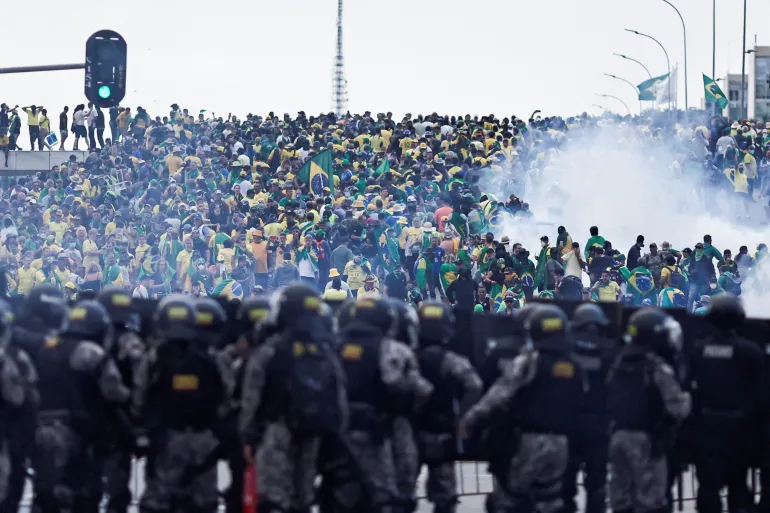
I’m Still Here also resonates in today’s Brazil, as the nation recovers from a contemporary coup attempt. On January 8, 2023, thousands of supporters of former President Jair Bolsonaro stormed Brasilia’s Three Powers Plaza, hoping to incite a military uprising to overturn President Lula’s election. The riot, echoing past authoritarian tactics, underscored how fragile democracy remains in Brazil.
Journalist Lucas Figueiredo believes the lack of accountability for past military abuses has fueled present-day political instability.
“To this day, the military sees itself as having the right to attempt a coup d’état in the 21st century. This is ample proof that no memory has been built up about those events,” Figueiredo said.
Bolsonaro, a former army captain who has praised the military dictatorship, dismissed the film when asked by a reporter, saying, “I’m not even going to waste my time.”
Shifting Attitudes and Calls for Justice
Despite past resistance, there are signs of change. Bolsonaro himself is now facing charges related to the 2023 coup attempt, with Brazil’s top prosecutor accusing him and 33 others of plotting to overthrow the government. If convicted, Bolsonaro could face decades in prison.
Meanwhile, Brazil’s Supreme Court has ruled that disappearances from the dictatorship era remain an “ongoing crime,” potentially opening the door for prosecutions despite the Amnesty Law.
Marcia Carneiro, a history professor at Fluminense Federal University, sees this as a turning point.
“There is a new awareness emerging that those who act against the rule of law can be punished. This is interesting and new in Brazil,” she said.
Cultural Impact and the Road Ahead
Despite the political weight of its subject, I’m Still Here has resonated with a broad audience, largely due to its focus on family. Instead of being framed purely as a political statement, the film portrays the human cost of authoritarianism through intimate moments of loss and resilience.
“Everyone has a family—a mother, a father—and is affected when they see them suffering,” Carneiro explained. “Viewers recognize the possibility of something like this happening in their home.”
The film’s success has intensified demands for official recognition of past crimes. Although President Lula reinstated a commission on political deaths and disappearances, survivors and their families say it lacks sufficient funding and authority. Herzog, whose father’s death was staged as a suicide by the military, is among those calling for more action.
“What are they waiting for? For everyone connected to that period to die?” he asked. “Brazil has a politics of forgetfulness, and we have evolved very, very little.”
However, in a small but symbolic step, Brazil recently began issuing corrected death certificates for victims of the dictatorship, acknowledging that their deaths were caused by the state. The move has provided a measure of solace for some families.
As I’m Still Here prepares to take the global stage at the Oscars, its impact extends far beyond Hollywood. Whether it wins or not, the film has ignited a long-overdue reckoning in Brazil—one that may finally hold the nation accountable for its darkest chapter.