
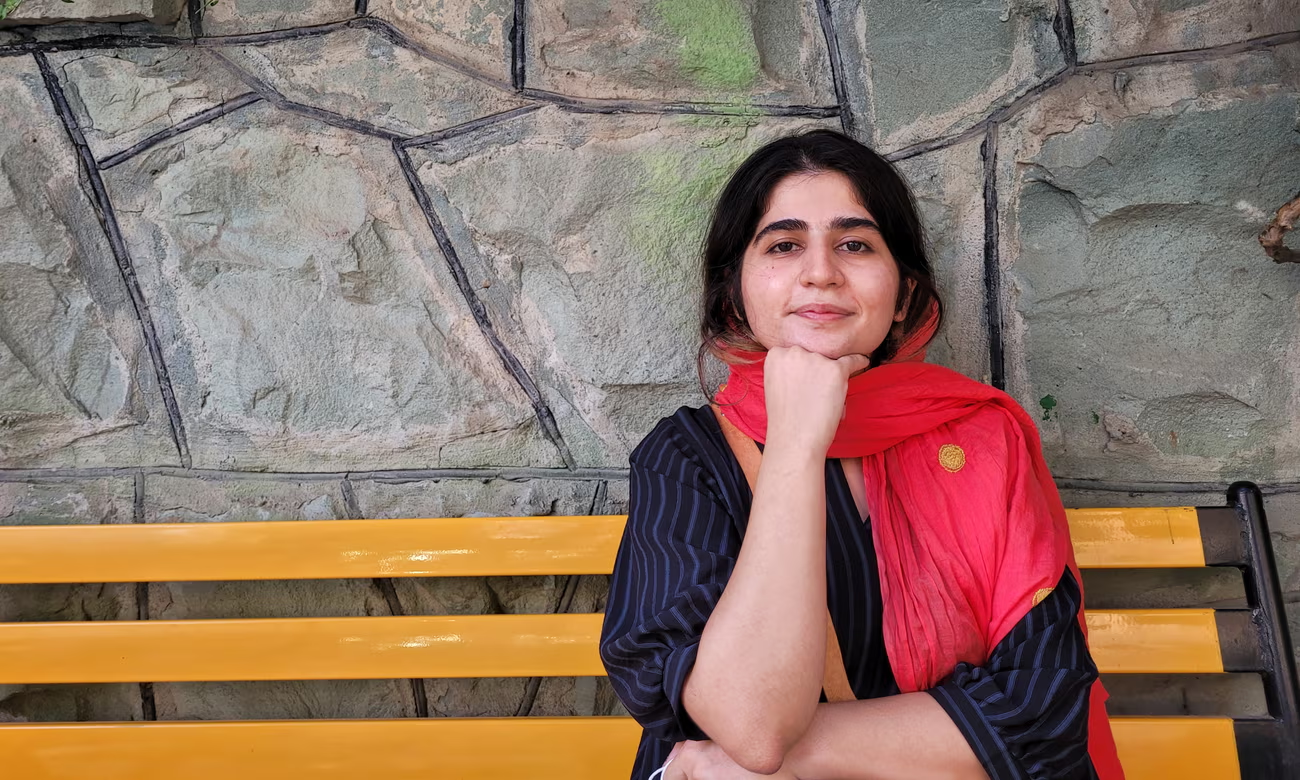
Maziar Bahari once dismissed claims that books could change lives, seeing them as mere hyperbole. But his perspective shifted when he encountered Sepideh Gholian, one of Iran’s most prominent political prisoners. “If anyone wants to know why writing matters, her book is the best example,” says Bahari, a London-based journalist and documentary filmmaker. “Her words transport us beyond the reach of interrogators and prison wardens, proving literature’s power to liberate the mind and soul.”
Gholian, now 30, is currently held in Evin Prison, Tehran’s notorious detention center known for housing political prisoners, including British-Iranian charity worker Nazanin Zaghari-Ratcliffe. Despite the suffocating conditions, she has managed to write—a feat made possible by mobile phones periodically smuggled into the prison. Her first book, a diary of prison life, was published in Farsi in 2020. Now, she is preparing to release her second book in English next month: The Evin Prison Bakers’ Club: Surviving Iran’s Most Notorious Prison in 16 Recipes.
Gholian’s journey to becoming a symbol of resistance began in Dezful, Khuzestan, where she supported the 2018 Haft Tappeh sugarcane complex strike, advocating for workers’ rights. Her activism led to her first arrest and a 30-day detention filled with torture, physical abuse, and threats of so-called honor killings. Upon her release, she publicly detailed her ordeal, only to be rearrested after a state-broadcasted “confession”—a coerced admission of crimes against the state. Released again in 2023, she was swiftly imprisoned once more after footage of her denouncing Supreme Leader Ayatollah Ali Khamenei went viral. She has remained in custody since.
Through IranWire, a citizen journalism platform Bahari founded after his own 118-day imprisonment in 2009, he learned about Gholian’s second book—a cookbook born from the cracks in Iran’s punitive prison system. While the regime maintains a strict grip on detainees, corruption and loopholes allow for moments of unexpected leniency. Prisoners, particularly those with high-profile connections, smuggle in kitchen equipment, and cooking becomes an act of defiance, solidarity, and survival.
The recipes in The Evin Prison Bakers’ Club reflect the ingenuity of Gholian and her fellow inmates. Deprived of most resources, they create elaborate, sugar-heavy desserts—symbolic of their craving for comfort in captivity. Each recipe is dedicated to a specific woman: pumpkin pie for Nobel laureate Narges Mohammadi, now in her 10th year of imprisonment; date crumble for long-time dissident Fatima Muthanna, serving a 15-year sentence; and madeleines for journalist Marzieh Amiri, arrested during the 2022 pro-democracy protests.
Beyond honoring well-known figures, Gholian’s book also sheds light on those whose names are unknown outside Iran. “There’s a level of protection that famous prisoners have,” Bahari explains. “By telling the stories of the lesser-known women, she is giving them a voice and visibility.”
The book arrives with endorsements from Nobel Peace Prize-winning human rights lawyer Shirin Ebadi and Reading Lolita in Tehran author Azar Nafisi. Its pages reveal harrowing realities, including a woman forced to secretly abort her child within the prison walls. Yet, amidst the suffering, the prisoners form a microcosm of the Iran they dream of—one where diverse social, ethnic, and political backgrounds unite rather than divide.
Gholian’s connection with Zaghari-Ratcliffe is particularly poignant. The book describes how the British-Iranian detainee, clad in a brown apron, baked ginger cookies for her young daughter before her release in 2022. To this day, Gholian says the scent of cinnamon evokes memories of their friendship.
Reports surfaced last year of Gholian staging a hunger strike, but Bahari confirms she is now in good spirits. Her future, however, remains uncertain. Iran’s regime often grants amnesties before Nowruz, the Persian New Year on March 20, but the process is arbitrary. If she is not included, her release could be next year—though there are no guarantees.
Should she regain her freedom, her prospects remain fraught with risk. Her history suggests she will not remain silent for long. “I really hope she doesn’t get into trouble again,” Bahari says. “She has a whole life ahead of her. She dreams of becoming a lawyer, of studying, of living a ‘normal’ life in Iran.” He pauses, then clarifies—because in Iran, under its current regime, “normal” is a concept that exists only in quotation marks.