
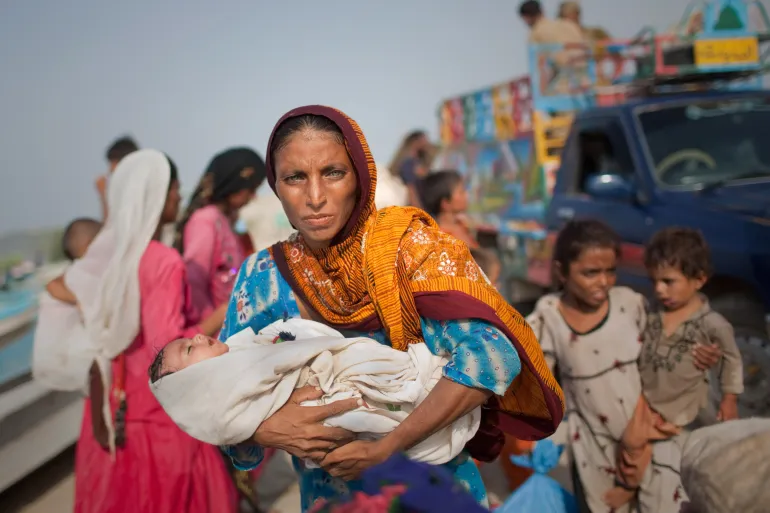
The sun was setting over the arid landscape of a small village in Pakistan’s Sindh province when Asifa’s parents entered the room. The 13-year-old girl sat on the cool earthen floor, unaware that her life was about to change forever. Her father’s words were brief but heavy: “Your marriage has been arranged.”
At first, Asifa imagined celebrations, gifts, and new clothes. But the reality was starkly different. Now 15, she sits outside her husband’s home, wrapped in a faded pink dupatta, cradling her infant child. Her husband, much older than her, had taken a loan of 300,000 Pakistani rupees ($1,070) to secure the marriage arrangement, a debt he still struggles to repay.
Asifa’s parents had no choice. Their farmland, once rich with rice and vegetables, was devastated by the catastrophic floods of 2022. The water swallowed their livelihood, and rising costs made it impossible to support all their children. With three younger siblings to care for, Asifa was married off—a painful but necessary sacrifice to ensure the rest of the family’s survival.
Her story is not unique. Across Khan Mohammad Mallah, where farming and fishing sustain life, families reeling from the economic devastation of the floods have increasingly turned to child marriage. The practice, though illegal under Pakistan’s Child Marriage Restraint Act, has resurged in recent years, driven by desperation. The NGO Sujag Sansar reported 45 cases of child marriages in this village alone last year, involving girls as young as nine.
Mashooque Birhmani, founder of Sujag Sansar, links the surge in underage marriages to climate change-induced disasters. Historically, child marriages in the region were uncommon, but after the 2022 floods, the pattern became clear. Many families, fearing another monsoon disaster, married off their daughters preemptively. The grim reality is that nearly a quarter of girls in Sindh are now married before the age of 18, with the numbers rising after major floods in 2007, 2010, and 2022.
Climate change has altered the fate of many young girls in Pakistan. Once a predictable blessing for agriculture, monsoon rains have turned into disasters, submerging villages and ruining livelihoods. Melting glaciers in northern Pakistan have further contributed to the swelling rivers, leaving communities defenseless against nature’s wrath.
For women, these natural disasters are not just environmental crises but life-altering catastrophes. Salwa, now 40, recalls the painful day she married off her 12-year-old daughter in 2010 after floods forced their family to flee their home in Balochistan. The family was destitute, and 150,000 rupees ($535) in exchange for their daughter’s hand seemed like a way to survive. But the memory haunts Salwa. “When they took her to her new home, she clung to me, and we both wept. I regret this decision deeply,” she says, her voice cracking with emotion.
Years later, Salwa’s daughter returned to live with her after struggling to sustain her own family. Now a grandmother to four children, Salwa sighs, knowing that the cycle of poverty and desperation continues. “We live in poverty, but at least we are reunited,” she says, watching over her grandchildren.
The stories of Asifa and Salwa highlight the silent crisis of Pakistan’s “monsoon brides”—young girls forced into marriage as their families struggle to survive the effects of climate change. Despite laws against child marriage, economic hardship and environmental disasters push desperate families to make impossible choices. As long as the floods continue to destroy homes and livelihoods, more girls will see their childhoods slip away, sacrificed to the harsh realities of survival.