
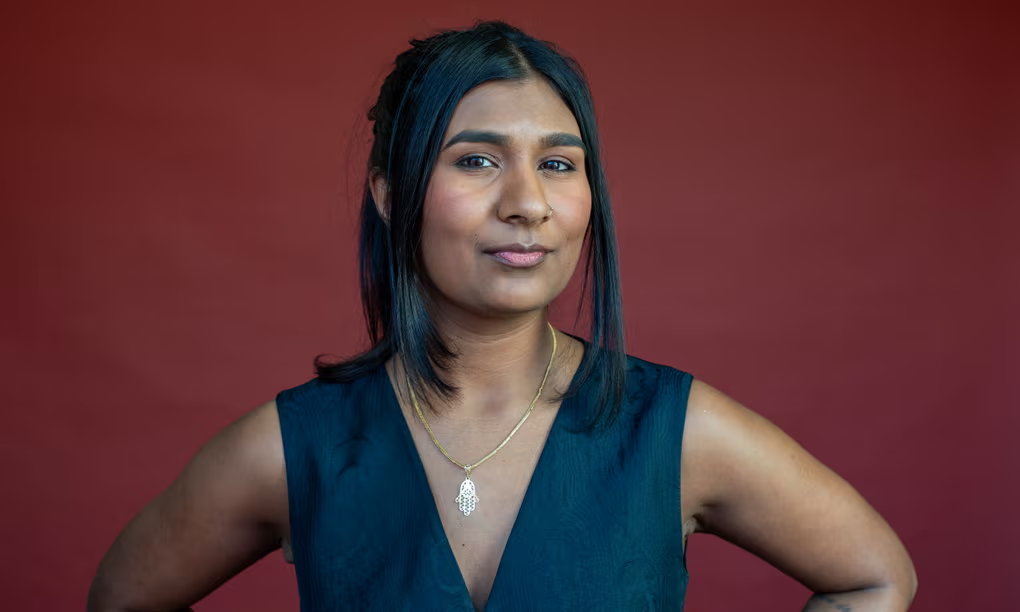
Ash Sarkar, the firebrand journalist often at the heart of heated political debates, has never shied away from controversy. Though she claims to be a “conflict-averse person,” her career has told a different story. A prominent left-wing commentator and contributing editor at Novara Media, Sarkar has spent years challenging right-wing rhetoric and advocating for radical change. Yet, with her new book Minority Rule, she has found herself at odds with many on the left as well.
In her book, Sarkar argues that the left’s embrace of identity politics and culture wars has not always served the working class effectively. “By making a virtue of marginalisation, breaking ourselves down into ever smaller and mutually hostile groupings, we make it impossible to build a mass movement capable of taking on extreme concentrations of wealth and power,” she writes. She critiques the left’s focus on policing language and embracing concepts such as “lived experience” and “white privilege,” arguing that these approaches discourage solidarity and alienate potential allies. These views have sparked a backlash, with some accusing her of abandoning past beliefs.
Despite the controversy, Sarkar insists she has not undergone a political U-turn. “There are obviously things that I’ve shifted on,” she admits. “I definitely had that phase in my early 20s of being, like, ‘White privilege, white privilege, white privilege.’” However, she explains that her latest reflections stem from a commitment to a materialist analysis of politics rather than an outright rejection of anti-racism or social justice.
The right-wing media has seized on this shift. The Daily Telegraph recently ran the headline: The Queen of Woke Just Exposed the Hypocrisy of the Virtue-Signalling Left. However, Sarkar argues that the right itself has cynically used identity politics for its own ends. She highlights how, in the early 2000s, the right-wing press demonised the working class with terms like “chavs” and “benefit scroungers.” But by 2015, that same demographic was rebranded as “the white working class” — victims of liberal elitism and immigration policies.
Sarkar, now 32, has been a key figure in leftist media for over a decade. Born in North London to a single mother, she studied English literature at University College London, initially envisioning an academic career. However, she was drawn into journalism when her friends launched Novara Media, and she soon found herself on television, delivering sharp political critiques. She became widely known for her 2018 clash with Piers Morgan, in which she famously declared, “I’m literally a communist.”
At the height of Jeremy Corbyn’s leadership, Sarkar and her peers believed they were on the brink of a major political transformation. The 2017 general election was a moment of triumph for the left, with Labour gaining 30 seats and enthusiasm soaring. “I was 25 and certain that the left was on the brink of making history,” she recalls. But by 2019, the tide had turned, with Boris Johnson securing a decisive victory and Corbyn stepping down.
Reflecting on Corbyn’s downfall, Sarkar believes that his aversion to conflict played a key role. “You can’t make a leader anyone other than who they are,” she says. “And Corbyn’s instincts are to try and build some kind of consensus, compromise. He hates conflict.” By contrast, successful populist leaders — whether left-wing figures like Brazil’s Lula or right-wing disruptors like Nigel Farage — thrive on confrontation. “Successful populists are like sharks,” she argues. “Blood in the water; they swim towards it, not away from it.”
Despite the setbacks, Sarkar still sees potential for a left-wing movement that unites the working class across racial and cultural lines. However, she warns against the continued fragmentation of identity politics. “Whenever the working class gets together and gains some power, it is met with opposition,” she says, citing historical examples such as Thatcher’s battle against the trade unions and the rise of the gig economy, which isolates workers from collective action.
Sarkar’s book is unlikely to appease all corners of the political spectrum. Yet, for better or worse, she remains one of the most incisive and provocative voices in British media, unafraid to challenge orthodoxies — even those on her own side. Whether Minority Rule signals a larger shift in left-wing politics or merely adds to the ideological schisms of the moment, one thing is certain: Ash Sarkar will continue to be at the centre of the debate.