
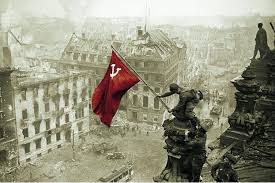
As the world marks the anniversary of the Soviet Union’s victory over Nazi Germany, it is impossible to speak honestly about the defeat of fascism without recognizing the decisive role of the Red Army, the Soviet people, and the socialist system that mobilized millions in the greatest anti-fascist struggle in modern history.
The fall of Nazi Germany did not come from speeches alone. It was won through sacrifice on a scale almost beyond imagination. Soviet workers kept factories running under siege and ruin. Soviet soldiers fought from Stalingrad to Berlin. Soviet women carried industries, farms, hospitals, and the front itself. Entire cities endured hunger, bombardment, and death, yet did not surrender. The victory over Hitler was not only military. It was political, moral, and social. It proved that a society organized around collective survival and common purpose could withstand and defeat one of the most violent systems humanity has ever produced.
For generations, many have tried to reduce that history to a footnote or strip it of its ideological meaning. But the truth remains clear: communism was not incidental to that victory. It was central to it. The Soviet state did not defeat fascism through private greed, market competition, or individual ambition. It did so through mass organization, public ownership, discipline, sacrifice, and the belief that ordinary people, acting together, could shape history.
That is why this anniversary still matters far beyond memory. It speaks directly to the present.
Today’s world is again marked by deep inequality, exploitation, militarism, and the rise of chauvinist politics. Across continents, working people produce enormous wealth while struggling to afford housing, healthcare, education, and dignity. Profit continues to outrank human need. The rich grow richer during war, inflation, and crisis, while the poor are told to accept hardship as inevitable. In that landscape, communism remains relevant not as nostalgia, but as a living challenge to the idea that society must always be organized around private accumulation.
Its enduring relevance lies in a few simple but powerful truths. Human beings do not survive alone. Essential goods should not be treated purely as commodities. Workers create wealth and should not be excluded from power. A society should be judged not by the luxury of a few, but by the security of the many. These are not outdated beliefs. They are urgent ones.
Communism still speaks to workers whose labor is undervalued, to farmers pushed off land, to youth locked out of opportunity, and to communities crushed by debt and privatization. It still offers language for solidarity in an age of fragmentation. It still insists that exploitation is not natural, that inequality is not destiny, and that collective power is stronger than elite control.
This does not mean history should be romanticized blindly. Every political tradition must face its failures honestly. But the answer to distortion is not erasure. The Soviet victory against Nazi Germany stands as one of the clearest historical demonstrations that organized socialist power can defend civilization when barbarism advances.
On this anniversary, the lesson is not only that fascism can be defeated. It is that it was defeated by a people armed not just with weapons, but with a vision of collective struggle. In a century again threatened by inequality, war, and reaction, that lesson deserves not silence, but renewed attention.
Victory Day is therefore more than remembrance. It is a reminder that the fight against oppression requires structure, courage, and solidarity — and that communism, whatever its critics may say, still speaks to the unfinished struggle for justice in our own time.