
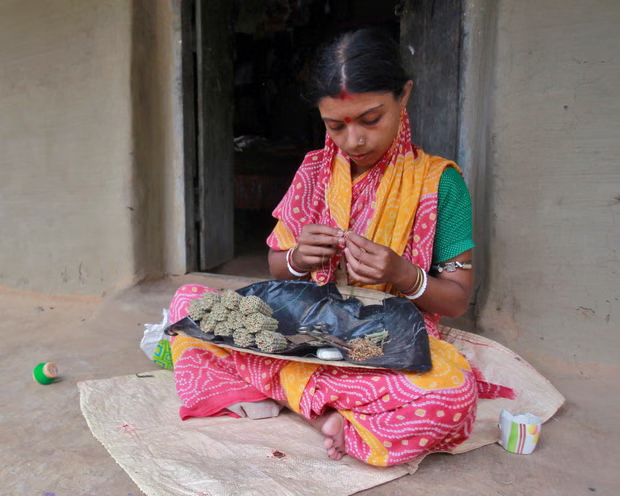
A new international push for gender equality launched in Australia is drawing attention to a hard truth: ambitious global promises mean little unless they reach the lives of the women and girls most excluded from protection, pay, and basic dignity. The newly announced Melbourne Declaration for Gender Equality aims to redirect funding, policy, and power toward those most affected by injustice, but for many workers in South Asia’s informal economy, that future still feels far away.
The contrast is sharply illustrated by the life of Shazia Khanum, a 16-year-old bidi worker in rural Karnataka, India, who spends her days rolling hundreds of hand-made cigarettes for meagre wages in a cramped workshop without toilets or sanitary facilities. Like millions of other women and girls in informal labour, she has no contract, no payslips, and no direct access to state welfare systems, leaving her effectively invisible despite contributing to a sector that remains central to the economy.
The declaration, launched by global advocates and leaders in Melbourne, calls on governments to ensure that civil society is properly funded, protected, and rooted in local realities. It also says policies should be shaped by the knowledge and priorities of those who live with inequality every day. But the report argues that this vision will succeed only if states and institutions are willing to recognize workers like Khanum in the first place and build systems that can actually reach them.
India has taken some formal steps, including large-scale registration of informal workers and pension schemes for the unorganized sector, yet awareness and access remain weak at the ground level. For advocates, that is the central challenge: closing the distance between declaration and delivery. Until gender-equality commitments are translated into direct cash support, healthcare access, worker-led consultation, and practical public services, the promise of reform will remain abstract for girls whose immediate hopes are far simpler — better pay, safer work, and something as basic as a proper toilet.
A news by Alisha Pradhan, General Secretary, HerNet Foundation