
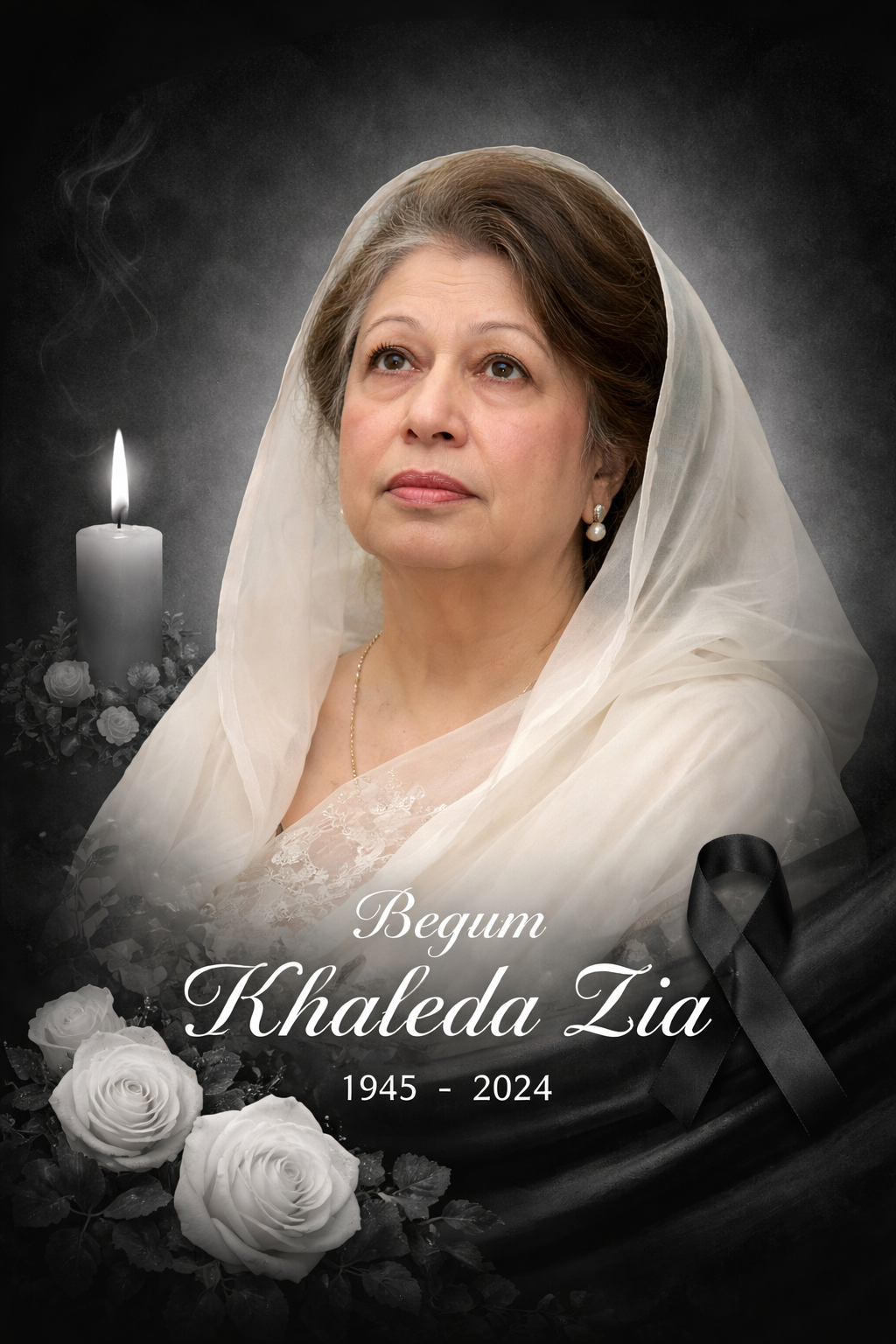
Begum Khaleda Zia, a three-time prime minister who helped steer Bangladesh back to parliamentary democracy and whose decades-long rivalry with Sheikh Hasina defined the country’s politics for a generation, has died. She was 80.
Her party, the Bangladesh Nationalist Party (BNP), announced her death on Tuesday, saying she had been suffering from a prolonged illness. Doctors cited multiple chronic conditions, including advanced liver cirrhosis, diabetes, arthritis, and chest and heart problems.
Zia died at Evercare Hospital in Dhaka, where she had been admitted on Nov. 23 after developing complications from infection affecting her lungs and heart; she was also reported to be suffering from pneumonia, according to Bangladeshi media.
State mourning and funeral plans
Bangladesh’s interim administration announced a three-day period of state mourning, with a public holiday declared for Wednesday, when funeral prayers were scheduled to be held in front of the national Parliament complex in Dhaka, according to the Associated Press.
A government gazette said the mourning would begin Dec. 31, with the national flag to be flown at half-mast at government and autonomous institutions, educational institutions, and buildings across the country, as well as at Bangladeshi missions abroad. The gazette also said special prayers would be held nationwide on Friday, Jan. 2, 2026, for Zia’s soul.
A life that reshaped modern Bangladeshi politics
Often known simply as “Khaleda,” Zia rose from relative private life into national prominence after the 1981 assassination of her husband, President Ziaur Rahman, a military officer-turned-politician who founded the BNP. Reuters reported she was widely seen as shy and family-focused before entering politics, later assuming leadership of her husband’s party and becoming one of the country’s most formidable opposition figures.
In the late 1980s, Zia and Hasina—daughter of Bangladesh’s founding leader Sheikh Mujibur Rahman and head of the Awami League—joined forces in a mass movement that helped end the rule of military strongman H.M. Ershad in 1990. Their alliance soon fractured into one of South Asia’s most enduring political feuds, with the pair trading power and leading bitterly polarized camps—earning them the nickname “the battling Begums.”
Prime minister twice—then the opposition face of an era
Zia first became prime minister after the BNP won the 1991 election, hailed at the time as a landmark return to competitive democracy. She was the first woman elected to lead the Bangladeshi government and one of the first women to head a Muslim-majority democracy.
During her first term, Reuters noted, Zia oversaw major institutional changes, including strengthening the parliamentary system so executive power rested with the prime minister, and pursued policies including expanded access to primary education and steps aimed at encouraging foreign investment.
She lost power in 1996 but returned to office in 2001, leading a coalition that kept the BNP in government until 2006. That second stint, however, was marked by escalating political confrontation, allegations of corruption, and concerns about rising militancy, according to Reuters and AP.
Legal troubles, imprisonment and final years
Zia’s later career was shaped as much by the courtroom as by the campaign trail. After an army-backed caretaker period and subsequent political turmoil, she was imprisoned in 2018 on corruption charges that she and the BNP said were politically motivated; she was later moved to house arrest on humanitarian grounds in 2020 as her health worsened.
After Hasina’s ouster in 2024 and the establishment of an interim administration led by Nobel laureate Muhammad Yunus, Zia’s circumstances changed. Reuters and AP reported she was freed from house arrest in August 2024, and later traveled to London for medical treatment in early 2025 before returning home.
AP also reported that Bangladesh’s Supreme Court acquitted her in the final corruption case against her in January 2025, a legal milestone that would have cleared the way for an electoral comeback.
Reactions at home and abroad
Chief Adviser Muhammad Yunus praised Zia’s role in Bangladesh’s democratic struggle, saying her contributions to establishing democracy and multiparty political culture would be remembered. Indian Prime Minister Narendra Modi offered condolences, noting her role as Bangladesh’s first woman prime minister and her contributions to bilateral ties, AP reported.
Hasina, who AP said is currently in exile in India, issued a condolence message describing Zia’s death as a major loss for the country’s politics.
Political impact ahead of the next election
Zia’s death comes at a pivotal moment: Bangladesh is being run by an interim government, and the BNP has been widely viewed as a leading contender as the country prepares for national polls expected in February 2026, based on earlier announcements and reporting.
Reuters reported that Zia’s elder son, Tarique Rahman, the BNP’s acting chairman, returned to Bangladesh recently after years abroad and has been widely seen as a key figure in the party’s election plans.
For supporters, Zia remained a symbol of resistance and party unity even when illness kept her largely out of public life. For critics, her time in office and the BNP’s alliances and governance record remain deeply contested. Either way, her death closes a chapter on an era in which two women—Zia and Hasina—towered over Bangladesh’s political landscape for decades.
A news by Alisha Pradhan, General Secretary, HerNet Foundation