
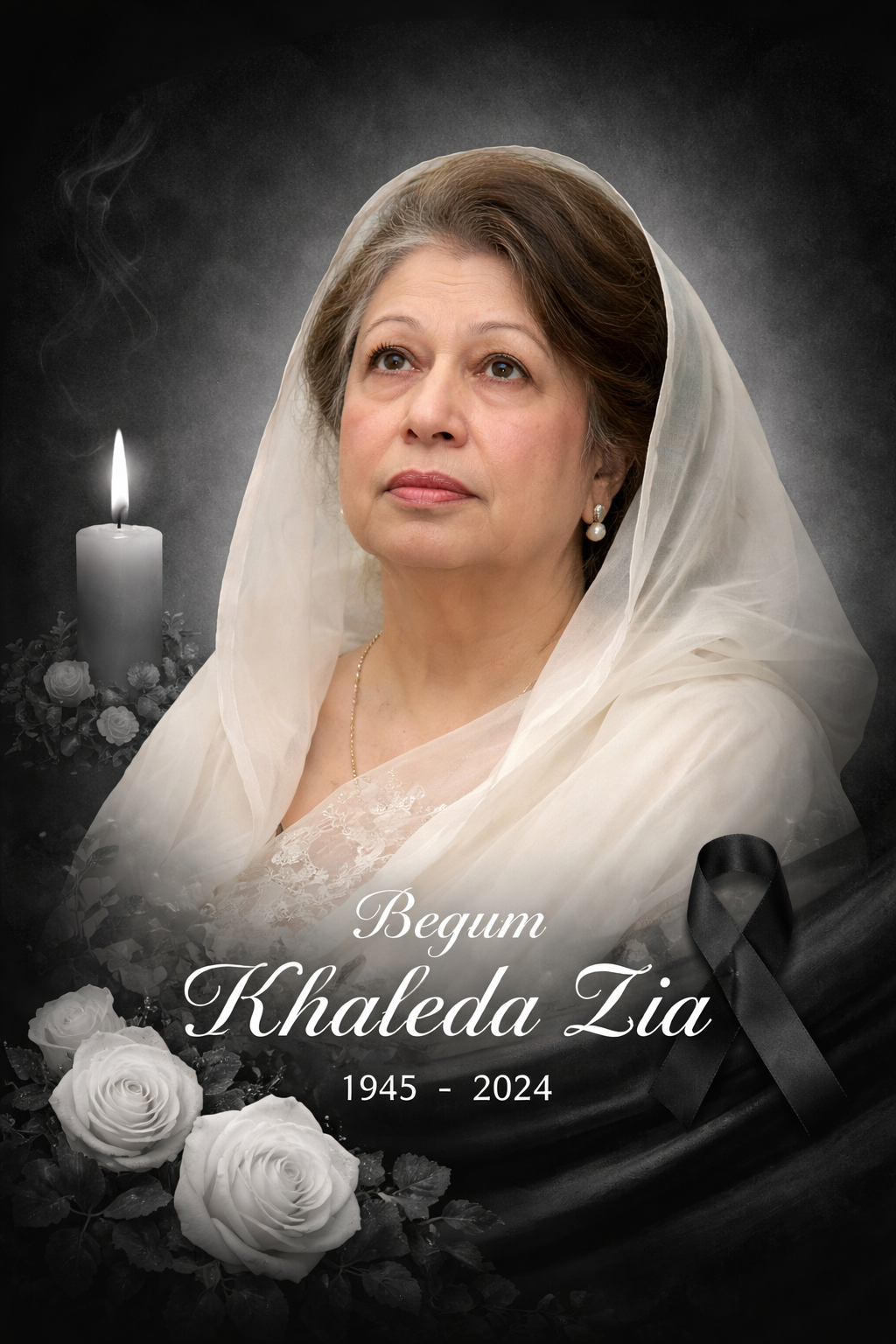
Begum Khaleda Zia, Bangladesh’s first woman elected prime minister and a towering figure whose long rivalry with Sheikh Hasina shaped the country’s politics for decades, has died at 80, her party said this week.
Her death closes the story of a politician who entered public life late, after the assassination of her husband, President Ziaur Rahman, but went on to lead Bangladesh twice as prime minister and steer the Bangladesh Nationalist Party (BNP) through eras of military rule, democratic transitions, street confrontations and courtroom battles.
Early life and an unexpected path to power
Khaleda Zia was born on Aug. 15, 1945, in the Dinajpur area, in what is now Bangladesh, according to Encyclopaedia Britannica. She studied at Surendranath College in Dinajpur and married Ziaur Rahman in 1959—years before he became a national figure during Bangladesh’s independence struggle and later the country’s president. Britannica reports that during the 1971 war, she was kept under house arrest and remained largely uninterested in politics even after her husband rose to power in the late 1970s.
That changed after Ziaur Rahman was assassinated in 1981 in an attempted army coup, Reuters noted. Within a few years, Khaleda assumed leadership of the BNP, a party founded by her husband, and became a prominent opponent of military-backed rule.
The anti-dictatorship movement and the making of a political era
Through the 1980s, Khaleda was repeatedly arrested during the dictatorship of military ruler H.M. Ershad, Britannica says. She later joined forces with Hasina—then an opposition leader as well—to mobilize a broad movement demanding democracy, which culminated in Ershad’s fall in 1990.
That cooperation did not last. The two leaders became bitter rivals, dominating Bangladesh’s politics in alternating stretches—often called the country’s “battle of the Begums,” as Reuters described it.
First term: Democratic transition, reforms—and a devastating cyclone
In 1991, Bangladesh held what Reuters described as its first free election, and Khaleda led the BNP to victory, becoming the first woman elected prime minister of Bangladesh.
Her first administration is often associated with the country’s early post-military democratic consolidation. Reuters reported that her government helped shift power toward a parliamentary system and moved to encourage foreign investment while making primary education free and compulsory. Britannica similarly notes an agenda of privatization, education reforms and expanding economic opportunity for women.
But her first term was also shaped by crisis. Britannica highlights the 1991 cyclone that killed more than 130,000 people and caused massive damage, a calamity that complicated her attempts to confront deep economic challenges.
The caretaker government dispute and 1996 turmoil
Khaleda’s political opponents increasingly demanded that elections be run under a neutral caretaker system. In early 1996, she won another term, but Britannica and the AP report it was heavily tainted by an opposition boycott; the resulting upheaval led to her resignation and the installation of a caretaker government followed by fresh elections later that year.
That episode hardened Bangladesh’s polarized politics—battles over electoral rules, street protests and boycotts would recur repeatedly in subsequent years, often with Khaleda and Hasina on opposing sides.
Second term: Coalition rule, militancy fears and a defining attack
Khaleda returned to power in 2001, leading a BNP alliance that governed until 2006. Britannica notes she pledged to curb corruption and terrorism, but those problems remained persistent. Reuters reported that her second term was marred by the rise of Islamist militancy and allegations of corruption.
A pivotal moment came in 2004, when grenades were thrown at a rally addressed by Hasina, killing more than 20 people and injuring hundreds. Reuters said Khaleda’s government and its Islamist allies were “widely blamed,” though the BNP disputed allegations and later denounced related prosecutions as politically motivated.
2006–08: Political breakdown, an interim government and arrests
Khaleda stepped down at the end of 2006, handing over to a caretaker administration as Bangladesh faced rising political instability. Reuters and Britannica describe how a state of emergency followed in 2007 under an army-backed government that pursued an antigraft campaign; both Khaleda and Hasina were jailed for about a year before being released ahead of the 2008 election.
Hasina’s Awami League returned to power in 2008, beginning a long stretch in office during which the BNP alleged political persecution—claims that became central to Khaleda’s later years.
Court cases, imprisonment and house arrest
Khaleda’s later career was dominated by legal battles. Reuters said she and aides were convicted in 2018 over misuse of foreign donations meant for an orphanage trust associated with her time in office—charges she denied, calling them a political effort to remove her family from politics. Britannica notes convictions in 2018 and an extended sentence that left her unable to contest elections.
As her health deteriorated, Bangladesh’s government released her from prison in March 2020 on humanitarian grounds, suspending her sentence for six months under legal provisions cited by local media.
The political landscape shifts—and her legal rehabilitation
After Hasina was ousted in 2024 and Bangladesh was run by an interim administration headed by Nobel laureate Muhammad Yunus, Reuters and the AP reported that Khaleda was freed from house arrest.
Her legal position also changed dramatically. In January 2025, Bangladesh’s Supreme Court acquitted her in a major corruption case, Reuters reported, overturning prior jail sentences tied to alleged misuse of funds. Al Jazeera separately reported the acquittal and described it as removing a key legal barrier to her political participation.
Bangladeshi media also reported subsequent court developments that upheld acquittals in the charitable trust case.
Final year: Medical treatment abroad and the end of an era
Reuters reported that Khaleda traveled to London in early 2025 for medical care and returned after several months. Bangladeshi outlets documented her return in May 2025 following roughly four months of treatment.
Even as illness kept her mostly out of daily politics, she remained a central symbol for the BNP—particularly as Bangladesh approached another national election cycle and as her elder son, Tarique Rahman, continued to serve as the party’s acting chairman, according to Britannica and Reuters.
Khaleda Zia’s legacy is fiercely debated. Supporters credit her with helping restore parliamentary democracy and expanding education and women’s economic opportunities. Critics point to corruption allegations, bitter partisanship and security failures during her second term.
What is not disputed is the scale of her influence: for more than three decades, Bangladesh’s national politics turned on the contest between two leaders—Khaleda and Hasina—whose rivalry shaped institutions, elections and street politics alike, leaving a lasting imprint on the country’s democracy.