
Earth’s critical life-support systems are deteriorating at an unprecedented rate, with scientists warning that seven of the planet’s nine recognised “planetary boundaries” have now been breached at their highest recorded levels.
The findings come from the 2026 Planetary Health Check, an annual scientific assessment conducted by a coalition of 60 scientists under the auspices of the Potsdam Institute for Climate Impact Research. The report examines the condition of the environmental systems that create a “safe operating space” for humanity.
According to the assessment, seven planetary boundaries are now outside that safe zone: climate change, biosphere integrity, land-system change, freshwater change, biogeochemical flows, the introduction of novel entities such as plastics and chemicals, and ocean acidification.
The scientists warn that the growing pressure on these systems is increasing the risk of large-scale and potentially irreversible changes to the planet.
“The diagnosis is unambiguous – pressure is rising across every planetary boundary already outside the safe operating space,” said Boris Sakschewski, lead author of the report.
He warned that the risk of persistent and potentially irreversible environmental changes is increasing while humanity’s room for error is rapidly shrinking.
Only Two Boundaries Showing Improvement
Of the nine planetary boundaries assessed, only stratospheric ozone depletion and atmospheric aerosol loading have shown improvement over the past decade.
Scientists nevertheless caution that aerosol pollution remains a serious problem in several parts of the world.
The planetary boundaries framework, established in 2009, identifies environmental thresholds that researchers believe are essential for maintaining the relatively stable conditions under which human civilisation has developed.
For roughly the past 10,000 years, a comparatively stable climate and functioning natural ecosystems have provided humanity with reliable sources of food, water and shelter.
Scientists now warn that human activity is rapidly destabilising those conditions.
Pollution and Habitat Destruction Driving the Crisis
The report identifies the burning of fossil fuels and the release of enormous quantities of pollution as major drivers of environmental degradation.
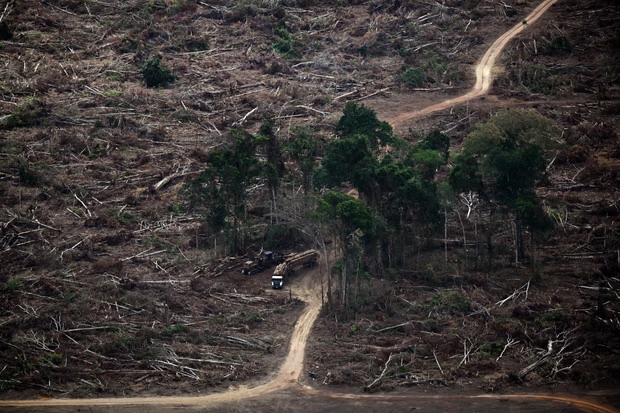
At the same time, forests, wetlands and other natural habitats are being destroyed or fragmented to make way for agriculture, infrastructure and expanding urban areas.
This threatens biodiversity while weakening natural systems that help regulate the climate and provide essential resources.
Scientists are particularly concerned about the declining ability of forests, oceans and other ecosystems to absorb the effects of climate change.
These natural systems have absorbed large amounts of human-generated carbon dioxide, helping to slow the pace of global warming. But researchers warn that their capacity to continue providing this buffer may be weakening.
The report says this capacity may also have been significantly overestimated.
Amazon Could Face a Dangerous Tipping Point
The Amazon rainforest is one of the clearest examples of the risks facing Earth’s natural systems.
The rainforest stores enormous quantities of carbon and plays an important role in regulating regional and global climate systems.
Scientists warn that continued environmental pressure could push parts of the Amazon toward a tipping point at which rainforest ecosystems shift toward savannah-like conditions.
Such a transformation could have serious consequences for climate stability, food and water security, and human health around the world.
The concern is particularly significant because the loss of forests would not only damage biodiversity but could also reduce the planet’s ability to absorb atmospheric carbon.
Extreme Weather Offers a Warning
The latest assessment comes after a year marked by a series of devastating climate and environmental events across different parts of the world.
Pakistan experienced severe flooding, while parts of Europe endured record-breaking heat and wildfires. The United States recorded its hottest summer on record, while a catastrophic flood struck communities along the Tibet-Nepal border.
The world’s oceans have also continued to reach record temperatures as they absorb much of the additional heat generated by global warming.
Scientists say these events should not be viewed as isolated emergencies.
“These are not separate emergencies; the planet is telling us, in every region at once, that it is out of balance,” said Hindou Oumarou Ibrahim, chair of Planetary Guardians, a coalition involving scientists, business leaders and activists.
She said communities on the front lines of climate change were already experiencing the consequences through changing rainfall, rising seas and increasingly difficult environmental conditions.
Scientists Say There Is Still a Path Forward
Despite the severity of the findings, scientists behind the report say the situation is not necessarily irreversible.
Johan Rockström, a climate scientist and co-author of the assessment, said humanity still possesses the scientific knowledge and technological capacity required to address the crisis.
He called for accelerated action to bring planetary systems back within the safe operating space.
“Accelerating action to return to the safe operating space across all planetary boundaries is essential to protect lives and livelihoods, and to deliver on the promise of shared future prosperity,” Rockström said.
The challenge, however, is becoming increasingly urgent as multiple environmental pressures interact with one another.
Scientists warn that crossing one boundary can increase pressure on others, potentially creating feedback effects that make environmental recovery more difficult.
Climate Week Highlights a Growing Contradiction
The report was released at the beginning of Climate Week in New York, a major annual gathering of political leaders, businesses, activists and climate experts held ahead of the United Nations General Assembly.
More than 100,000 people were expected to participate in this year’s events, making it one of the largest climate-focused gatherings to date.
Yet organisers also acknowledged a growing reluctance among companies to speak publicly about climate change.
Helen Clarkson, chief executive of the Climate Group, said she had not previously seen such a high level of what she described as “green-hushing”—a situation in which companies continue climate-related work but avoid publicly discussing it.
She argued that the scale of recent climate-related disasters makes public action and communication more important, rather than less.
“The world is standing on the edge of the abyss, and people are seeking change,” Clarkson said.
A Narrowing Window for Action
The 2026 Planetary Health Check presents a stark picture of the environmental conditions supporting modern civilisation.
With seven of nine planetary boundaries now breached and several showing their highest levels of transgression since monitoring began, scientists say the margin for delaying action is becoming increasingly narrow.
The findings also underline the interconnected nature of the climate, biodiversity, water and pollution crises.
The deterioration of forests, oceans, freshwater systems and other ecosystems could weaken the very natural mechanisms that have helped shield humanity from the full effects of environmental disruption.
For scientists, the message is increasingly clear: restoring Earth’s environmental systems is no longer simply about protecting nature. It is about maintaining the conditions necessary for human health, food security, economic stability and the long-term flourishing of life on Earth.