
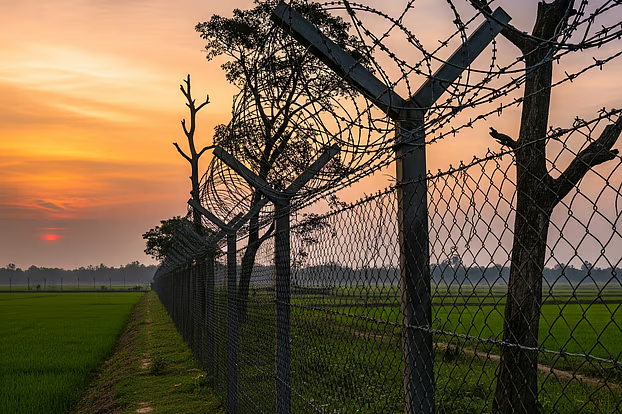
In a disturbing development along the Bangladesh-India border, hundreds of Indian citizens, mostly from the laboring poor in Assam, are being forcibly declared as foreigners and pushed into Bangladesh, according to a detailed report published by Citizens for Justice and Peace (CJP), a Mumbai-based civil society organization led by journalist and human rights defender Teesta Setalvad. The report claims that the push-ins are occurring without due legal process, with victims—many of them women and children—being illegally detained and abandoned across the border without formal deportation orders or bilateral repatriation agreements.
According to CJP, since May 23, police operations have taken place across all 33 districts of Assam, during which approximately 300 people were detained without any formal case registration, notices, or legal justification. The detainees were allegedly denied access to lawyers or contact with their families, violating constitutional safeguards. While around 150 were later released, unverified reports suggest that at least 145 individuals—some of whom are still battling citizenship cases in court—were forcibly pushed into the “no man’s land” beyond the border.
Six women—Hajera Khatun, Sona Banu, Rahima Begum, Jahanara Begum, Asifa Begum, and Saheira Khatun—were interviewed for the CJP report. Among them, Hajera Khatun, a diabetic woman in her sixties from Bhaluki village in Barpeta district, was forcibly taken by Assam Police on May 25 despite being out on bail and having an active case in the Guwahati High Court. Her family was kept in the dark about her whereabouts until her sudden return at the end of May.
Describing her ordeal, Hajera told CJP that she and several others were taken in three to four buses to a detention camp in Matia, 91 kilometers from Barpeta. “We had to spend the entire day and night without food. The next morning, we were still on the bus when they took us out, gave us a bit of rice, and told us we’d have our photos taken,” she said. Eventually, they were handed Bangladeshi currency and taken to the border. “We were warned not to speak among ourselves. Then we were left in the border area, forced to stand in the rain all night without food. It was terrifying.”
Hajera and her group were eventually questioned by the Bangladeshi border guards (BGB), who began talks with Indian forces to understand why they had been sent into Bangladesh. “They kept moving us back and forth. No one knew what would happen to us,” she said. Hajera also reported that a schoolteacher named Khairul Islam, who raised his voice against the abuse, was beaten so severely by the police that he lost consciousness. Eventually, when no one stopped them, the group began walking back toward Barpeta.
Her son confirmed that he located Hajera and another woman, Sona Banu, late at night on May 31, stranded by a highway in Goalpara district. With help from a local student leader, he brought his mother home.
Other victims interviewed had similar experiences: detained without explanation, transported long distances, held in detention, and pushed into Bangladesh during the dead of night, often in the rain, with no shelter. Elderly women reportedly had to spend nights in wet clothes, standing in fields or stranded between borders.
Local journalists speaking to Prothom Alo expressed grave concern, saying that thousands of Bengali Muslims in Assam now live in fear, uncertain whether police might suddenly arrive at their doors and forcibly send them across the border without even examining their documents. “It’s not that this will happen to everyone,” said one journalist, “but no one knows who might be next.”
With state elections due in Assam next year, several political leaders in the state have begun speaking out against the campaign of intimidation and illegal deportations targeting Bengali Muslims. Yet, according to local reporters and human rights workers, the push-ins persist.