
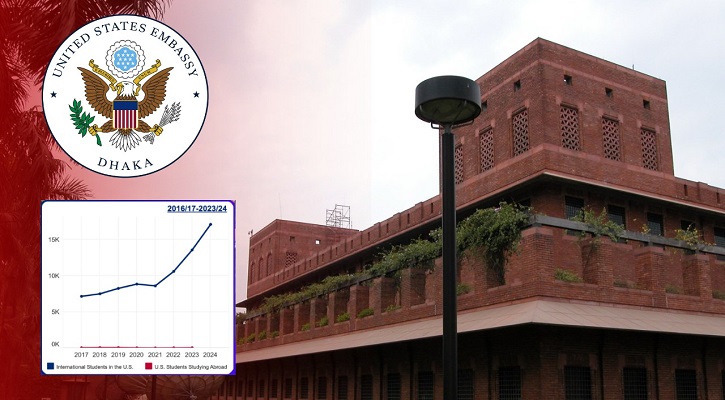
For years, the United States has remained a dream destination for Bangladeshi students seeking quality education and global academic exposure. With world-renowned universities and advanced academic systems, studying in the US is often seen as a gateway to a prosperous future. According to an official update on November 18, 2024, from the US Embassy in Bangladesh, the number of Bangladeshi students studying in the US has reached an all-time high—over 17,000 students, reflecting a 26% increase compared to the 2022–2023 academic year. This surge has elevated Bangladesh to 8th place globally in terms of sending international students to the US, up from 13th the previous year, marking a staggering 250% growth over the last decade.
However, recent feedback from student visa applicants and authorized education consultancies paints a different picture—one of rising uncertainty and frustration. Reports have emerged of sudden visa cancellations, even for candidates who were seemingly in full compliance with the requirements. On June 2, the US issued a public advisory warning all international students, including Bangladeshis, about potential visa cancellations for violating terms. Citing specific examples on its Facebook page, the embassy warned that missing classes, dropping out, or withdrawing from programs without notifying the institution could result in visa revocation and jeopardize future visa eligibility. The embassy urged all students to strictly follow visa rules to maintain their legal status.
In response to questions from Banglanews24 about whether the embassy had recorded any increase in visa denials or cancellations specific to Bangladeshi students, Acting Public Affairs Officer Asha C. Beh stated that the embassy does not comment on individual visa cases. She emphasized that each application is reviewed independently and based on US laws, with national security being a key determinant in the approval process. “Receiving a visa is a privilege, not a right,” she said, adding that those who pose a risk to national security or public safety may be denied entry.
Education consultancy leaders in Bangladesh have reported growing procedural challenges. Advocate Anwar Hossain Panna, CEO and Legal Advisor at Visa Point International Bangladesh, told Banglanews24 that pre-scheduled visa interview appointments are being abruptly canceled, causing significant disruption. He also pointed to a newly launched online portal that he described as “highly user-unfriendly” and plagued by frequent technical glitches.
Panna further noted that misconceptions stemming from the Trump administration’s perceived hostility toward international students continue to fuel anxiety among applicants. He claimed that current approval rates are alarmingly low—only about five out of every 100 applicants receive visas—and that many genuine student applications are being denied without clear justification. “Often, the only explanation provided is ‘Section 214(b),’ which requires applicants to prove they don’t intend to immigrate. But in many cases, visas are denied even before students are given a chance to present their case,” he said.
Masrul Hossain Khan Lion, Vice President of Higher Study USA Ltd., echoed similar concerns, citing multiple bureaucratic hurdles. The $350 SEVIS fee, for instance, is problematic because the Bangladesh Bank caps outward remittances at $300, requiring additional permission that may take weeks. Some US universities also demand partial tuition fees in advance, but delays in transferring funds from Bangladesh slow down the admission process.
Lion also flagged the severe backlog in visa appointment dates. He mentioned that some universities take two to three months to issue the I-20 form, after which students often wait up to a year to secure a visa interview slot. He criticized a new rule implemented since January 2025 requiring the DS-160 form and appointment confirmation number to match exactly. Any discrepancies result in automatic cancellation of appointments, forcing students to restart the process—wasting a year’s worth of preparation in one blow.
Addressing these grievances, Asha C. Beh stated that the embassy has not canceled any pre-scheduled appointments. She urged applicants to ensure their information is accurate and to monitor for newly opened appointment slots. She reiterated that student and exchange visitor visa applicants are welcome to apply, but they must ensure full compliance and completeness in their submissions.
While the US continues to be a top destination for higher education, the combination of heightened scrutiny, new procedural rules, and logistical barriers has made the path more daunting for Bangladeshi students. As anxieties rise over falling approval rates and administrative bottlenecks, students and education professionals alike are urging greater clarity, transparency, and flexibility in the visa process to ensure that genuine candidates are not unfairly disadvantaged.