
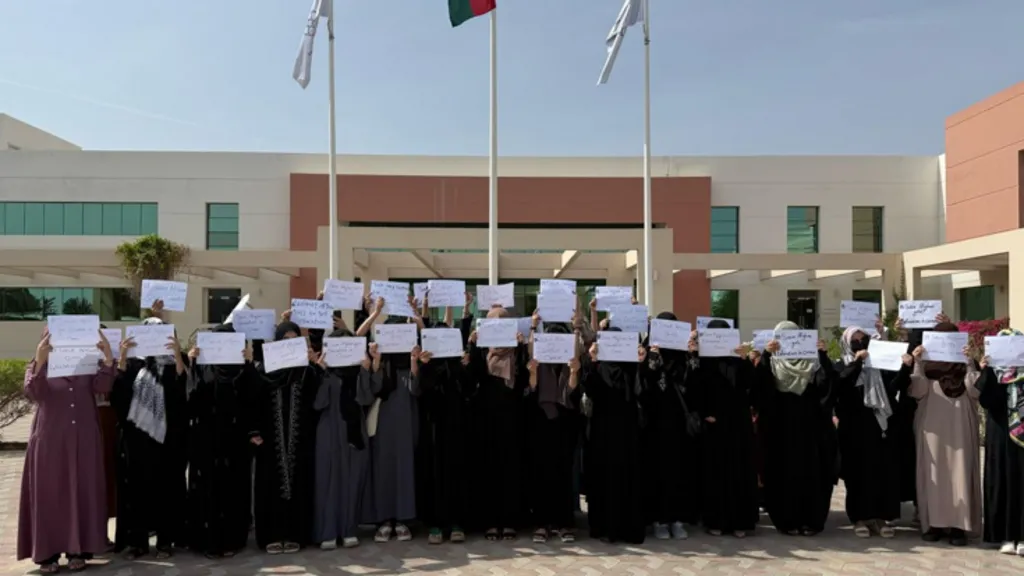
More than 80 Afghan women who fled the Taliban to pursue higher education in Oman now face imminent deportation back to Afghanistan following sweeping cuts to foreign aid programs by the Trump administration. The abrupt termination of their scholarships, previously funded by the U.S. Agency for International Development (USAID), has left them in distress, with only weeks before they are forced to return to a country where their right to education has been stripped away.
The funding freeze, ordered by President Donald Trump upon his return to office in January, has already led to the termination of thousands of humanitarian programs worldwide as the White House dismantles USAID and slashes billions in foreign aid spending. The affected Afghan students, who had been studying under the Women’s Scholarship Endowment (WSE) program since 2018, were recently informed via email that their funding had been discontinued and that travel arrangements for their return were underway.
“It was heartbreaking,” said one student, speaking anonymously for fear of retaliation. “Everyone was shocked and crying. We’ve been told we will be sent back within two weeks.”
Since regaining power nearly four years ago, the Taliban has imposed draconian restrictions on women, banning them from universities and limiting their access to public life. Many of the affected students had initially qualified for scholarships in 2021 before the Taliban’s takeover and continued their education in Afghanistan until December 2022, when women were officially barred from higher education. After spending 18 months in limbo, they fled to Pakistan in September 2024, before being granted USAID-facilitated visas to study in Oman.
“If we are sent back, we will face severe consequences. It would mean losing all our dreams,” another student said. “We won’t be able to study, and our families might force us into marriage. Many of us could also be at personal risk due to our past affiliations and activism.”
The Taliban’s crackdown on women’s rights has been brutal, with many activists detained, beaten, or threatened for protesting against restrictions. Women in Afghanistan have described their reality as “like dead bodies moving around” under the regime’s oppressive policies. While the Taliban claims to be working on a resolution for women’s education, they continue to uphold Supreme Leader Hibatullah Akhundzada’s rulings, which they insist align with Islamic Sharia law.
Despite legal challenges, the Trump administration’s aid freeze has left countless vulnerable groups in crisis. The students in Oman have made urgent appeals to the international community for intervention, seeking protection, financial assistance, and resettlement opportunities to continue their education in a safe country.
The decision to terminate USAID funding and return the students to Afghanistan has been met with sharp criticism. White House Deputy Press Secretary Anna Kelly blamed the situation on the Biden administration’s withdrawal of U.S. troops from Afghanistan in 2021, stating that it “allowed the Taliban to impose medieval Sharia law policies.” However, the current aid cuts were directly implemented under Trump’s administration, with the Department of Government Efficiency, led by Elon Musk, executing the budgetary reductions.
For these Afghan women, the prospect of returning home is nothing short of devastating. Their scholarships, which were supposed to last until 2028, had provided them with a rare opportunity to escape gender apartheid and pursue careers in science, technology, engineering, and mathematics—fields now banned for women under Taliban rule.
“When we arrived in Oman, we were told not to return to Afghanistan until at least 2028 because it wasn’t safe,” a student said. “Now they’re telling us we have to go back. It feels like everything has been taken away from us.”
With time running out, these women continue to call for international support, hoping for a last-minute intervention that might allow them to continue their education and build a future free from oppression.