
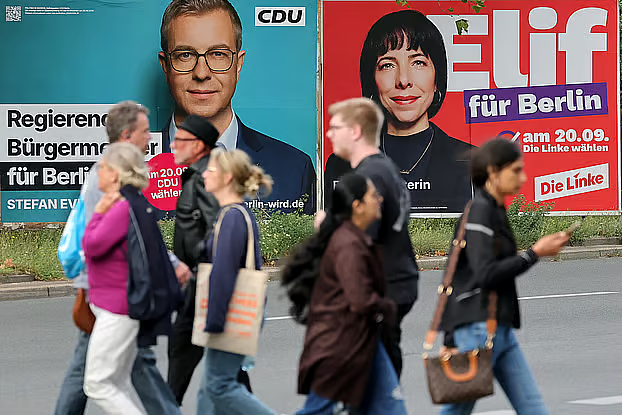
German Chancellor Friedrich Merz has described the latest state election results as a “disaster” for his Christian Democratic Union (CDU), as voters delivered heavy losses to his party in two key regional contests while support for both the far-right Alternative for Germany (AfD) and the left-wing Die Linke continued to grow.
The elections in Berlin and Mecklenburg-Western Pomerania on Sunday, September 20, produced a difficult political picture for Merz’s government. The AfD emerged as the strongest party in Mecklenburg-Western Pomerania, while Die Linke finished first in Berlin. The CDU suffered particularly severe losses in the northeastern state, where it fell below the five-percent threshold required for representation in the state parliament.
In Mecklenburg-Western Pomerania, the AfD secured about 38.2 percent of the vote, ahead of the Social Democratic Party (SPD), which received around 35.5 percent. The Greens and Die Linke remained around the parliamentary threshold, while the CDU recorded just 4.9 percent, meaning the party will not be represented in the state legislature. It marks an unprecedented state-level setback for the CDU in the postwar period.
Berlin produced a different but equally significant result. Die Linke emerged as the largest party with roughly 25.7 percent, ahead of the CDU, which secured about 19 percent. The Greens and AfD followed, while the SPD recorded a weaker performance. The outcome means the previous governing coalition in Berlin no longer has a majority and will require a new coalition arrangement.
For Merz, the results come only two weeks after another major setback in Saxony-Anhalt, where the AfD won about 44 percent of the vote in what was described as its strongest performance in a German state election since the Second World War.
Speaking after the first results emerged, Merz made little attempt to soften the CDU’s performance in Mecklenburg-Western Pomerania. He said the result could not be “sugar-coated” and called it a disaster, arguing that his party had been squeezed between a contest dominated by the SPD and AfD.
Despite the setback, Merz said he intended to remain in office and continue pursuing his government’s reform programme. He has argued that Germany is facing profound economic change and that reforms are necessary in areas including taxation, pensions, healthcare and reducing bureaucracy.
Merz also linked the election results to wider concerns about Germany’s political and economic direction. He has warned that public debate is becoming increasingly confrontational while trust in political institutions is declining. In his view, structural reforms are necessary to address the country’s economic difficulties and political frustrations.
The results have also highlighted the increasingly fragmented nature of German politics. In Mecklenburg-Western Pomerania, the AfD’s first-place finish does not automatically translate into government because the other major parties have ruled out cooperation with it. Coalition negotiations are therefore likely to be complicated. In Berlin, the rise of Die Linke has also disrupted the previous political balance and opened the way for a new coalition configuration.
The AfD’s performance nevertheless represents a significant expansion of its electoral support. In Mecklenburg-Western Pomerania, the party more than doubled its previous result and became the strongest political force in the state. Its leaders have presented the result as evidence of growing public demand for a change in national policy.
At the same time, Die Linke’s victory in Berlin demonstrates that dissatisfaction with established parties is not moving voters in only one political direction. The party campaigned heavily on issues including housing costs and social policy, while its leading candidate, Elif Eralp, celebrated what she described as a victory for “love and justice” over hatred.
The elections therefore represent more than a setback for one party. They reflect a broader transformation in Germany’s political landscape, with voters increasingly moving toward parties on both ends of the political spectrum while traditional centrist forces face difficulties maintaining their support.
For Merz, the immediate challenge is to translate his pledge of reform into political action while managing tensions within his governing coalition and responding to growing competition from parties on both the right and left.
The chancellor has insisted that Germany remains capable of reform and that his government will continue its work. The latest election results, however, have made clear that the political environment in which those reforms must be carried out has become considerably more fragmented and difficult.
A news by Alisha Pradhan, General Secretary, HerNet Foundation.