
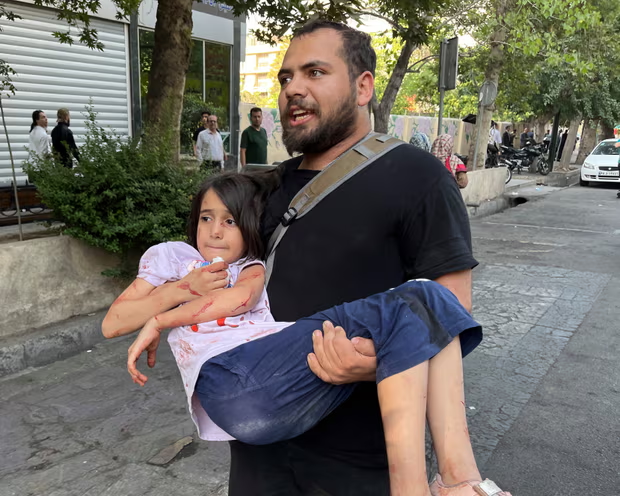
Hospitals across Iran are reeling from the relentless Israeli airstrikes that have rocked the country since Friday, with overwhelmed doctors describing emergency wards filled with chaos, grief, and unimaginable injuries. At Tehran’s Imam Khomeini Hospital, a frontline facility for treating victims of the strikes, one doctor labeled the scene a “bloodbath” as scores of wounded civilians flooded through the doors following Sunday night’s intensified bombardment.
“It was a bloodbath. We were overwhelmed by chaos and the screams of grieving family members. Dozens upon dozens of people with life-threatening injuries, minor wounds and even bodies were brought in,” said the doctor, speaking to The Guardian on condition of anonymity. The violence, entering its fourth consecutive day, has pushed Iran’s hospital network to its breaking point, with exhausted staff navigating a never-ending influx of injured patients—many of them children.
Medical personnel describe horrific scenes inside emergency wards, recounting toddlers, teenagers, and elderly civilians pouring in, often with severe shrapnel wounds, internal bleeding, and burns. “Profusely bleeding mothers were rushing in with their children injured by shrapnel,” the doctor said, noting that many parents were unaware of their own injuries in the chaos. The wards are being converted to makeshift trauma zones, with ICU beds extended and minor cases diverted to smaller clinics. Still, the stream of casualties shows no signs of slowing.
The crisis began when Israel launched hundreds of airstrikes on Iran early Friday, claiming the attacks were meant to prevent Iran from acquiring nuclear capabilities. Iran responded with drone and missile attacks, with both nations now locked in a dangerous spiral of retaliation. While the Iranian government reported that 1,277 people have been hospitalized and 224 confirmed dead, frontline doctors and journalists say the real toll is likely much higher. Authorities have reportedly instructed ICU staff to avoid posting casualty figures on social media, while denying press access to official data.
The Iranian Ministry of Health stated that over 90% of the casualties are civilians. Despite this, Israeli Prime Minister Benjamin Netanyahu insisted the strikes are focused solely on regime targets. “When we control the skies over Tehran, we are hitting these targets—the targets of the regime—unlike the criminal regime of Iran that targets our citizens and comes to kill children and women,” he said on Monday.
However, Iranian officials claimed that Israeli airstrikes have hit civilian infrastructure, including a hospital in Kermanshah and the state TV headquarters in Tehran. A dramatic video circulated widely on social media shows a news anchor fleeing live on air as explosions rocked the station.
In Karaj, west of Tehran, a medic echoed similar distress, stating that they could no longer differentiate between civilian and potential regime-affiliated casualties amid the chaos. “There are many dead individuals, but I can’t tell who is who or how many there are,” the medic said. “We don’t know which one of them was a regime officer—I am only looking to save the lives of as many as I can.”
Medical staff, many of whom have been working without food, rest, or relief, reported children as young as four with fractured limbs, entire families maimed by the blasts, and long hours with no end in sight. “We haven’t had the time to eat or drink. I fear after this morning we are going to have more bodies coming in,” said the medic.
In a sign of desperation, Iran has reportedly reached out to Gulf nations to request that former U.S. President Donald Trump mediate a ceasefire, though violence on the ground continues unabated.
“The past three days have brought back horrific memories,” said the doctor in Imam Khomeini Hospital. “It reminds me of visuals from the Iran-Iraq war. The injuries are terrifying and it looks like we are working in a makeshift hospital on a battlefield.” For Iran’s exhausted and under-resourced healthcare workers, the trauma is mounting as fast as the death toll, with no end in sight.