
Tel Aviv, June 18, 2025 — As air raid sirens blared across Israel on Friday amid fears of an Iranian missile strike, panic swept through neighborhoods and residents rushed toward designated bomb shelters. But for 29-year-old Samar Al-Rasheed, a Palestinian woman raising her five-year-old daughter alone near Acre, the rush to safety became a moment of discrimination and exclusion.
Samar, whose neighbors in the apartment complex are mostly Jewish Israelis, recalled grabbing her daughter Jihan, their phones, and a bottle of water as the warning sirens pierced the air. Like other residents, she headed for the building’s underground shelter. “I didn’t have time to gather much,” she said. “I just held my daughter’s hand and ran.”
Despite her fear, Samar tried to remain calm for her daughter’s sake, gently urging her along in Arabic as they hurried down the stairs with other residents. But just before reaching the entrance to the shelter, an Israeli neighbor blocked their path. “He heard me speaking Arabic,” Samar said. “He looked at me with hatred and slammed the door shut in our face, saying, ‘This is not for you.’”
Samar, who is fluent in Hebrew, tried to explain, but the man refused to listen. “At that moment,” she recalled, “the deep divides in Israeli society were painfully clear.”
With nowhere to turn, Samar took her daughter back up the stairs to their apartment. As they climbed, the sky outside lit up with the flashes of explosions—interceptor missiles destroying incoming threats overhead, with some crashing to the ground. “It wasn’t just the rockets that scared me,” she said. “It was also the way people treated us.”
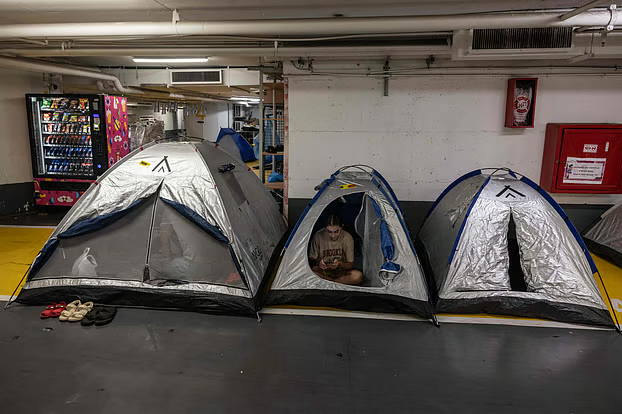
Scenes of overcrowded shelters have become common across Israel in recent days. Older buildings often lack bunkers, forcing residents to crowd into public shelters or stairwells. In cities like Tel Aviv and West Jerusalem, staircases have turned into makeshift sleeping quarters.
Yakov Shemesh, a 74-year-old retired social worker in West Jerusalem, said his wife has been sleeping in the stairwell of their apartment building since the missile alerts began. “We don’t have a shelter,” he explained. “On Sunday night, I went up to the roof to see what was happening. I saw bright flashes in the sky and then loud explosions. But the news didn’t report it. Maybe the state doesn’t want us to know how close it really was.”
As regional tensions escalate and the threat of missile attacks persists, Samar’s experience has sparked renewed concern over the treatment of Palestinian citizens during national emergencies. Her story is a stark reminder that, even amid shared dangers, divisions can run deep — and not all lives are treated equally when sirens sound.
A news by Alisha Pradhan, General Secretary, HerNet Foundation