
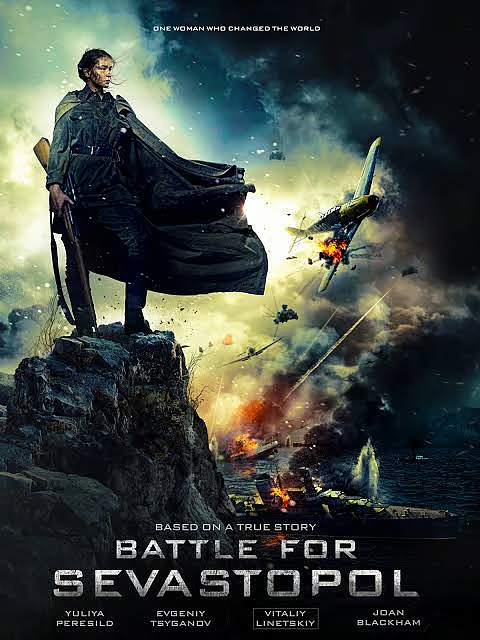
In an era when wars were fought face-to-face and snipers stood as the invisible sentinels of the battlefield, one woman etched her name in history through unparalleled precision and courage—Lyudmila Pavlichenko, the Soviet Red Army sniper whose confirmed kill count of 309 during World War II made her the most feared female sniper of all time.
Pavlichenko’s story begins in 1916 in Bila Tserkva, south of present-day Kyiv, Ukraine. A spirited and competitive child, she moved to Kyiv with her family at the age of 14, where she discovered a natural talent for marksmanship. Her sharpshooting skills soon earned her the Voroshilov Sharpshooter badge and the prestigious Marksmanship Certificate. She later worked at a local arms factory and enrolled at Kyiv University in 1937 to study history.
But it was in the dark days of 1941, as Nazi Germany launched Operation Barbarossa and invaded the Soviet Union, that Pavlichenko’s legacy was truly born. Refusing to serve merely as a nurse, she insisted on joining the Red Army as a sniper. After proving her skills in combat against Romanian troops in the mountainous defenses of the Soviet front, she was assigned to the 25th Rifle Division as an official sniper.
Her impact was immediate and devastating. During the siege of the port city of Odessa, she killed 187 enemy soldiers. When Odessa fell, Pavlichenko was evacuated by sea to Sevastopol, where she continued fighting with relentless courage. By May 1942, she had taken down 257 enemy troops, including elite enemy snipers. Her reputation spread quickly, and even the Nazis came to fear the name “Pavlichenko,” calling her “Lady Death.”
Eventually promoted to Lieutenant, she was severely wounded in combat and withdrawn from the frontline. By then, her kill count stood at a staggering 309, including 36 enemy snipers. After recovering, she was elevated to the rank of Major and served as a sniping instructor for the Red Army.
Following the war, Pavlichenko returned to academia at Kyiv University, this time as a historian. Her contributions to the Soviet war effort earned her the USSR’s highest military honor, the Hero of the Soviet Union, and two Orders of Lenin. Her autobiography, Lady Death: The Memoirs of Stalin’s Sniper, gained wide readership. Her legacy was further immortalized in music, as American anti-fascist folk singer Woody Guthrie dedicated the song “Miss Pavlichenko” to her bravery.
In 2015, her life was brought to the big screen in the biopic Battle for Sevastopol, which achieved critical and commercial success. The Soviet Union had already issued a commemorative stamp in her honor in 1976, two years after her death from a stroke on October 10, 1974.
Despite her heroic status, Pavlichenko struggled with post-war trauma and depression, a stark reminder of the psychological toll borne by those who live through war. Her story is one of unparalleled bravery but also of the deep scars that violence leaves behind.
Today, while snipers remain a part of modern military forces, the world increasingly acknowledges that true strength lies not in warfare but in peace. Pavlichenko’s life reminds us of both the extraordinary capabilities of individuals in times of crisis and the enduring human hope for a world where no one is forced to pick up a rifle to defend their existence.