
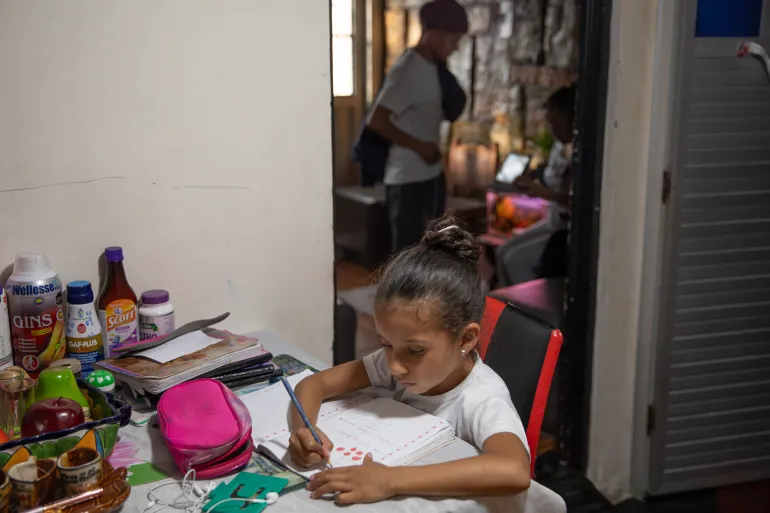
The news froze Jennyfer Ramirez in place. A Facebook post, unassuming at first glance, featured the face of her mother’s ex-boyfriend—and beneath it, a word that shattered her world: femicide. Ramirez was only 17, waiting for her mother, Leidy Navarrete, to arrive at her uncle’s house in southern Bogotá on December 23, 2022. Instead, she learned that her 33-year-old mother had been murdered—strangled by her ex-partner Andres Castro in her apartment, just hours before she was meant to leave for work. Two days before Christmas, Ramirez collapsed from the shock. That moment marked the end of life as she knew it.
Today, Ramirez is one of thousands of young Colombians living as what experts call the “invisible victims” of femicide: the children left behind. Now 19, she is one of three siblings navigating life without their mother, each bearing the emotional and psychological scars of gender-based violence. But a new piece of legislation passed by Colombia’s Congress aims to change their future by formally recognizing and supporting children orphaned by femicide.
The law, awaiting signature from President Gustavo Petro, is part of a growing wave of legislative reform across Latin America, where countries like Argentina, Chile, Brazil, and Ecuador have already implemented similar protections. It guarantees financial support, psychological services, funeral coverage, and extended educational benefits to minors affected by femicide until they turn 18—or 25, if they are pursuing higher education or living with a disability.
“It recognizes that, in the process of femicide, the mother isn’t the only victim,” said Representative Carolina Giraldo, one of the lawmakers behind the bill. The legislation was crafted with testimonies from families who have lived the tragedy firsthand, including those represented by the nonprofit Orphans of Femicide Colombia.
The stakes are urgent. According to the Colombian Observatory of Femicides, at least 1,746 children in the country lost one or both parents to femicide between 2019 and 2024. Across Latin America and the Caribbean, the United Nations estimates that 11 women are murdered each day because of their gender. The ripple effects are vast and enduring. “A femicide doesn’t affect just one part of your life,” said Geraldina Guerra, director of the human rights group Fundación ALDEA. “It affects every part of it.”
For Ramirez, the pain is palpable. “From one moment to another, everything changed,” she said. “I have no stability. I have no purpose.” Her mother, once the anchor of her life, is gone. The holidays are now hollow. Therapy is too expensive, and her father—who drives a cement mixer—is unable to afford the sessions that could help his children cope. “If it weren’t for my two siblings,” she said quietly, “I wouldn’t have a reason to be alive today.”
Her younger sister Luna, now six, witnessed the murder and is perhaps the most deeply affected. After the femicide, Luna went to live with her grandmother, Jacqueline Plata, while Ramirez and her brother Fabian moved in with their father. Luna’s father—Navarrete’s killer—is serving a 31-year prison sentence. Luna remembers everything in chilling detail. Some days, she mourns her mother. Other days, she rails against her father with rage that no child should carry.
While Luna has received limited therapy through her school and Colombia’s public health system, the care has been grossly insufficient. Her sessions were capped at three. That’s why Plata supports the new law. “More than any economic aid, we’re glad to have psychological support for the children,” she said.
Studies show that the aftermath of femicide often results in long-term psychological trauma. A 2019 study from Chile’s Diego Portales University found that 90 percent of children orphaned by femicide experienced symptoms of depression, anxiety, or post-traumatic stress. A 2024 study by Fundación ALDEA and UNICEF in Ecuador revealed that 72 percent of families caring for these children struggled to meet basic needs, including food and medical care. The emotional devastation is matched by financial strain—funeral costs, legal proceedings, and daily survival.
Critics initially pushed for the Colombian bill to be broadened to include children who lost parents to all homicides. But lawmakers chose to keep the focus on femicide, recognizing it as a distinct and particularly devastating form of gender-based violence that demands specific legal and psychological responses.
Once enacted, the law could be a lifeline for families like Ramirez’s. She hopes to enroll in a university to study tourism, a dream she clings to in honor of her mother. “My mother practically made me in her image,” she said. “I learned a lot of things from my mother that now I can offer to others.”
In a country where too many children have inherited grief instead of guidance, the new legislation offers a path forward—not just for healing, but for justice and dignity.