
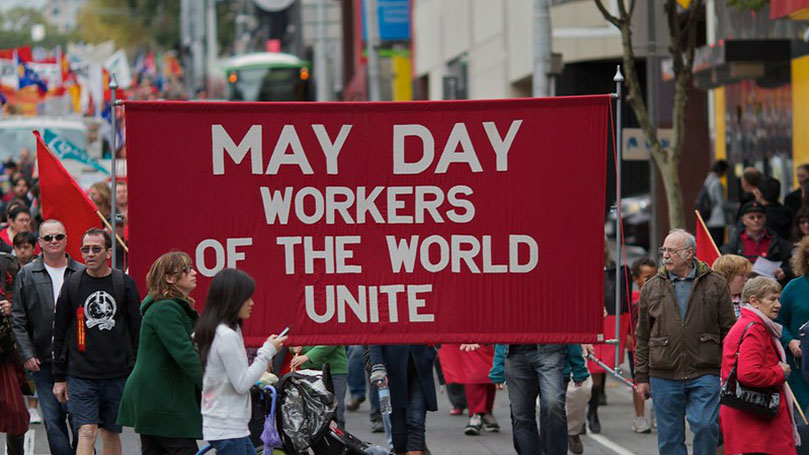
Every year on May 1st, millions across the world take to the streets, gather in factories, and raise their voices in celebration and remembrance of International Labor Day—a day rooted not merely in the call for better working conditions, but in the very heartbeat of communist philosophy and its vision of a classless society built on the dignity of labor. Originating from the Haymarket affair in Chicago in 1886, when workers demanding an eight-hour workday were met with police brutality, May Day has transcended its immediate historical roots to become a powerful symbol of resistance against exploitation, particularly in nations influenced by Marxist and socialist ideologies.
Communist philosophy, particularly as envisioned by Karl Marx and Friedrich Engels, framed the struggle between labor and capital as the central contradiction of capitalist societies. For communists, International Labor Day is not simply a commemoration—it is an affirmation of the historic mission of the working class to overthrow capitalist systems and establish a dictatorship of the proletariat, paving the way to a classless, stateless society. The hammer and sickle, an emblem that once flew high over half the world, is a reminder of this aspiration: the unity of industrial and agricultural workers against bourgeois domination.
In the Soviet Union, May Day became one of the most important national holidays, marked by massive parades through Red Square showcasing not only military might but the supposed strength and unity of the working class. From Cuba to China, from Vietnam to Venezuela, May Day has been used by communist governments as both a celebration and a reaffirmation of ideological commitment to workers’ power, with speeches invoking Marx, Lenin, and revolutionary ideals. It has also served as a means of mobilizing the masses, reinforcing the belief that labor is not just an economic necessity, but a moral force capable of transforming society.
However, beyond the rhetoric and pageantry, the day carries with it a deeply human message: the right of every person to work in conditions of dignity, fairness, and freedom from exploitation. While the dream of a stateless, classless society remains unrealized, the principles of communist labor theory continue to echo in global debates over workers’ rights, unionization, automation, and economic inequality.
In today’s capitalist world, where income disparity has reached staggering levels and labor has been increasingly commodified, May Day offers a moment of pause—a chance to reflect on whether the dignity of work is being preserved or eroded. For many, especially in the Global South and among precarious gig economy workers, the ideals of International Labor Day remain as urgent as ever. In them, the echo of Marx’s declaration rings clear: “Workers of the world, unite. You have nothing to lose but your chains.”
As long as labor remains undervalued and capital continues to dominate, May Day will endure—not only as a holiday, but as a call to action. It is a reminder that the struggle for workers’ rights is inseparable from the larger pursuit of social justice, and that the vision of a world where labor is no longer a commodity, but the foundation of human freedom, remains one worth fighting for.