
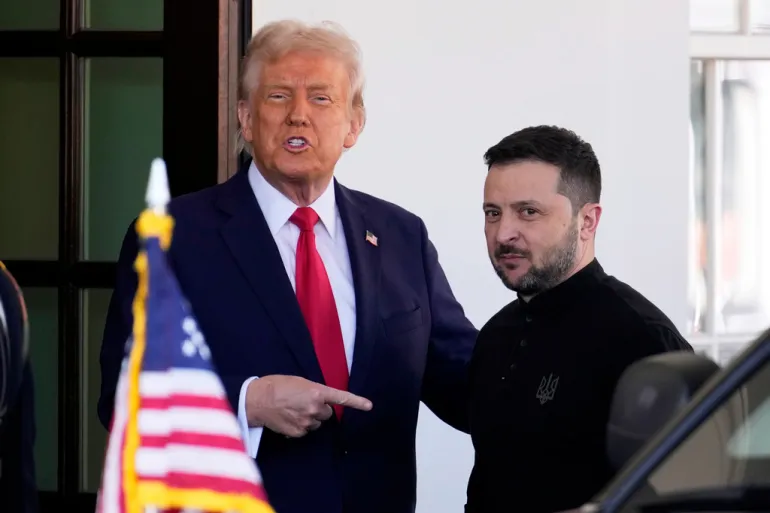
In a move that signals a significant shift in US foreign policy and a renewed economic alliance, the United States and Ukraine have signed a major agreement granting Washington access to Ukraine’s rare mineral reserves while establishing a joint fund to finance the reconstruction of the war-ravaged nation. The deal, finalized in Washington, DC, on Wednesday, follows months of tense negotiations and marks a turning point after diplomatic tensions peaked during a fiery confrontation between US President Donald Trump and Ukrainian President Volodymyr Zelenskyy in February.
The agreement, titled the United States-Ukraine Reconstruction Investment Fund, lays out a framework in which both nations will jointly manage and invest resources toward rebuilding Ukrainian infrastructure. It also secures a strategic stake for the US in Ukraine’s extensive reserves of critical minerals, which are vital for modern technologies including electric vehicles, semiconductors, and defense systems. Ukraine is estimated to possess about 5 percent of the world’s critical mineral reserves, with deposits of 22 of the 34 minerals classified as essential by the European Union.
US Treasury Secretary Scott Bessent, speaking on behalf of the Trump administration, described the pact as a powerful signal to Russia that the United States stands firmly behind a “free, sovereign, and prosperous Ukraine.” He emphasized that no individuals or entities involved in supporting Russia’s war efforts would benefit from Ukraine’s reconstruction process. “President Trump envisioned this partnership between the American people and the Ukrainian people to show both sides’ commitment to lasting peace and prosperity in Ukraine,” Bessent said in a statement.
The Ukrainian Ministry of Economy confirmed that the US would contribute to the fund through direct investment and future military aid, while Ukraine would allocate 50 percent of revenues generated from the exploitation of its natural resources. The fund is to be governed equally by both nations, and all profits will be reinvested exclusively in Ukraine for the first ten years. Following that period, the profits may be shared under terms yet to be detailed. The agreement does not retroactively apply to past US military aid.
Ukrainian Minister of Economy Yulia Svyrydenko praised the deal as a “strategic partnership” that not only brings investment but also strengthens Ukraine’s economic sovereignty. “This agreement is the outcome of extensive negotiations, and I am grateful to both negotiating teams for their professionalism and dedication,” she said. Prime Minister Denys Shmyhal, meanwhile, assured citizens that the agreement would preserve Ukraine’s full control over its subsoil resources, infrastructure, and mineral wealth, adding that the accord would not hinder the country’s aspirations to join the European Union.
Despite the eventual success of the agreement, its path was turbulent. Talks were briefly derailed following a very public and heated exchange between Trump and Zelenskyy on February 28, where conflicting visions on Ukraine’s future reportedly clashed. However, cooler heads prevailed in subsequent weeks, culminating in a deal that both parties now hail as balanced and forward-looking.
Tymofiy Mylovanov, head of the Kyiv School of Economics and former economy minister, called the deal a “major political and diplomatic win” for both countries. Writing on X, he noted that while Trump gains a domestic political victory, Ukraine successfully resisted pressure and retained control over key national interests. “Despite enormous pressure, every overreaching demand from the other side was dropped. The final deal looks fair,” he stated.
Although the agreement must still be ratified by the Ukrainian parliament before it takes effect, it is already being viewed as a possible turning point in Ukraine’s ongoing struggle against Russian aggression. While the deal does not contain explicit security guarantees, US officials have argued that strengthening Ukraine’s economy and embedding US business interests in the country will serve as a deterrent to further Russian incursions.
As the world watches to see how the partnership unfolds, the mineral deal reflects a broader strategy by the Trump administration to combine economic diplomacy with geopolitical positioning. For Ukraine, it represents both a lifeline for recovery and a signal that its future remains deeply entwined with the support of global powers determined to resist authoritarian expansionism.