
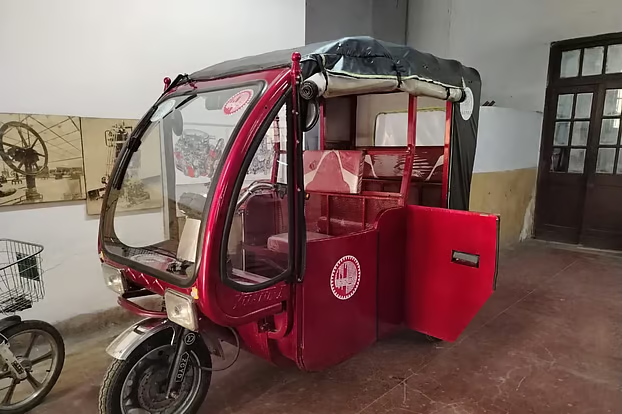
A team from the Department of Mechanical Engineering at Bangladesh University of Engineering and Technology (BUET) has developed a new rickshaw design that promises to be significantly safer than the traditional versions currently in use. Although the production cost of the newly designed rickshaw will be comparable to that of existing battery-powered models, it incorporates critical safety features that are missing from today’s rickshaws. The Dhaka North City Corporation (DNCC) has confirmed it will allow these new models to operate on city streets, phasing out the older rickshaws over time.
Led by Professor Md. Ehsan, a six-member research team began working on the project in 2022, aiming to enhance the safety of rickshaws. Previous attempts to collaborate with the government were unsuccessful, but the need for safer transport has become more urgent, especially with the rising number of unregistered and unregulated battery-run rickshaws that have created major traffic management challenges across Dhaka.
The newly designed rickshaw, resembling a small electric three-wheeler, includes 16 added features addressing the flaws identified in 12 types of currently used battery-powered rickshaws. Along with Professor Ehsan, the team included Professor A Salam Akand and Md. Aman Uddin from the Mechanical Engineering Department, Professor Md. Ziaur Rahman Khan from the Department of Electrical and Electronic Engineering, and research engineers Md. Asaduzzaman and Abdul Aziz Bhuiyan.
According to the team, the rickshaw will be 3.2 meters long, 1.5 meters wide, and 2.1 meters high, with a capacity to carry between 325 to 425 kilograms, allowing a driver to easily transport two passengers. The rickshaw features enhanced braking systems with hydraulic disc brakes on all three wheels and an additional parking brake, providing much greater control and safety compared to existing models.
Safety features also include side mirrors (“looking glass”) and indicators, both absent in current rickshaws, thus reducing accident risks when turning or reversing. A canopy and a glass windshield will protect passengers and drivers from rain, while a permanently mounted headlight with high beam, low beam, and daytime running lamp functions will improve road visibility.
The BUET team estimated the commercial production cost at around BDT 150,000. Private companies like Bivatec, contacted by the researchers, indicated that the battery alone would cost between BDT 50,000 to 60,000, with the rest covering the vehicle’s structure. According to Bivatec’s Managing Director Saidur Rahman, a single battery charge could last approximately 120 kilometers, and batteries would need to be replaced every 18 months, with options for recycling old units.
Speed has been a significant concern with traditional rickshaws, especially when unauthorized modifications increase their speed dangerously. Experts note that traditional pedal rickshaws are structurally safe only for speeds up to 10 km/h, whereas many motorized versions reach 30 km/h without the necessary braking systems. However, BUET’s newly designed rickshaw can safely reach speeds up to 30 km/h, thanks to its robust hydraulic braking system.
Efforts are already underway to introduce these rickshaws on Dhaka’s roads. According to Mohammad Ejaz, Administrator of Dhaka North City Corporation, drivers will require licenses and the rickshaws will be registered. DNCC plans to offer driver training programs soon, after which trained drivers can apply for number plates. The government will also regulate where rickshaws are allowed to operate within Dhaka, preventing them from roaming the entire city freely, and it will fix standard fares for rides.
Regarding the current unregulated battery-powered rickshaws, Mohammad Ejaz said DNCC would proceed slowly but surely to remove them from the streets, signaling a gradual but definite transition to a safer, better-managed urban transport system.