
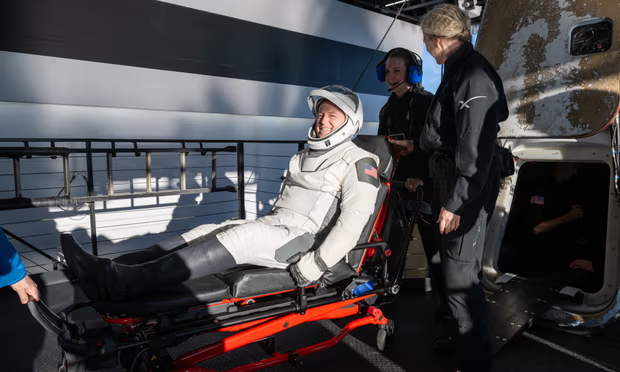
Two NASA astronauts who had been unexpectedly stuck onboard the International Space Station (ISS) since June 2024 finally returned to Earth on Tuesday evening, marking the end of a prolonged and unforeseen stay in space. Sunita Williams and Barry “Butch” Wilmore, originally meant to spend only a short duration evaluating Boeing’s Starliner capsule, landed safely in the Gulf of Mexico alongside fellow astronauts Nicholas Hague and Russian cosmonaut Aleksandr Gorbunov after a 17-hour descent aboard a SpaceX Dragon capsule.
The crew’s dramatic return took place at 5:57 p.m. ET (9:57 p.m. GMT), as the spacecraft slowed from an intense 17,000 mph re-entry into Earth’s atmosphere before gliding under four parachutes and splashing down into the calm waters off Tallahassee. NASA mission control welcomed them home, and a pod of dolphins even made an unexpected appearance around the capsule, adding a surreal touch to the moment. “What a ride. I see a capsule full of grins, ear to ear,” Hague radioed back as the crew prepared for recovery.
Williams and Wilmore’s nine-month ordeal began when their Starliner capsule, Boeing’s first crewed mission, encountered significant technical issues, forcing NASA to return it to Earth empty in September. The duo, originally scheduled for a 10-day evaluation mission, were instead incorporated into the ISS crew to replace astronauts who had been reassigned to other missions. Their extended stay became a topic of political debate, with SpaceX CEO Elon Musk and former President Donald Trump making claims about their “abandonment” in orbit, assertions that the astronauts themselves tried to downplay.
Their return journey started when the SpaceX Dragon capsule, aptly named “Freedom,” undocked from the ISS at 1:05 a.m. ET on Monday. The four astronauts spent their final moments onboard the station laughing, hugging colleagues, and posing for farewell photos before sealing themselves into the capsule for pre-flight checks. As the spacecraft pulled away from the ISS, NASA’s Anne McClain bid them farewell, wishing them a smooth journey home.
Following the splashdown, the capsule was hoisted onto a recovery vessel, where the astronauts underwent medical evaluations as part of standard post-flight procedures. Hague was the first to emerge, waving and smiling, followed by Gorbunov, Williams, and Wilmore. Williams, now the second-most experienced American astronaut in terms of cumulative space days at 608, flashed a thumbs-up as she was helped from the capsule. Only Peggy Whitson, a former NASA astronaut, has spent more total days in space, with 675.
Their extended mission had not only tested their endurance but also became entangled in political rhetoric. Musk insisted that the Biden administration had ignored an offer to bring them home earlier, a claim Wilmore later confirmed was “absolutely factual” while admitting that he lacked detailed knowledge of the decision-making process. Nonetheless, in February, Wilmore sought to shift the narrative, emphasizing that they felt neither “abandoned” nor “stranded” but rather “prepared and committed.”
The situation also fueled tensions between Musk and the international astronaut community, including Danish astronaut Andreas Mogensen, who criticized Musk’s claims as misleading. This led to a heated exchange, with Musk launching personal attacks against Mogensen and even Senator Mark Kelly, himself a former astronaut, for his support of Ukraine. The feud escalated as Kelly responded by publicly cutting ties with Tesla, another Musk-owned company, citing concerns over Musk’s political stance and funding decisions.
Meanwhile, the future of Boeing’s Starliner program remains uncertain, with engineers continuing to investigate its thruster issues and helium leaks at the White Sands facility in New Mexico. Reports suggest that the spacecraft may not be cleared for flight again until 2026, a significant setback for Boeing in NASA’s commercial crew program. Despite this, the company remains optimistic about Starliner’s potential, working towards regaining flight certification and proving its viability as a competitor to SpaceX’s Dragon capsules.
As the astronauts now recover from their prolonged stay in space, their resilience and professionalism stand as a testament to human endurance and adaptability. Their unexpected odyssey, filled with political drama and technical challenges, has reshaped conversations about space travel and commercial partnerships, leaving the world watching what comes next for both NASA and its private sector collaborators.