
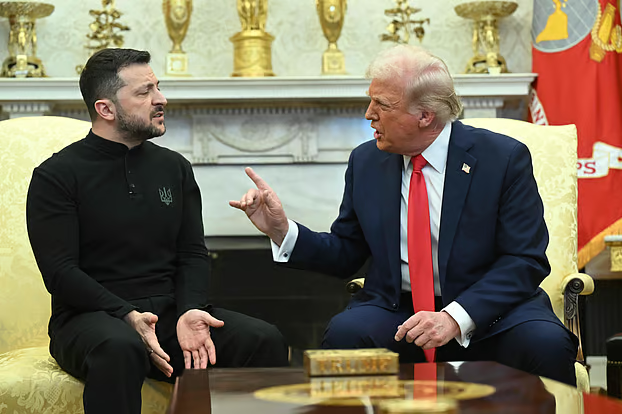
U.S. President Donald Trump and Ukrainian President Volodymyr Zelensky have engaged in a heated exchange over NATO commitments and U.S. military aid to Ukraine. The dispute erupted following Trump’s recent statements questioning America’s financial and military support for Ukraine, sparking concern among U.S. allies and prompting a sharp response from Zelensky.
Trump’s Controversial Comments
During a rally in South Carolina over the weekend, Trump stated that if re-elected, he would reconsider U.S. commitments to Ukraine and suggested that NATO allies should bear a greater financial burden. His remarks implied that Ukraine could no longer rely on automatic U.S. backing, triggering a wave of reactions both domestically and internationally.
“I would tell our NATO allies that they need to pay their fair share, and as for Ukraine, we cannot continue writing blank checks without accountability,” Trump said, hinting at a major shift in U.S. foreign policy should he return to office.
Zelensky’s Response: ‘A Matter of Global Security’
Ukrainian President Volodymyr Zelensky, in an urgent address from Kyiv, condemned Trump’s remarks, calling them dangerous not only for Ukraine but for the stability of the entire Western alliance.
“If the United States wavers in its support, it is not just Ukraine that will suffer, but the entire democratic world,” Zelensky said. “We have been fighting for freedom, for our people, and against an aggressor that threatens global security.”
NATO Allies Express Concern
European leaders quickly reacted to the dispute, emphasizing the importance of continued U.S. support. NATO Secretary-General Jens Stoltenberg expressed concern over any shift in America’s commitment, warning that weakening support for Ukraine could embolden Russian aggression.
German Chancellor Olaf Scholz and French President Emmanuel Macron both reaffirmed their nations’ dedication to Ukraine, urging Washington to maintain bipartisan support for Kyiv.
Republican and Democratic Reactions
Trump’s statements have caused division within the U.S. political landscape. While many Republican lawmakers aligned with Trump’s “America First” stance, some members of the party expressed concerns about abandoning Ukraine. Senate Minority Leader Mitch McConnell reiterated the strategic necessity of supporting Ukraine, stating, “This is not just about Ukraine—it’s about preventing further Russian aggression.”
On the Democratic side, President Joe Biden denounced Trump’s rhetoric, calling it “reckless and short-sighted.” Biden reaffirmed his administration’s unwavering support for Ukraine, stating, “America does not turn its back on its allies.”
What’s Next?
The Trump-Zelensky clash has raised fresh uncertainties regarding the future of U.S.-Ukraine relations. With the 2024 U.S. presidential election results shaping the next phase of American foreign policy, Ukraine’s defense strategy and NATO’s stability hang in the balance.
As tensions escalate, the world watches closely to see whether Trump’s rhetoric will translate into real policy changes should he return to office—or whether bipartisan efforts will continue to uphold America’s longstanding commitments to Ukraine and NATO.