
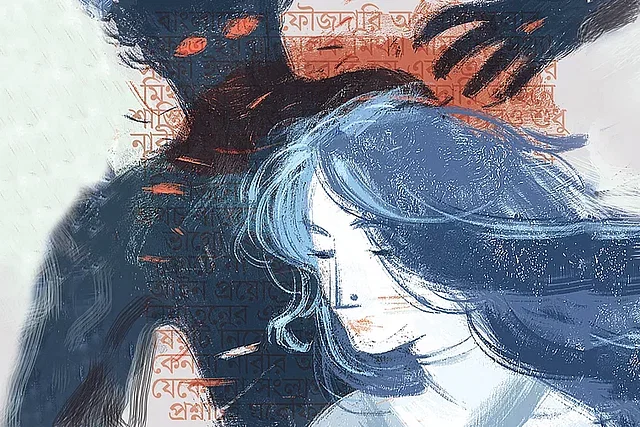
Despite the political upheaval resulting in the fall of the Sheikh Hasina government on August 5 and the subsequent formation of an interim government with Dr. Muhammad Yunus as the Chief Advisor on August 8, the situation of violence against women and children in Bangladesh remains grim and unchanged.
In a recent and horrifying incident, two young women, aged 21 and 22, one a garment worker and the other a beauty parlor employee, were abducted and gang-raped by six men in South Keraniganj’s West Dee Road on August 9. While one escaped during the night and revealed the ordeal to local students, who rescued the other woman the following morning.
Another case saw a 65-year-old woman who came to Dhaka hoping for aid, become a victim of gang rape on September 7. She was found in a critical condition at Suhrawardy Udyan by Shahbagh police following a 999 emergency call.
Despite the change in governance, the plight of women and children as reflected in the monthly criminal case statistics remains dire and unchanged. The victims, currently undergoing treatment at the One Stop Crisis Center (OCC) of Dhaka Medical College, bear testimony to the ongoing brutality. The elderly woman has been discharged and taken home by her son, while the two young women are in contact with the police for their ongoing case.
Data from the Police Headquarters indicate that from January to September this year, there have been a total of 12,769 cases under various sections of the Women and Child Repression Prevention Act, 2000, with half of these being cases of rape or attempted rape. Other cases include dowry-related violence, acid attacks, kidnappings, and confinement of children.
Violence against women and children is a manifestation of the erosion of social fabric – a decline in mutual respect, tolerance, and family ties, which has not seen any sign of improvement even with political changes. According to Professor Muhammad Umar Farooq, chairman of the Department of Criminology and Police Science at Maulana Bhasani Science and Technology University, “The persistence of these crimes reflects deep-rooted societal issues that a simple change in political leadership cannot quickly resolve.”
The interim government has been urged to take significant measures to restore faith in the judicial process for victims seeking justice and to ensure quicker and more effective legal proceedings. Furthermore, it has been suggested that strengthening community ties and enhancing the societal view towards women could play a pivotal role in changing the current scenario.
As Bangladesh continues to grapple with these deeply entrenched issues, the formation of a ‘Rapid Response Team’ involving administration, police, lawyers, counselors, and the youth is in the pipeline, aimed at combating the high rates of violence more effectively.