
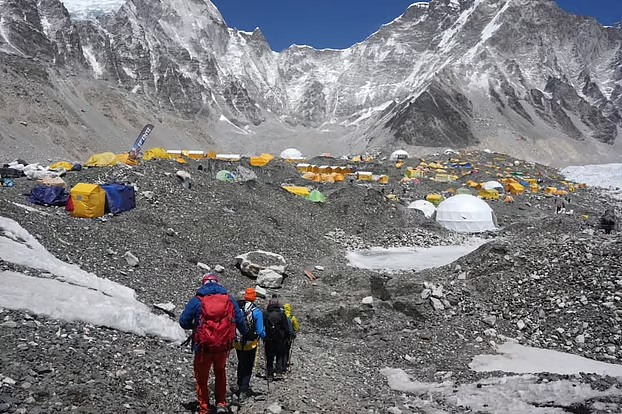
The melting of glaciers around Mount Everest has long been associated with rising global temperatures and climate change. But a new study has identified an unexpected additional source of heat: the thousands of people who gather every climbing season at Everest Base Camp.
Researchers say fuel burned at the camp, along with human urine discarded directly onto the Khumbu Glacier, could contribute to the melting of an estimated 2,500 tonnes of snow and ice each year.
The findings come at a time when the vulnerability of Himalayan glaciers is drawing renewed attention following a devastating glacial disaster along the Nepal–China border on August 26. A sudden mountain flood and mudflow reportedly killed more than 1,000 people, while more than 5,000 others remained missing. The disaster has once again highlighted the potentially deadly consequences of a rapidly changing Himalayan environment.
The international research team studied the environmental impact of human activity at Everest Base Camp, which sits on the Khumbu Glacier on the Nepalese side of Mount Everest. Their findings were published in the journal Regional Environmental Change.
During the 50-day spring climbing season in 2023, around 1,600 tents were operating at the base camp. Researchers found that climbers, guides and support staff consumed 824 liquefied petroleum gas cylinders, 18,935 litres of kerosene and 5,130 litres of petrol for cooking, heating tents and generating electricity.
The camp is far more than a temporary collection of mountaineering tents. During peak season, it becomes a densely populated high-altitude settlement equipped with cafés serving espresso, large television screens, high-speed internet, hot showers and even systems designed to keep tent floors warm.
All of these activities generate heat in an environment where the surrounding glacier is already under pressure from a warming climate.
According to the researchers’ calculations, the energy generated through fuel consumption and human activity at the camp amounted to approximately 849,174 megajoules. That amount of energy is theoretically sufficient to melt around 2,492 tonnes of snow and ice. Accounting for the study’s margin of error, the estimated figure ranges from roughly 1,964 to 3,020 tonnes.
One of the study’s most unusual findings concerns urine.
At extreme altitude, climbers and guides drink large quantities of water to reduce the risk of dehydration. As a result, the base camp produces an estimated 6,000 litres of urine every day during the climbing season.
Unlike solid waste, which is collected and transported down the mountain, much of the urine is reportedly discharged directly onto the glacier. Researchers calculated that the heat associated with urine alone could contribute to the melting of approximately 154 tonnes of ice during a single climbing season.
The volume of urine produced is enormous. Around 6,000 litres a day would be enough to fill an Olympic-sized swimming pool over time, or the equivalent of approximately 83 tanker trucks or 16,700 ordinary bathtubs.
The researchers stressed, however, that these human activities are not the principal reason Everest’s glaciers are shrinking. Climate change remains the dominant driver of glacier melt. Their findings instead demonstrate how concentrated human activity can add another layer of pressure to an already fragile environment.
Satellite observations reinforce the evidence of a warming trend around Everest Base Camp. By examining Landsat satellite imagery from 1991 to 2023, the researchers found that temperatures in the base-camp area increased by an average of 0.28 degrees Celsius per year. The warming rate recorded around the base camp was approximately twice the rate observed in the surrounding areas of the Khumbu Glacier.
The actual human impact could be even greater than the study’s estimate.
Researchers, including senior surveyor Kim Lal Gautam of Nepal’s Department of Land Management, noted that their calculations did not account for every source of heat generated by human activity. Heat produced by helicopter operations, the bodies of climbers and workers, and yaks used to transport equipment was not included in the assessment.
The findings raise a broader question about the sustainability of mass tourism and mountaineering on one of the world’s most vulnerable glaciers. Everest attracts thousands of climbers, guides, porters and other workers each year, concentrating a substantial human population in an extremely sensitive high-altitude environment.
For decades, the world’s attention has focused on the role of greenhouse-gas emissions and global warming in the retreat of Himalayan glaciers. The new research does not challenge that conclusion. Instead, it offers a more localized warning: when thousands of people gather repeatedly on a rapidly melting glacier, their collective activities can also have a measurable environmental impact.
The researchers therefore argue that continuing to concentrate thousands of people on a glacier that is already melting rapidly may not be sustainable in the long term.
Everest may remain one of humanity’s greatest symbols of exploration and adventure, but the glacier beneath its base camp is increasingly revealing the environmental cost of that fascination.
A news by Alisha Pradhan, General Secretary, HerNet Foundation