
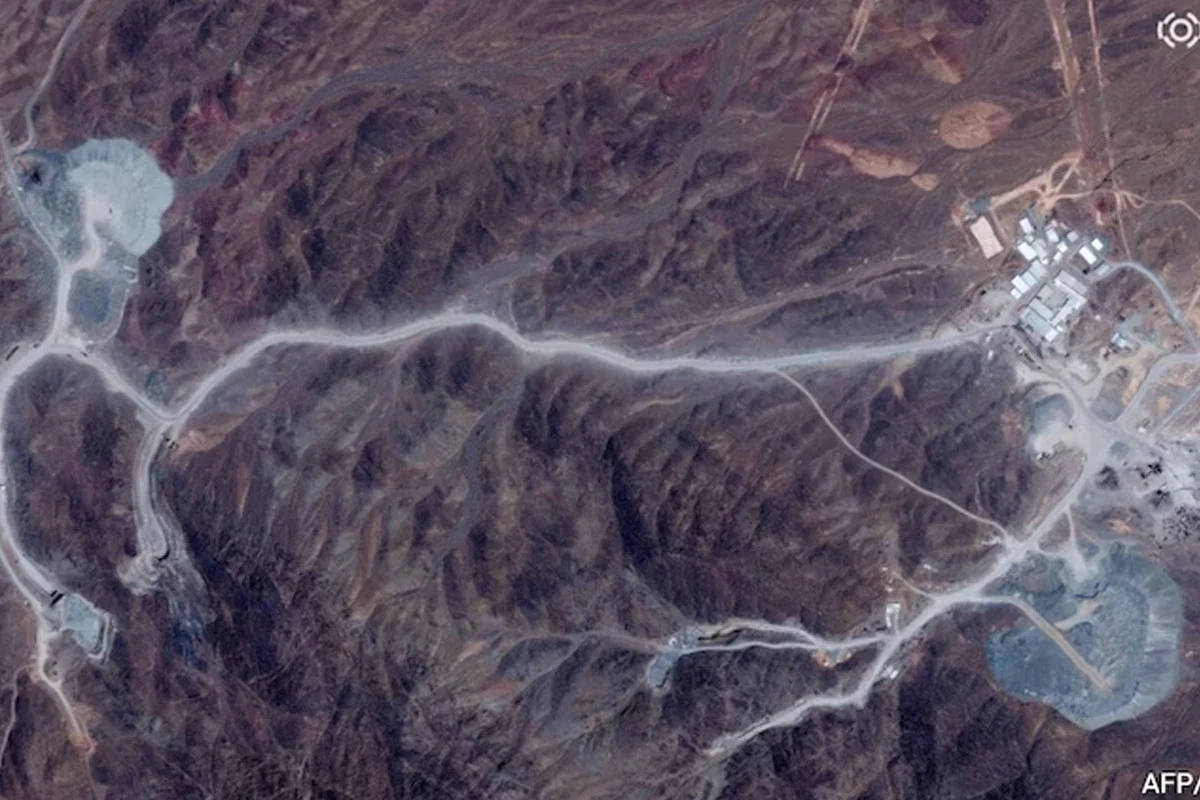
Fresh satellite imagery of a heavily fortified site near Iran’s Natanz nuclear complex has renewed questions over whether Tehran is developing a new underground facility capable of supporting its nuclear programme.
The site, known as Pickaxe Mountain, or Kuh-e Kolang Gaz La, lies roughly 140 miles south of Tehran and close to the Natanz nuclear complex. An analysis of satellite imagery covering six years suggests that construction activity at the site has intensified dramatically in 2026, according to researchers at the Washington-based Center for Strategic and International Studies (CSIS).
The development has attracted international attention because of the location and the apparent effort to reinforce the mountain and its underground infrastructure. However, the available imagery does not establish what Iran is actually building inside the mountain, leaving the precise purpose of the facility uncertain.
CSIS researchers examined satellite images taken between 2020 and August 2026. Their analysis identified three distinct phases of activity around five major access points and road networks surrounding Pickaxe Mountain.
According to the researchers, the site appears to have moved beyond its initial tunnel-excavation phase. Construction now seems increasingly focused on developing internal infrastructure and strengthening the facility’s external security.
Satellite imagery shows an unprecedented level of road construction and vehicle activity around the mountain during 2026. Researchers have also observed reinforced and elevated tunnel entrances, newly paved internal roads, stronger security measures around key access points and extensive earth-moving operations.
Taken together, these developments suggest that Iran is transforming the site into a more sophisticated and secure underground complex.
The findings are particularly significant because Israeli intelligence agencies have previously claimed that Iran moved uranium-enrichment centrifuges and related equipment to Pickaxe Mountain last autumn.
CSIS analysts, however, said satellite imagery alone could neither confirm nor disprove that Israeli claim. Their assessment instead suggested that the facility may not yet be fully equipped for uranium enrichment, based on the continuing construction and the apparent absence of infrastructure that would be expected at a fully operational enrichment site.
Iranian President Masoud Pezeshkian has also questioned whether satellite imagery can reveal what is actually happening deep beneath the mountain. In September last year, he reportedly called for inspections by the International Atomic Energy Agency (IAEA) to establish the site’s purpose.
In practice, however, international nuclear inspectors have not subsequently been granted the access necessary to independently verify what lies beneath Pickaxe Mountain.
The mountain’s strategic significance is partly linked to the history of Iran’s nuclear infrastructure. After an above-ground centrifuge assembly facility at Natanz was damaged in 2020, Ali Akbar Salehi, who was then one of the leading figures in Iran’s nuclear programme, announced plans to establish a new underground facility.
One possibility is that Pickaxe Mountain is the underground replacement or expansion of such a facility.
Another scenario is that Iran could eventually use the mountain to establish a uranium-enrichment operation capable of processing its existing stockpile of highly enriched uranium to even higher levels. The source report notes that Iran has been assessed as holding around 440 kilograms of uranium enriched to 60 percent.
A further possibility is that the underground complex is intended to protect or restore nuclear research and chemical-conversion capabilities damaged during US and Israeli strikes on Iranian nuclear-related facilities in June 2025.
The site’s location presents a formidable challenge to any attempt to destroy it from the air. Buried deep beneath granite rock, the facility is believed to be sufficiently protected that even the United States’ most powerful conventional bunker-busting weapon, the GBU-57 Massive Ordnance Penetrator, could face difficulties in reaching or destroying its most deeply buried sections.
That does not, however, establish that the facility is designed for nuclear weapons production. The same underground characteristics that make a site difficult to attack can also be useful for protecting conventional nuclear research, enrichment infrastructure, equipment and personnel.
The central question therefore remains unanswered: what exactly is Iran constructing beneath Pickaxe Mountain?
The latest satellite evidence points to an increasingly fortified underground installation, but imagery cannot reveal the full nature of the equipment inside the mountain. Without direct inspection, outside observers cannot conclusively determine whether the site is intended for uranium enrichment, centrifuge production, nuclear research, the relocation of damaged capabilities—or some combination of these activities.
The development nevertheless underscores the growing difficulty of monitoring Iran’s nuclear programme. As more of its infrastructure moves underground and behind increasingly hardened security measures, satellite imagery can reveal construction patterns and changes on the surface, but it cannot provide a complete picture of what is taking place beneath the ground.
For now, Pickaxe Mountain remains one of the most closely watched and least understood sites in Iran’s nuclear landscape.
A news by Alisha Pradhan, General Secretary, HerNet Foundation