
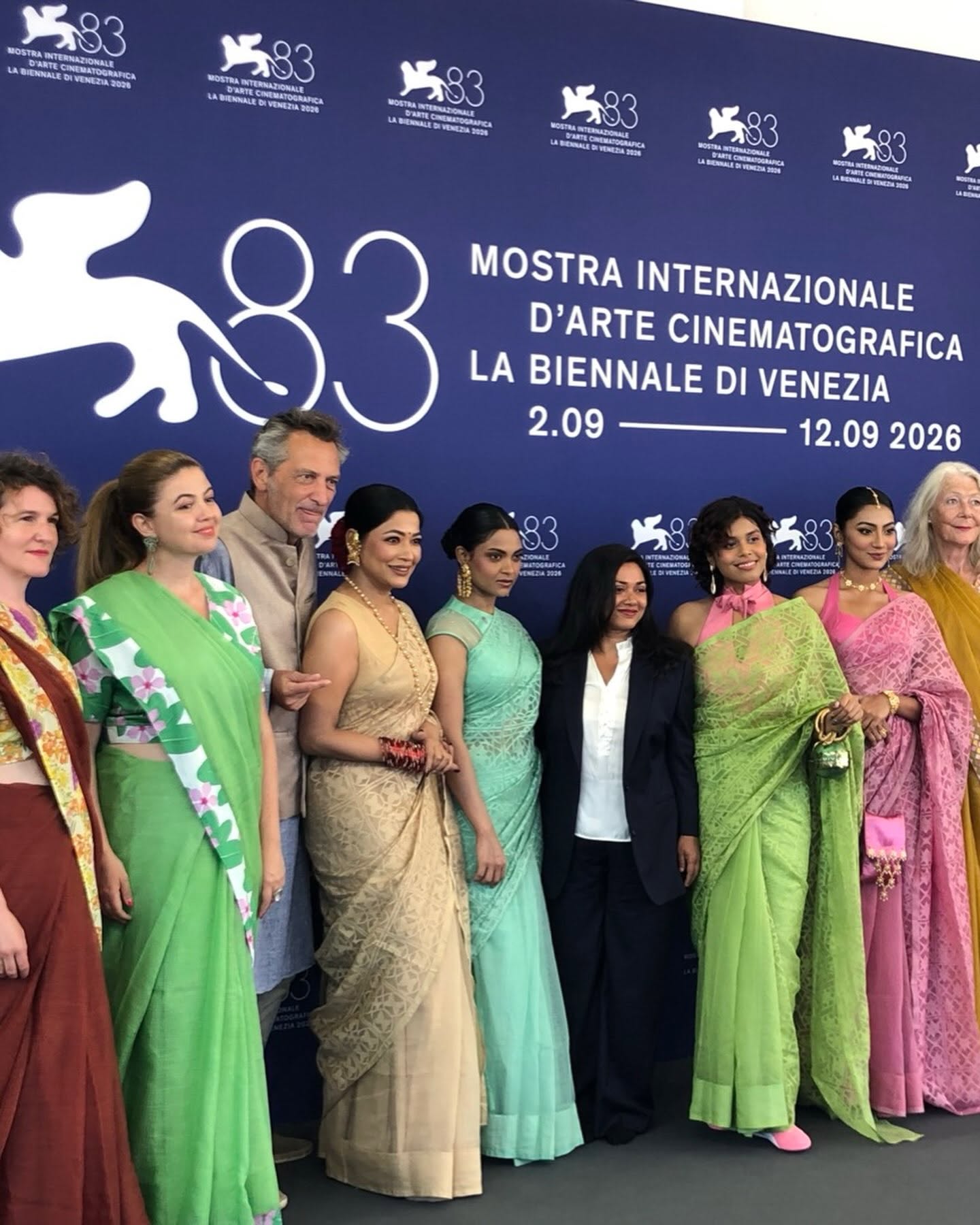
A significant new chapter in Bangladeshi cinema unfolded on Sunday as Rubaiyat Hossain’s The Difficult Bride received its world premiere at the 83rd Venice International Film Festival, marking the first time a feature-length film from Bangladesh has entered the festival’s prestigious Orizzonti Competition.
The film was officially screened at Sala Darsena on September 6, bringing a distinctly Bangladeshi story, language and visual identity to one of the world’s most celebrated film platforms. The film is a France-Bangladesh-Portugal-Norway-Germany co-production and runs for approximately 88 minutes.


A milestone for Bangladeshi cinema
Directed and written by Rubaiyat Hossain, The Difficult Bride represents a landmark moment for Bangladesh on the international festival circuit. Hossain, whose previous films include Meherjaan, Under Construction and Made in Bangladesh, has once again placed women’s experiences and social expectations at the centre of her filmmaking. The Difficult Bride is her fourth feature film and her Venice debut.
The film follows Zaineen, a young woman in Dhaka preparing for marriage. What initially appears to be a conventional journey toward a wedding gradually becomes increasingly unsettling as beauty rituals, family expectations, social pressures and unexplained physical and psychological experiences begin to overwhelm her.
According to the film’s official synopsis, Zaineen’s body begins to react unexpectedly as she navigates beauty rituals and preparations for marriage. Home remedies, social expectations and haunting visions transform the process into a struggle against the pressures imposed upon her.
Rather than presenting marriage simply as a romantic or celebratory institution, Hossain uses the experience to examine the ways in which women’s bodies, appearances, desires and choices can become subject to social control.
A distinctly Bangladeshi story on an international stage
Although the film is an international co-production, Bangladesh remains at the heart of The Difficult Bride. The film is presented in Bengali and English, with its story rooted in Dhaka and in the social and cultural realities surrounding womanhood in Bangladesh.
The production brings together Bangladeshi and international filmmakers. Production companies include Khona Talkies, led by Rubaiyat Hossain and Aadnan Imtiaz Ahmed, alongside France’s Les Films de l’Après-Midi, Portugal’s Midas Filmes, Norway’s Barentsfilm and Tandem Production.
The cast features Zaineen Chowdhury Karim, Rikita Nondine Shimu, Sunerah Binte Kamal, Azmeri Haque, Dameer Khan, Saberi Alam, Shatabdi Wadud and Mohammed Bari.
Behind the camera, the film brings together an international creative team, including cinematographer Leonor Teles, editor Raphaëlle Martin-Hölger, production designer and costume designer Jonaki Bhattacharya, composer Jim Williams, sound designer Marie-Clotilde Chery and visual-effects artist Arnaud Chelet.
From an urban legend to a feature film
The story’s journey to Venice has been a long one. Hossain has said that The Difficult Bride began as a short-film idea in 2006 and evolved over nearly two decades before becoming the feature presented at Venice.
The director has described the project as deeply connected to her understanding of how women’s bodies and movements are observed, regulated and judged in Bangladesh. The film combines social realism with dreams, ghosts, urban myths and intuition, creating a cinematic world in which reality and psychological experience constantly overlap.
That fusion of the everyday and the supernatural gives The Difficult Bride a distinctive voice. Beneath its wedding rituals, beauty treatments and family gatherings lies a larger question: how much freedom does a woman have to define herself when society has already defined what she is expected to be?
A celebration of Bangladeshi culture in Venice
The film’s historic premiere was also accompanied by a strong visual celebration of Bangladeshi identity.
Members of the film’s international and Bangladeshi team appeared in colourful sarees on the Lido di Venezia, creating a striking presence against the blue Venice Film Festival backdrop.
One of the attendees described the day as an unforgettable experience that lasted almost 20 hours, calling it a day filled with “beautiful emotions and experiences.” She also highlighted the significance of wearing a specially created green saree for the occasion.
The sarees were conceived by Rubaiyat Hossain, who wanted members of the team to carry a shared expression of Bangladeshi colour and culture to Venice. The vibrant sarees became a visual statement of identity, turning the festival appearance into more than a conventional red-carpet moment.
The team also expressed gratitude to French producer François d’Artemare, whose Les Films de l’Après-Midi is among the film’s production partners, for helping make the occasion special for the large international team.
More than a festival appearance
The Venice selection comes at a particularly important moment for Bangladeshi cinema. For decades, filmmakers from Bangladesh have sought greater representation at major international festivals, often carrying stories of the country’s history, politics, society, gender and everyday life to audiences beyond South Asia.
The Difficult Bride takes that journey in a different direction. Its central conflict is intimate rather than political: a woman preparing to become a bride. Yet through that personal experience, the film opens a wider conversation about femininity, beauty, marriage, bodily autonomy and the expectations placed on women.
The film’s selection also follows Hossain’s growing international reputation. Her 2019 film Made in Bangladesh, which focused on garment workers fighting for unionisation, was presented internationally and went on to receive recognition at the Torino Film Festival.
With The Difficult Bride, she now brings a distinctly Bangladeshi feminist perspective into the competitive landscape of Venice.
Bangladesh takes its place on the Venice screen
The historic screening on September 6 therefore represents more than the premiere of one film. It is a moment of international recognition for Bangladesh’s filmmaking community and for stories rooted in the country’s own social and cultural landscape.
At Venice, The Difficult Bride arrived not simply as an international co-production, but as a film carrying Bangla language, Bangladeshi characters, Dhaka’s atmosphere and a deeply local conversation about women to one of the world’s most prestigious cinematic stages.
For Bangladeshi cinema, the significance is difficult to overstate.
After years of filmmaking, rewriting and production, Rubaiyat Hossain’s The Difficult Bride has finally reached Venice — and with it, a piece of contemporary Bangladesh has reached one of the world’s most important film festivals.
A news by Alisha Pradhan, General Secretary, HerNet Foundation