
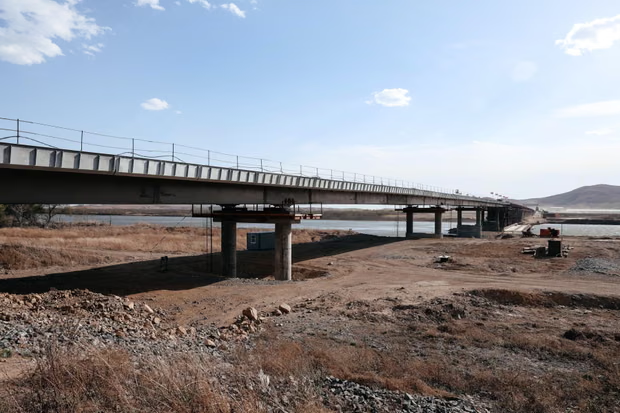
Russia and North Korea have opened their first-ever road bridge connecting the two countries, marking a significant new development in their increasingly close relationship and further strengthening a partnership that has expanded rapidly since the beginning of Russia’s full-scale war in Ukraine.
The approximately one-kilometre crossing stretches over the Tumen River, linking Khasan in Russia’s Far East with Tumangang in North Korea. Located in a remote area near the countries’ Pacific coastline, the new bridge creates the first direct road connection between the two neighbours and adds another layer to their growing transport and economic links.
The bridge was formally inaugurated on Monday during a ceremony attended virtually by Russian Prime Minister Mikhail Mishustin. Addressing the event, Mishustin described the new infrastructure as an important opportunity to expand cooperation between Moscow and Pyongyang across multiple sectors.
He said the new crossing could contribute to regional development, encourage tourism and generate employment, while also strengthening trade and broader economic, scientific, technological and cultural exchanges between the two countries.
Following the ceremony, vehicles from both Russia and North Korea crossed the newly completed bridge, symbolically beginning a new chapter in cross-border transportation between the two countries.
The bridge has been named after Yakov Novichenko, a Soviet officer who is credited with saving North Korea’s founding leader, Kim Il-sung, from an assassination attempt by a pro-South Korean group. Its name reflects the long historical relationship between Moscow and Pyongyang, even as the two countries have entered a much more strategically significant partnership in recent years.
Russia and North Korea were already connected by a railway bridge across the Tumen River, known as the Friendship Bridge. The new road crossing therefore expands an existing transportation link and provides an additional route for movement between the two countries. Regular flights also operate between Vladivostok and Pyongyang.
However, the opening of the bridge has attracted attention well beyond its potential economic benefits. Ukrainian human rights organisations have raised concerns that the new route could eventually serve military and logistical purposes, particularly given the depth of Russia and North Korea’s cooperation since the Ukraine war began.
Ukrainian human rights organisation Truth Hounds has suggested that the crossing could become a logistical corridor through which North Korean troops, construction personnel and military officials could travel into Russia. In the opposite direction, Russian technology and resources could potentially move into North Korea through a route that may be more difficult to monitor.
Such concerns are rooted in the increasingly extensive military relationship between Moscow and Pyongyang. Since Russia launched its full-scale invasion of Ukraine in 2022, North Korea has emerged as one of Moscow’s most important international partners. North Korea has supplied Russia with military equipment and ammunition and has also sent thousands of troops to Russia’s Kursk region, where they have reportedly assisted Russian forces in responding to a Ukrainian military incursion.
The relationship has increasingly developed into an exchange of military capabilities. According to South Korean intelligence, Russia is believed to have provided North Korea with air-defence missiles, electronic warfare systems, drones and technology connected to reconnaissance satellites.
The strengthening relationship has also extended into tourism and civilian exchanges. North Korea reopened parts of the country to Russian tourists in 2024, and Russian visitors have subsequently travelled to newly promoted North Korean destinations, including beach resorts and ski facilities. Officials in both countries have presented tourism as an area with potential for further expansion.
Yet the increasingly visible partnership between Moscow and Pyongyang has also generated debate inside Russia. The country’s growing reliance on North Korea and Iran has prompted questions about the direction of Russian foreign policy and the shrinking circle of countries prepared to maintain close relations with Moscow.
During an interview with Russian broadcaster RBC last month, Foreign Minister Sergei Lavrov was asked how Russia had reached a situation in which North Korea and Iran were described as its two principal allies. Lavrov rejected the implication that Russia should be concerned about such partnerships, arguing that there was nothing inherently problematic about the countries with which Moscow now maintains close relations.
At the same time, Russia’s traditional partners have increasingly expressed concern about the continuing war in Ukraine and its wider consequences. Kazakhstan, a longstanding Russian ally, has been among the countries signalling unease over the conflict.
During a meeting in July, Kazakh President Kassym-Jomart Tokayev told Russian President Vladimir Putin that leaders from a number of countries were questioning why the war was continuing. Tokayev also acknowledged that the nature and direction of the conflict remained unclear to many, including Kazakhstan.
Against this backdrop, the opening of the Tumen River road bridge carries significance beyond its physical structure. It represents another tangible link between two governments whose strategic relationship has grown considerably during a period of increasing international isolation for both countries.
While Moscow presents the bridge primarily as a tool for economic development, tourism and cross-border cooperation, its location and timing have inevitably raised questions about its potential strategic and logistical importance. The new road connection gives Russia and North Korea another channel through which people, goods and potentially resources can move across their border.
For both countries, the bridge is therefore more than a new piece of infrastructure. It is a visible symbol of a partnership that has evolved from a historic relationship into a broader strategic alignment, with consequences extending from trade and tourism to military cooperation and regional security.
As Russia continues to face pressure over the war in Ukraine and North Korea remains heavily isolated from much of the international community, their expanding cooperation suggests that the Tumen River may increasingly become a physical and strategic gateway between two governments seeking closer ties in a rapidly changing geopolitical landscape.
A news by Alisha Pradhan, General Secretary, HerNet Foundation