
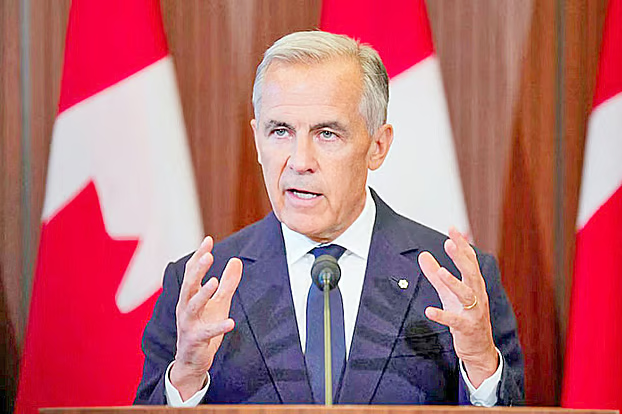
Canadian Prime Minister Mark Carney’s warning at the World Economic Forum in Davos earlier this year continues to resonate amid growing tensions between major powers. His message was straightforward: middle powers must work together if they are to protect themselves from pressure and coercion by stronger states.
Canada has increasingly tried to put that principle into practice. When US President Donald Trump threatened to take control of Greenland, an autonomous territory of Denmark, Ottawa stood alongside its European allies. Canada has also continued providing military and financial support to Ukraine and remains a member of NATO, whose central purpose includes protecting Europe against external aggression. In addition, Canada has joined the European Union’s SAFE initiative for joint defence procurement.
Yet while Canada has demonstrated solidarity with Europe on security issues, it is now facing a major economic confrontation with the United States. Washington has launched new trade measures against its northern neighbour, and European capitals have largely remained quiet.
That silence is difficult to justify.
Canada has traditionally been one of the United States’ closest economic partners. But the Trump administration has repeatedly questioned the country’s political and economic independence, with Trump even suggesting that Canada should become the 51st US state. Rather than formally annexing the country, his administration has pursued policies designed to increase American economic leverage over Canadian industries.
Among the most serious measures is a threatened 50 percent tariff on Canadian automobiles, trucks and auto parts, reportedly scheduled to take effect from January 1. Washington has also imposed additional punitive tariffs affecting around $20 billion worth of Canadian exports.
The broader objective appears to be making Canada increasingly dependent on the US economy while discouraging Ottawa from developing stronger commercial relationships elsewhere. Trump has also threatened further tariffs if Canada expands alternative trade arrangements with partners such as the European Union.
Canada is particularly vulnerable to such pressure because of the structure of its economy. Around 70 percent of its exports are destined for the United States. A prolonged trade confrontation could therefore have consequences that Ottawa would find difficult to absorb on its own.
This is precisely where Europe has an opportunity—and a responsibility.
The European Union should offer Canada a deeper economic, political and strategic partnership. Rather than simply expressing diplomatic solidarity, Europe should present itself as a credible alternative to excessive dependence on the United States.
One immediate step would be to explore a broader tariff-free trading arrangement between the EU and Canada. Such an initiative would have economic benefits for both sides, but its political significance could be even greater. It would demonstrate that countries facing pressure from larger powers do not have to respond individually.
The two sides could also deepen cooperation on Arctic security, energy and critical minerals. Canada has the potential to become an important alternative supplier of liquefied natural gas and critical minerals, including rare earth elements, reducing Europe’s dependence on more vulnerable supply chains.
For Europe, such cooperation would serve both economic and strategic interests.
The first obstacle, however, is political timidity.
Despite repeated evidence that confrontation with Trump can sometimes produce concessions when countries demonstrate a willingness to resist pressure, European leaders have often appeared reluctant to take firm positions. Trump, however, has shown little reason to believe that cautious accommodation will necessarily protect countries from his demands.
If middle powers coordinate their responses, they gain more options and greater bargaining power. A country negotiating alone with a much larger economic or military power is inherently weaker than a group of countries acting collectively.
Carney captured this dilemma when he argued that middle powers have two choices in an era of competition among major states. They can compete with one another for the favour of powerful countries, or they can cooperate and create a stronger third path of their own.
Canada has increasingly chosen the second option. Europe should support it.
A generous economic offer to Canada would not only strengthen Ottawa’s position in negotiations with Washington; it would also serve Europe’s own long-term interests. The United States may not always focus its economic and political pressure on Canada. Europe itself could become the target of future disputes over Greenland, technology, trade, Iran or other geopolitical issues.
The question is whether Europe wants to confront such pressure alone.
A second obstacle is Europe’s own perception of its position in the international system.
Before Trump’s return to the centre of American politics, the US-led rules-based international order provided Europe with a relatively stable environment. The European Union could regard itself as an economic superpower, negotiate with Washington from a position of considerable confidence and regulate major American technology companies when necessary.
The strategic environment is now different.
In a world where raw power increasingly shapes international relations, Europe must recognise that it does not yet possess the political unity, military capacity, geopolitical influence, economic dynamism and technological strength of the United States or China.
In that sense, Europe increasingly resembles Canada: both are major economies with significant international influence, but neither possesses the comprehensive power of the world’s two dominant states.
The European Union is by far the largest among the middle powers. But being the largest middle power is not the same as being a superpower.
Recognising that distinction could encourage Europe to build stronger relationships with other countries facing similar vulnerabilities.
The third challenge lies within the European Union itself.
The EU has enormous potential to lead a broader coalition of middle powers, but its institutional structures can sometimes make flexible partnerships difficult. At present, the deepest forms of economic integration are largely designed for countries seeking EU membership or willing to adopt the bloc’s extensive rules and regulations.
Europe needs a more flexible model.
Different partners may require different forms of cooperation. Some countries may be suitable for deeper economic integration, others for political coordination, and others for strategic or security partnerships. There is no reason every relationship must follow the same institutional path.
For Ukraine and several Balkan countries, deeper cooperation could eventually lead toward EU membership. But countries such as Canada—and potentially the United Kingdom—could develop much closer economic and strategic ties without having membership as their ultimate objective.
There are already signs of movement in this direction.
European Commission President Ursula von der Leyen has spoken about closer links between the European Union and the Comprehensive and Progressive Agreement for Trans-Pacific Partnership, or CPTPP. The trade grouping includes countries such as Canada, Japan, Australia and the United Kingdom.
Together, the EU and CPTPP countries represent a substantial share of the global economy, potentially creating a powerful network of middle powers with the ability to reduce dependence on either Washington or Beijing.
Discussions on digital trade have already begun, and participating countries have committed to avoiding certain protectionist measures against one another. Yet progress remains slow.
That needs to change.
The current geopolitical environment demands more than traditional diplomatic declarations. Europe needs to build practical networks of economic and strategic cooperation with countries that share its interest in preserving an open international system.
Canada is an obvious partner.
The two sides share democratic institutions, strong economic ties, common security interests and a commitment to supporting Ukraine. They also face similar pressures from a world increasingly shaped by competition between larger powers.
Standing with Canada would therefore not simply be an act of solidarity. It would be an investment in Europe’s own strategic resilience.
The choice facing middle powers is becoming increasingly clear. They can compete among themselves for access to powerful states and hope to avoid becoming the next target of economic or political pressure. Or they can cooperate, diversify their relationships and create alternatives that make coercion more difficult.
Canada has already signalled which path it intends to take.
Now Europe must decide whether it is prepared to walk that road alongside Canada.
A news by Alisha Pradhan, General Secretary, HerNet Foundation