
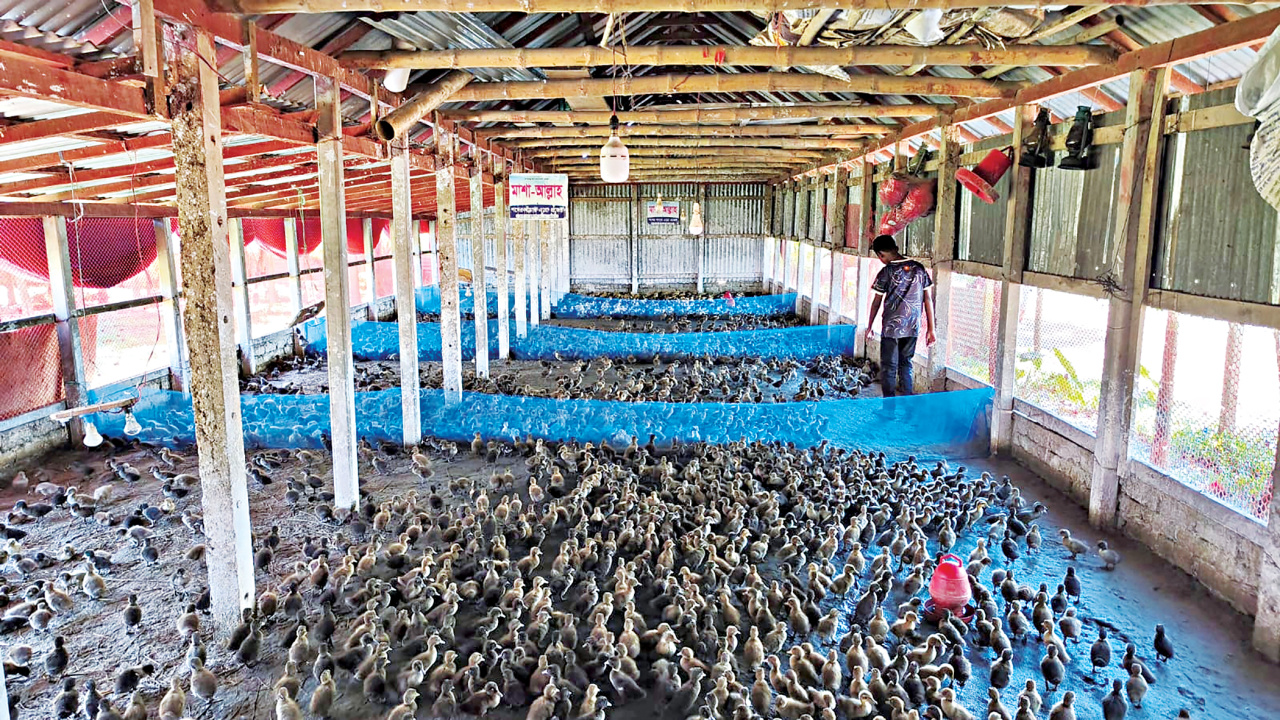
In the remote haor village of Kuturikona in Netrokona’s Madan upazila, a simple traditional method of hatching duck eggs has evolved into a powerful source of income, helping hundreds of families move away from poverty and giving rural women a stronger role in their households and communities.
The transformation began nearly four decades ago when Hadis Ullah, a local villager, started experimenting with a low-cost technique for hatching duck eggs. Using rice husk and hurricane lamps, he began producing ducklings from eggs collected from other areas and selling them to villagers interested in raising ducks.
At the time, life in Kuturikona was heavily dependent on agriculture. During the 1990s, most villagers survived by sharecropping or working as agricultural labourers in the haor’s paddy fields. Their earnings were often barely enough to meet basic needs, while floods and other natural disasters could destroy crops and push families deeper into financial hardship.
Hadis Ullah believed duck farming could provide an alternative source of livelihood. He initially worked on a small scale, but villagers soon recognised the potential of the idea. Since the haor provides abundant natural food for ducks—including insects, small fish and snails—the birds could be raised with very little expenditure on commercial feed.
The major obstacle was the availability of ducklings. Poor transportation and communication made it difficult for villagers to regularly bring ducklings from distant locations. Local production, therefore, offered an opportunity to make duck farming more accessible and sustainable.
Hadis Ullah continued refining his hatching technique with his wife Shahena Akter and his brothers. Although the venture initially required considerable personal investment, he eventually exhausted his savings and even sold land to keep the initiative running. Over time, however, production expanded and the business became profitable.
Hadis Ullah died in 2016, but the transformation he helped initiate continued to grow. His wife Shahena says that almost every household in the village is now connected in some way to duck farming, with women playing a particularly important role.
While many men continue to work in agriculture, women have increasingly taken responsibility for raising ducks, collecting and selling eggs, hatching ducklings and managing hatchery operations. For many families, this has turned what was once seasonal agricultural work into a more regular source of income.
The traditional incubation technique developed in Kuturikona remains remarkably simple. It does not depend on electricity or expensive modern machinery. Instead, rice husk is used to retain and regulate heat, while hurricane lamps provide the warmth needed for incubation.
For a batch of around 1,000 eggs, the process requires locally available materials, including rice husk, bamboo baskets, cotton, wooden boxes, blankets, cloth, egg trays, hurricane lamps and a thermometer. Many of these materials can be reused, keeping operating costs relatively low.
The process begins with the collection of fertilised duck eggs. According to local hatchery operators, around 30 to 40 eggs weighing approximately 60 to 70 grams are prepared for each batch. The eggs are washed with lukewarm water and disinfectant, dried in sunlight, wrapped in black cotton cloth and placed inside bamboo baskets containing rice husk.
A hurricane lamp positioned beneath the basket provides the heat. The eggs are turned every two to three hours to distribute the warmth evenly. After about 18 days, they are transferred to wooden boxes insulated with rice husk and blankets, where the ducklings hatch after approximately 28 to 30 days.
What began as a small household experiment has now developed into a significant rural industry. Yasin Mia, Hadis Ullah’s younger brother, later established the Rice Husk Incubation System Society, bringing together 138 small and large hatchery owners in Kuturikona. He serves as its president and operates the village’s largest hatchery.
According to Yasin, his own hatchery produces around 100,000 ducklings every month, while the combined output of the village’s 138 hatcheries is estimated at about three million ducklings monthly. Fertilised eggs are purchased for around Tk 20 each, while ducklings are sold for Tk 40–50, allowing hatchery owners to earn profits after covering their costs.
The village produces several breeds, including Khaki Campbell, Indian Runner, Jinding, Nageswari, Beijing and Muscovy. The annual production value of the hatchery industry is estimated at around Tk 120 crore, while roughly 250 to 300 families are involved in the sector.
Women are particularly central to the production process. They collect eggs, wash and dry them, arrange them in trays and baskets, and regularly turn them during incubation. Many women combine these responsibilities with household work, allowing families to operate hatcheries without the additional cost of hired workers.
For some women, the income has created an entirely new level of financial independence.
Hawa Akter, who established a hatchery with her family using their savings, now earns approximately Tk 50,000 a month from the operation. Another worker, Yasmin Akter, earns around Tk 20,000 monthly, helping her contribute significantly to her family’s expenses.
Majida, another hatchery owner, manages the business alongside her family members while continuing her household responsibilities. The family-based model keeps labour costs low while allowing women to participate directly in income-generating activities.
The economic impact has also changed social attitudes towards women and girls in the village. Shahena says girls from Kuturikona are now viewed differently because many of them possess practical skills and the ability to earn an income. She notes that the growing economic value of women has even contributed to a decline in dowry expectations in marriages involving women from the village.
The experience of Kuturikona demonstrates how access to income can strengthen women’s position within families and communities. Financial independence does not simply improve household earnings; it can also influence how women are perceived, respected and valued.
Yasin believes that easier access to finance could allow the village’s small hatchery operators to expand further. He has called on financial institutions to provide small entrepreneurs with loans on simpler and more accessible terms so that successful household enterprises can grow without being constrained by a lack of capital.
Local livestock authorities have also played a role in supporting the sector by providing technical knowledge, training and treatment facilities. Their involvement has helped hatchery operators improve their practices while enabling more villagers to participate in duck farming.
Dr Mohammad Shahidul Islam, district livestock officer in Netrokona, described the rice-husk-and-hurricane-lamp technique as an effective and affordable method that has contributed to the self-reliance of hundreds of families in Kuturikona.
According to him, women are now participating alongside men in the local workforce, while technical assistance, veterinary services and training have helped strengthen the sector. The 138 hatcheries in the village are estimated to have created employment opportunities for around 2,500 men and women.
The story of Kuturikona is ultimately more than a story about duck farming. It is an example of how local knowledge, community participation and a low-cost innovation can create economic opportunities in areas where conventional employment options remain limited.
For decades, the haor’s seasonal nature left villagers vulnerable to crop losses and long periods without work. Duck farming provided a way to use the region’s natural environment while creating an alternative livelihood that could continue beyond the agricultural season.
Most importantly, women have emerged at the centre of this transformation. From managing household hatcheries to generating independent incomes, they have demonstrated that rural women can become entrepreneurs and contributors to local economic development when appropriate opportunities are available.
The success of Kuturikona offers a broader lesson for Bangladesh’s rural economy: sustainable development does not always require sophisticated technology or large investments. Sometimes, a simple idea adapted to local conditions can create an entire community-based industry.
In Kuturikona, rice husk, bamboo baskets and hurricane lamps have helped hatch more than ducklings. They have helped hatch a new sense of economic independence, dignity and self-reliance—particularly among the women of the haor community.
A news by Alisha Pradhan, General Secretary, HerNet Foundation