
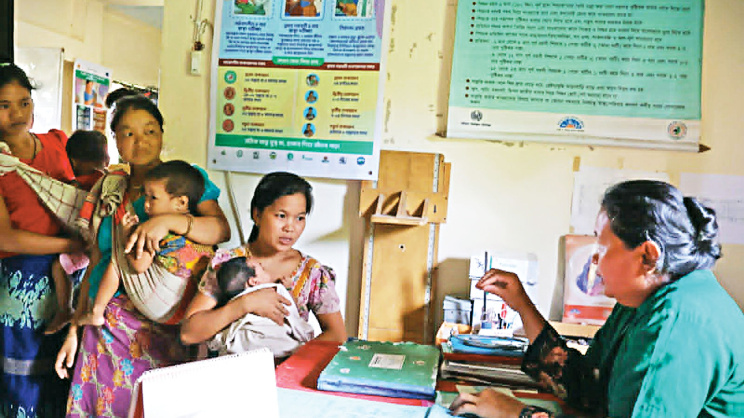
For families living in the remote hills of Khagrachhari’s Guimara upazila, ensuring that children grow up healthy is often a struggle that extends far beyond putting food on the table. Poverty, difficult terrain, limited healthcare facilities, language barriers and inadequate awareness about nutrition continue to shape the health outcomes of many indigenous families.
For 47-year-old Bishwabala Tripura, a mother of five, those challenges are deeply personal. One of her children once suffered from severe acute malnutrition (SAM), while accessing appropriate medical care was itself a major challenge.
“Whenever we have a medical problem, it is very difficult to reach a hospital,” she said. Even after making the journey, communication can remain difficult because many families struggle to explain their symptoms to doctors or fully understand medical instructions.
Financial hardship makes the situation even more complicated. Nutritious foods such as meat, eggs and fruits are often beyond the regular budgets of low-income households, leaving families dependent on whatever food is readily available.
Bishwabala’s experience is shared by many families across Guimara, where malnutrition is closely connected to broader social and economic difficulties. In some remote communities, reaching a healthcare facility can take several hours. The cost of travel, unfamiliarity with health facilities and difficulties communicating with medical professionals can discourage families from seeking care until an illness becomes serious.
Dr Rupan Chakraborty, medical officer at Matiranga Upazila Health Complex, said limited awareness is another major obstacle.
Many people from remote villages, he noted, do not seek medical attention even when they are seriously ill because they may not recognise the severity of their condition. Language differences can further complicate communication between patients and healthcare providers.
Against this backdrop, community-based interventions have begun to play an increasingly important role in improving nutrition awareness and healthcare access in the hills.
One such initiative is the Partnership for Resilient Livelihoods in CHT Region (PRLC) project, which takes a preventive and community-focused approach to malnutrition. Instead of relying solely on treatment after children become sick, the programme works directly with families to improve dietary practices, monitor children’s growth, support mothers and connect communities with healthcare services.
The project is implemented by Assistance for the Livelihood of the Origins (ALO), with support from Manusher Jonno Foundation (MJF) and funding from the European Union. ALO conducts activities at the community level, while MJF provides technical assistance, oversight and coordination for interventions related to livelihoods, health and resilience.
Since October 2023, the project has been holding monthly mothers’ group meetings, locally known as “Ma Dol”, across the three unions of Guimara. The sessions provide mothers with practical information on nutrition, child feeding, maternal health and healthcare.
So far, 665 mothers have participated in these sessions, while 360 girls have received health and nutrition support.
Community nutrition promoters have also conducted hundreds of household visits, allowing them to identify children at risk and provide families with advice and referrals. Through 662 home visits, the project identified three children with severe acute malnutrition and seven with moderate acute malnutrition. The children received additional nutritional support, follow-up care, counselling and referrals where required.
The programme has also helped pregnant women and new mothers access antenatal and postnatal care.
For Bishwabala, the intervention became particularly valuable because it addressed several problems at once. Through repeated home visits and mothers’ meetings, she learned more about balanced diets, appropriate child feeding and maternal health. Community workers also helped families navigate the healthcare system and, when necessary, accompanied them to medical facilities.
“When we went to the hospital, they helped us understand what the doctors were saying and what medicines we needed to take,” she said. “Without that support, many of us would have struggled.”
Manu Ching Marma, a paramedic working with the programme in Guimara, said accompanying patients can be crucial for families who are unfamiliar with the healthcare system.
Many mothers hesitate to visit hospitals because they do not know how the system works or find it difficult to communicate their problems, he said. Programme workers sometimes accompany them, explain symptoms to doctors, help translate medical advice and ensure that families understand how to follow treatment.
For health professionals, such community engagement can make a significant difference by allowing illnesses and nutritional problems to be detected earlier.
Dr Rupan said regular community visits help identify health concerns at an early stage, connect patients with appropriate treatment and encourage families to seek medical assistance before conditions become severe.
The project is also helping families improve their diets through small household nutrition gardens. Bishwabala’s family, for instance, received support to establish a garden where they could grow vegetables close to home. The initiative gave the family an additional source of nutritious food while reducing their dependence on purchasing vegetables from the market.
A similar change has taken place in the household of 32-year-old Rina Tripura.
Most mornings, Rina now collects vegetables from her small garden before preparing meals for her two children. A few years ago, however, she paid little attention to dietary diversity and often relied on rice and whatever vegetables happened to be available.
Meat, eggs and fruits were largely occasional foods.
“I thought filling my children’s stomachs was enough,” she said. “I did not know that they needed different kinds of food to grow properly.”
Regular participation in Ma Dol meetings and home visits by nutrition workers gradually changed her understanding of child nutrition. She learned about balanced diets, feeding practices and maternal health and began cultivating vegetables around her home.
Today, she tries to include vegetables in her children’s meals and provides eggs whenever the family can afford them.
But knowledge alone cannot eliminate the problem.
“We know what our children should eat,” Rina said. “The hard part is making sure we can provide it every day.”
Her observation points to one of the central challenges facing nutrition programmes in remote communities: awareness can improve relatively quickly, but household incomes and food affordability often change much more slowly.
The PRLC project therefore combines nutrition and healthcare activities with livelihood assistance and disaster preparedness. The broader goal is to help families improve their economic security while becoming better equipped to withstand future shocks.
Mihir Chakma, project coordinator for the CHT Region, said the programme provides livelihood assistance alongside health and nutrition support and disaster-response training, with the aim of helping families increase their incomes, access essential services and strengthen their resilience.
The project has also trained 20 young volunteers in disaster response and supported two women-led disaster management groups with a combined membership of 30.
According to Somen Chakma, monitoring officer of ALO, the project has recorded encouraging changes in income-generating activities, nutrition awareness and community preparedness.
Yet the difficulties facing indigenous communities in the Chittagong Hill Tracts cannot be resolved through short-term projects alone.
Shaheen Anam, executive director of Manusher Jonno Foundation, said poor nutrition outcomes in the region are driven by several interconnected factors, including poverty, limited awareness and inadequate access to public services.
She noted that the hill tracts continue to lag behind the national average across many development indicators. Within households, women may also prioritise feeding husbands and children over themselves, while limited knowledge about nutrition and healthy feeding practices can further affect family health.
Geographical isolation compounds these problems by making government services and healthcare more difficult to reach.
For organisations working in the region, the long-term objective is therefore not simply to provide assistance but to help communities develop the knowledge, resources and confidence needed to continue these practices independently.
The experience of families like Bishwabala’s and Rina’s suggests that even modest interventions can have a meaningful impact when they combine information with practical support. A nutrition lesson becomes more useful when a family can grow vegetables at home. Healthcare advice becomes more effective when someone helps a mother communicate with a doctor. Awareness becomes sustainable when communities have the means to act on what they have learned.
Shaheen Anam stressed that the continuation and expansion of these gains will ultimately require stronger government involvement. Development projects can demonstrate effective models, but lasting progress depends on whether communities adopt the practices and whether public systems are able to support them over the long term.
In Guimara, the journey toward better nutrition is therefore not a single intervention or a quick success story. It is a gradual process involving mothers, families, community workers, health professionals, local volunteers and development organisations.
For families living among the hills, improving children’s nutrition means overcoming several barriers at once—from the price of food and the distance to hospitals to the language spoken inside a consultation room.
The progress made so far shows that when healthcare, nutrition education, livelihoods and community participation are brought together, those barriers can begin to shrink. But for the gains to endure, the lessons learned in these communities will need to be supported long after individual projects come to an end.
A news by Alisha Pradhan