
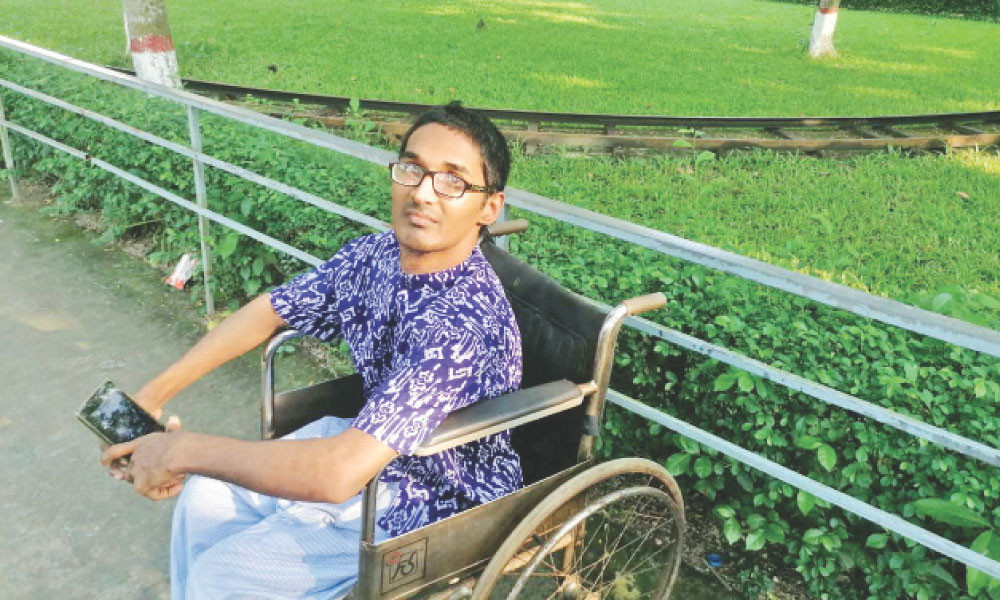
Born with cerebral palsy and rendered unable to walk after a botched leg operation in 2007, Khaled Mahmood Khan could have disappeared into the margins. Instead, the 30-something graduate in sociology from JBG College, Ghatail, has pieced together a career from his home in Korotia, Tangail Sadar—freelancing online, composing music, subtitling films and running a small literary platform—while shouldering family responsibilities.
Khaled, the youngest of three brothers, moves by crawling. He bathes unaided, but relies on his mother or wife for many daily tasks and needs assistance to travel outside. Tinnitus diagnosed in 2013 brought relentless ringing in his ears, often robbing him of sleep and focus; chronic insomnia means he uses sleeping medication. Yet he kept searching for a way to earn.
His first breakthrough came in 2010 with a browser add-on, “BD WebPortal,” that bundled Bangladeshi radio, TV and newspapers; it earned him his first $262 online. By the following year, he was freelancing—managing Facebook pages and groups, then moving onto Fiverr and Upwork for video editing, WordPress work and voice-over gigs. An uncle’s gift of a computer back in 2006 had lit the spark; lacking formal training, Khaled taught himself, later founding the “PC Helpline BD” blog, which briefly became one of the country’s top tech blogs. At his peak, he says, freelancing brought in about Tk 30,000 a month—enough to fund his wedding.
The path was rarely smooth. “People told my family there’s no point educating a ‘lame’ boy—he’ll never walk to an office,” Khaled recalls. “Some said I’d never have a healthy child.” He and his wife now have a daughter who, he notes with quiet pride, is “healthy and thriving.” In 2013, the death of his father forced a year-long retreat from online work and eroded his standing on Upwork. A sister-in-law—Orin—became his anchor. “Her encouragement showed me a new way forward,” he says.
Creativity has been both refuge and livelihood. Khaled has written and composed 21 original songs, producing vocals and arrangements himself with home equipment. “Music is how I forget my pain,” he says. He has also created Bengali subtitles for 24 acclaimed films across English, Korean, Hindi, Tamil and Telugu, and runs an online literary space, Kobitar Pata, while continuing small freelance assignments when his health allows.
Despite the skills, income is irregular. Cerebral palsy, tinnitus and insomnia limit how long he can concentrate, and his mobility keeps him out of traditional workplaces. “I don’t want to depend on anyone,” he says plainly. “A remote job that matches my skills would change everything.” His longer-term dream is to build a platform that trains and places people with disabilities into remote work, drawing on his own journey through self-learning and gig platforms.
Khaled’s story began in adversity. As a college student in 2007, he fell ill and underwent a leg procedure that went disastrously wrong; from walking with crutches, he was pushed to crawling. He learned to do most tasks with his left hand. Along the way he endured the casual cruelty that often shadows disability in Bangladesh, but pushed back with small, stubborn wins—learning code, building a toolbar, taking on clients, launching a blog, writing songs, subtitling films.
Today, he is neither an emblem of pity nor a viral “inspiration” trope. He is a working man asking for one straightforward bridge across the gap between potential and opportunity: steady, remote employment. And he is a reminder that Bangladesh’s disability discourse should move beyond charity to practical access—affordable assistive tech, remote-work pipelines, skill certification, and employers ready to judge talent by output, not by mobility.
“I just want the chance to stand on my own—without having to stand,” Khaled says.