
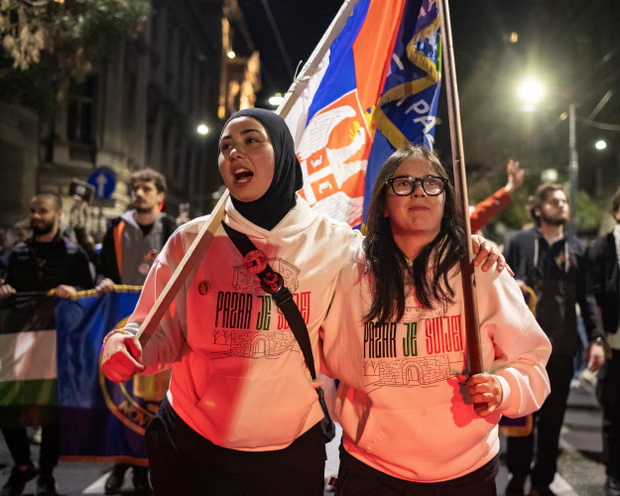
A year after a station canopy collapse in Novi Sad killed 16 people and ignited Serbia’s largest youth-led protests since the fall of Slobodan Milošević, the student movement that shook the country is wrestling with its next move: take the fight to elections or keep building power outside a system they long rejected.
Midway through a 16-day, 250-mile (400km) march from Novi Pazar to Novi Sad, student organizer Inas Hodžić embodied the movement’s stamina and sharpened demands. On Saturday—exactly one year after the disaster—he and tens of thousands more are set to rally in Novi Sad to tell President Aleksandar Vučić they will not stand down. “If, after everything, a new government fails to bring justice for the 16 victims, they will face the same fate as this government,” Hodžić said.
What began last autumn as a howl against corruption, repression and shoddy public works has evolved into a strategic debate. In December, open “plenums” forged unity around refusing engagement with established institutions. Today that once-binding principle is the movement’s fault line.
The split sharpened after the European parliament issued its harshest rebuke yet of Vučić’s government. Some students welcomed the support; others condemned “attempts to co-opt the student movement.” Meanwhile, a bloc pushing for emergency elections has started assembling an electoral list of candidates drawn from outside Serbia’s party system—and a growing swath of society is urging opposition parties to sit out in favor of the students’ slate. Two parties have already pledged to do so.
“The system needs a reset, independently of political parties,” said energy worker Branislav Manojlović. “That can only happen through the student electoral list guided by justice, solidarity and empathy.”
Skeptics warn that entering elections risks diluting a horizontal movement under pressure from arrests, alleged police brutality and relentless media attacks. “The call for elections was imposed as an ‘inevitable next step,’ but it means returning to the very system we initially rejected,” said film student Siniša Cvetić, who favors deepening direct-democracy structures and alliances with workers and farmers.
Others stake out a middle ground. Elections, argues scholar Ivica Mladenović, can “symbolically challenge” a captured state, but only if tied to longer struggles for autonomous unions, free education and independent media. “If the fight for elections becomes just a fight to change the government, it loses its emancipatory potential,” he said.
For Durham University professor Jana Bacevic, the turn to ballots exposes the limits of liberal democracy itself: “You cannot, except through violent revolution, move that system out of place,” she said, noting Serbia’s only decisive rupture came in 1944.
Vučić has dismissed the protests as a destabilization campaign and rebuffed calls for early elections, insisting Serbia will vote before the 2027 deadline while pursuing electoral reforms. Authorities deny accusations of police brutality even as scores of students and supporters have been detained in recent months.
Despite internal disagreements, few doubt what the movement has already changed. “The students awakened us from collective apathy,” said Manojlović. “Elections alone won’t change everything, so we must preserve what the movement created: constant civic participation.”
As marchers converge on Novi Sad a year after the tragedy that galvanized them, Serbia’s radicalized student generation faces its most consequential decision yet—whether to try to transform the system from within, or continue to confront it from the streets.