
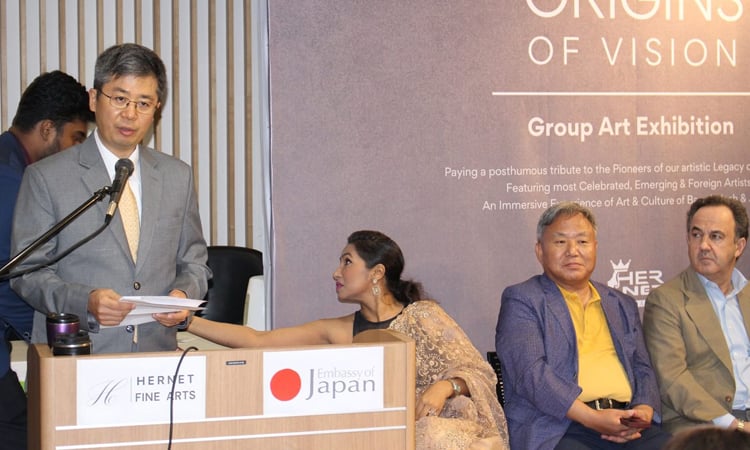
The group art exhibition titled “Origins of Vision”, jointly organised by HerNet Fine Arts and the Embassy of Japan in Bangladesh, has come to a successful close after a remarkable week-long celebration of cultural heritage and diplomatic harmony. Held from July 18 to 26 at the Japanese Embassy premises in Dhaka, the exhibition marked a historic milestone as the first major private tribute to the founding luminaries of Bangladeshi modern art, while also reinforcing the cultural ties between Bangladesh and Japan through collaborative artistic engagement.
Curated by Alisha Pradhan, Founder and Secretary General of HerNet Foundation and Chief Curator of HerNet Fine Arts, the exhibition brought together 47 prominent and emerging Bangladeshi artists whose works created a compelling dialogue between tradition and innovation. The exhibition was inaugurated on July 18 in the presence of distinguished guests, including Deputy Chief of Mission of Japan Takahashi Naoki, Spanish Ambassador Gabriel Sistiaga, Korean Ambassador Park Young-sik, and internationally acclaimed artist Monirul Islam, who served as the chief guest.
Takahashi Naoki underscored Japan’s commitment to cultural diplomacy, referencing the recent May 30 meeting between Japanese Prime Minister Ishiba Shigeru and Bangladesh’s Chief Adviser Dr. Muhammad Yunus in Tokyo, during which both leaders agreed to strengthen bilateral cooperation in arts and culture. In line with this vision, the exhibition featured curated works that explored Japanese aesthetics within the context of Bangladeshi creativity—many of the participating artists had studied or trained in Japan, further highlighting the mutual artistic influence between the two nations.
A major highlight of the exhibition was the rare and reverent tribute to Bangladesh’s artistic pioneers—Zainul Abedin, SM Sultan, Mohammad Kibria, Novera Ahmed, Rashid Choudhury, Quamrul Hassan, and Safiuddin Ahmed—through archival displays and preserved artworks presented to the public for the first time by a private institution. This homage served as a powerful reminder of the rich legacy on which the current generation of artists continue to build.
The exhibition also attracted a stellar lineup of guests and cultural figures, including Mohammad Eunus, Ahmed Shamsuddoha, Naima Haque, Farida Zaman, Sheikh Afzal, Mustafa Khalid Palash, and HerNet Foundation Chairman Monir Prodhan. Each brought their perspectives to the opening and closing ceremonies, reflecting on the evolution of Bangladeshi art and the significance of institutional support for artists.
Throughout the week, the exhibition engaged viewers with immersive cultural programming. Notably, a traditional Japanese Tea Ceremony was held on July 20, offering a meditative experience into Japanese rituals. This was followed by exhibitions of Ikebana (Japanese flower arrangement) and Origami, which drew large crowds and enriched the cultural fusion on display. The closing ceremony, held on July 26, was attended by dignitaries including renowned artist Farida Zaman, architect F.R. Khan, and Durjoy Rahman, founder of Durjoy Bangladesh Foundation. Japanese Ambassador Saida Shinchi delivered a heartfelt speech congratulating the organisers, and expressed hope that the exhibition would pave the way for deeper mutual understanding and stronger diplomatic ties through cultural exchange.
The presence of diplomats, artists, students, and art enthusiasts throughout the week turned Origins of Vision into more than just an exhibition—it became a living space for dialogue, remembrance, and forward-thinking collaboration. Alisha Pradhan’s vision, as expressed during her curatorial speech, is to globally elevate Bangladeshi art, honour its roots, and build infrastructure for its future. HerNet Foundation’s plans to launch the largest digital art data centre in Bangladesh and initiate a privilege card for artists were also shared during the event, promising sustained institutional support for the creative community.
As curtains fell on Origins of Vision, it left behind a trail of meaningful connections—between generations, between nations, and between art and diplomacy—signaling a renewed chapter of cultural engagement between Bangladesh and Japan.