
In a significant geopolitical development, three key G7 nations—France, the United Kingdom, and Canada—are preparing to formally recognize the State of Palestine at the upcoming United Nations General Assembly session in September 2025. With their recognition, the total number of countries acknowledging Palestinian statehood will reach 150. However, the move has reignited long-standing questions about the effectiveness and sincerity of such recognition, especially considering the harrowing history of colonial entanglement and ongoing human rights violations in Palestinian territories.
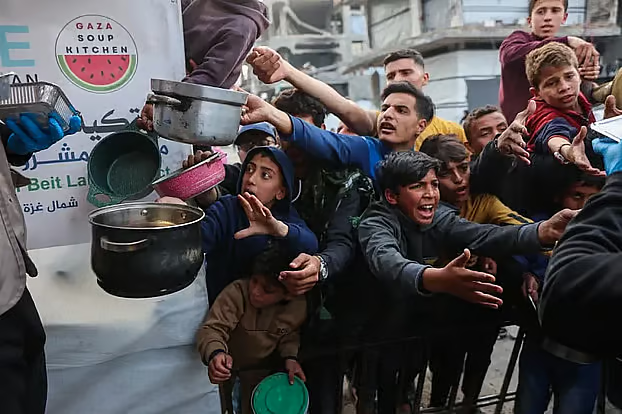
Despite 147 nations having previously extended recognition to Palestine, it remains a state in name only—lacking full sovereignty, security, and freedom. Israeli military aggression continues unabated, particularly in the besieged Gaza Strip, where the humanitarian situation has deteriorated to the level of famine. Access to food, medicine, and emergency aid remains severely restricted. Over the decades, hundreds of thousands of Palestinians have been killed, displaced, or injured, and the brutality continues with devastating regularity.
The announcement by France and the UK has raised suspicions among observers who point to the historical complicity of these nations in the Palestinian tragedy. Many experts suggest that this recognition is not just a diplomatic maneuver but also a symbolic act of repentance for their colonial past and active roles in shaping the modern Middle East’s fractured landscape.
Historically, both Britain and France were instrumental in dismantling the Ottoman Empire and carving up its Arab territories. Through secret agreements such as the 1916 Sykes-Picot Agreement, they laid the groundwork for Western control over the region, with Britain taking over Palestine under the League of Nations Mandate. Simultaneously, Britain made conflicting promises: to support an independent Arab state while also endorsing a “national home for the Jewish people” in Palestine through the 1917 Balfour Declaration.
This duplicity culminated in a massive influx of European Jews into Palestine, leading to growing tensions and violent uprisings. The 1947 UN partition plan further exacerbated the crisis by allotting a disproportionate share of land to a Jewish state, despite Jews comprising only a third of the population and owning a fraction of the land. In 1948, Israel was established, triggering the first Arab-Israeli war and the forced displacement of 700,000 Palestinians—a tragedy known as the Nakba.
Since then, the region has been plagued by repeated wars, continuous military occupation, and the systematic erosion of Palestinian land and rights. Gaza, in particular, has become synonymous with suffering. According to UN data, over 35,000 people have been killed in Gaza in just the last two years, many of them women and children. Israeli bombardments have reduced entire neighborhoods to rubble. The blockade has turned daily life into a struggle for survival.
Given this context, the recognitions by France and the UK carry symbolic weight but also historical baggage. Critics argue that such recognitions are hollow unless followed by concrete action: lifting the blockade on Gaza, ensuring unimpeded humanitarian aid, holding Israel accountable for war crimes, and creating real momentum toward a viable, independent Palestinian state.
Without these steps, recognition becomes an empty gesture—an addition to a growing list of symbolic endorsements that have done little to change conditions on the ground. For some, these recent recognitions resemble acts of penance for a century of colonial exploitation and betrayal. But for Palestinians still living under occupation, symbolism is not enough. Justice demands action.
The crisis in Palestine is not a religious conflict, but a colonial one—rooted in dispossession and displacement. While the international community has long championed the idea of a two-state solution, real peace can only be achieved through accountability, reparative justice, and an end to occupation. If France and the UK truly seek redemption for their roles in this history, they must do more than offer recognition—they must champion policies that uphold Palestinian rights and sovereignty in practice, not just in principle.