
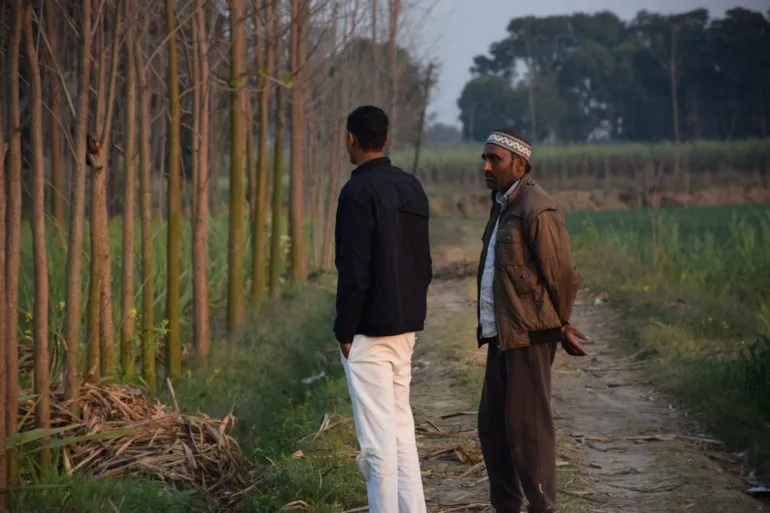
Meerut, India – Mohammad Mohsin never intended to spend the government’s farmer credit on crops. In 2023, the young man from a village near Meerut in northern India used a $1,440 loan under the Indian government’s Kisan Credit Card (KCC) scheme to make a down payment on a Maruti Wagon-R — not for himself, but to satisfy the dowry demands of his sister’s prospective in-laws. The wedding never happened. The debt, however, remained.
Launched in 1998 to provide accessible and low-interest loans to farmers for crop cultivation and other agricultural needs, the KCC scheme was envisioned as a crucial step in modernising rural credit and shielding farmers from exploitative moneylenders. But in India’s vast agrarian belt, where farming alone rarely sustains families and social obligations weigh heavily, KCC loans are increasingly being diverted to pay for healthcare, education, and especially weddings — turning what was meant to be a financial lifeline into a deepening trap.
When Mohsin withdrew the KCC funds from an ATM — a facility the scheme permits — he used the card, issued in his father’s name, not to buy fertiliser or seeds but to purchase a car demanded by his sister Aman’s suitor. That groom later demanded more: a larger vehicle, a Mahindra Scorpio, and hundreds of thousands of rupees in cash. Unable to meet the rising expectations, the marriage fell through in early 2025, but the debt endured.
With no money left to invest in his land and unable to repay the loan on time, Mohsin’s interest rate jumped from the subsidised 4 percent to 7 percent, further complicating his financial future. He now struggles to pay in small instalments, knowing the loan could soon be classified as a non-performing asset (NPA), ruining his creditworthiness. Worse still, to get another KCC loan — which may be needed if another wedding is arranged — he must first clear the previous debt. That’s where local middlemen come in, offering to help by paying off the interest and getting the loan renewed, all while charging 2 to 5 percent interest per day.
It’s a vicious cycle faced by thousands of farmers like Mohsin. His story reflects the growing misuse of the KCC scheme, originally meant to boost agricultural productivity, but now routinely used to cover non-agricultural personal expenses in the absence of a comprehensive rural welfare system. According to a 2024 study in The Pharma Innovation Journal, only a fraction of KCC loans are used for farming. Nearly 28 percent of respondents used the money for household needs, 22 percent for medical expenses, 14 percent for children’s education, and close to 10 percent for marriage-related costs.
“In our part of the world, no dowry means no groom,” Mohsin’s 60-year-old mother, Amina Begum, said, resigned to the social norm that continues to perpetuate this cycle of debt. Her daughter Aman, who completed a seven-year Islamic theology course in Deoband, remains unmarried, awaiting a family that “agrees.”
But agreement comes at a cost. Once new dowry demands are made, the family will likely need another loan. Mohsin, already caught between repayment obligations and social pressure, may again rely on the same flawed system — or the middlemen who profit from it.
Former village head Mohammad Mehraj explained the burden succinctly: “Farming barely pays enough to sustain a family. If there’s a medical emergency or a wedding, the pressure is too much.” That pressure often brings shame. In a nearby village, a man’s name was publicly read out after being declared a defaulter. Unable to face the embarrassment, his wife left him. He vanished soon after — no one knows whether he ran away or took his own life.
“The system doesn’t break down your door, it breaks your dignity,” Mohsin said, echoing a sentiment shared widely across rural India. In close-knit communities, a loan recovery officer’s visit is a source of social humiliation. His father Kamil, now in his 70s, whispered, “I’d rather starve than have a bank man knock on our door.”
According to Thomas Franco, former general secretary of the All India Bank Officers’ Federation, the KCC scheme, despite good intentions, has become a tool of serial indebtedness. “Loans get renewed every year without actual repayment, and in the bank’s books, it shows as a fresh disbursal, even though the farmer does not get the actual funds,” he said, noting how this distorts the success of the scheme.
By 2024, the Indian government had disbursed over $120 billion through KCCs, up from $51 billion in 2014. But these numbers hide a darker truth — thousands of farmers unable to break free from a debt cycle that pushes them further from the scheme’s original goal.
That cycle is costing lives. In 2023, Maharashtra — India’s richest state — reported 2,851 farmer suicides. The trend continued in 2025, with 269 suicides in the drought-hit Marathwada region in just the first three months — a 32 percent increase from the same period in 2024. Karnataka recorded 1,182 farmer suicides between April 2023 and July 2024. Uttar Pradesh and Haryana reported 42 percent and 18 percent rises in farm suicides, respectively, between 2021 and 2022.
Development economist Jayati Ghosh called the KCC scheme emblematic of a broader failure in India’s agricultural policy. Crop loans are often given for a single season, forcing unrealistic repayment schedules. “The failure lies with NABARD, the RBI, and successive governments,” she said, emphasising the need for a decentralised and subsidised credit system aligned with the lived realities of farmers.
“Cash alone cannot solve rural distress,” Ghosh said. Without structural reforms to public healthcare, education, and income support, credit schemes like the KCC will continue to be misused — not because farmers are irresponsible, but because they have nowhere else to turn. For Mohsin and thousands like him, what began as a lifeline has become a noose.