
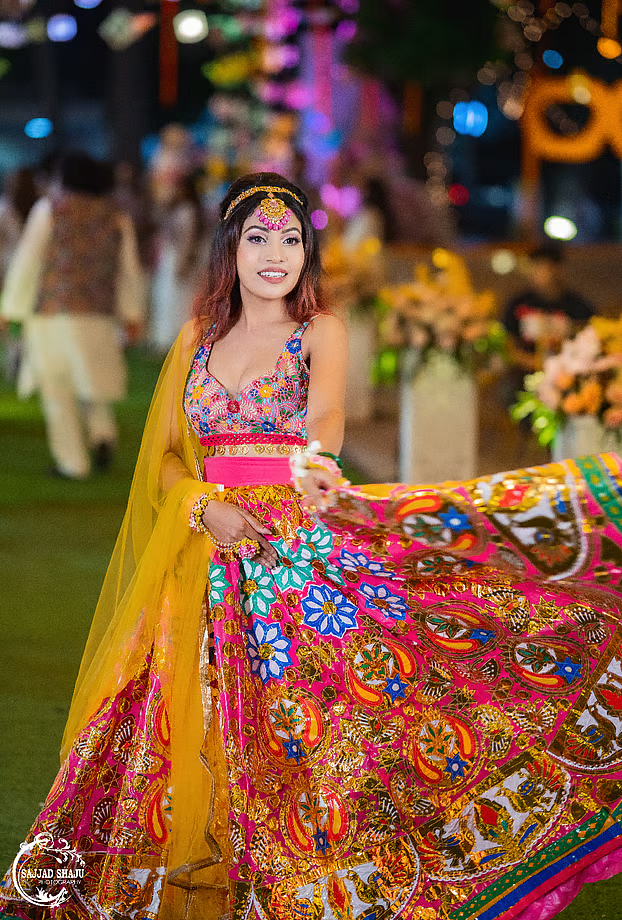
Tasmita Afiyat once aspired to become an architect, but fate had different plans for her. Today, she is a prominent fashion designer whose creative journey defied convention and carved a space for Bangladeshi culture on global platforms.
It all began in 2011 when Tasmita was waiting for her university admission results. Her mother took her to the auditions of “Style Guru,” a reality show on NTV. Surrounded by older contestants, many of them fashion teachers and students from reputed universities, Tasmita panicked and begged her mother to go home. But her mother insisted, “If you fail, I’ll take you home. But you must face the competition first.” That brave decision changed the course of Tasmita’s life.
When the judges asked her, “What is fashion?” she boldly replied, “Fashion is what you see in me.” The judges were captivated. From then on, the youngest contestant dazzled everyone by consistently topping the challenges—designing and presenting garments within just two hours.
Though she secured admission in Graphic Design at the University of Dhaka’s Faculty of Fine Arts, her father disapproved of her not choosing a conventional career like medicine or engineering. He even stopped talking to her. In defiance, Tasmita stopped accepting money from him and started building her own path. In 2012, she launched her fashion brand, Stride, while juggling a corporate job, freelancing, and university classes—all at once.
“I used to run so much I’d often need IV fluids,” she said. “Ask anyone who knows me. Maybe they’ll say I was rude, but no one can say I ever wasted ten minutes chatting. I had no friends. Work was my only companion. I’d wake up, go to class, head to the office, come home, eat, and sleep.” Her work ethic was so intense that Iresh Zaker, her boss at Asiatic, used to joke, “What will you do with so much money?”
Tasmita emphasized the importance of practical experience. “There’s no substitute for hands-on work. I was already doing animation work in an office before it was even taught in our third-year syllabus.”
She went on to become the costume designer for Rubaiyat Hossain’s film Under Construction, and created art direction for over 50 TV commercials. She even appeared on the U.S. reality show The Amazing Race, and began designing national costumes for global pageants like Miss Universe, Miss World, and Mister World. With each project, she carefully incorporated Bangladeshi heritage, gaining recognition as a cultural specialist on international runways.
This year, her collection Social Silencing received acclaim at Arka Fashion Week. She also designed the away jersey for the Bangladesh men’s national football team and has submitted the home jersey design too—featuring motifs inspired by Jamdani, making it the first-ever jersey with such a cultural imprint.
However, her journey was not without hardship. As a woman in an unconventional profession, she endured harsh criticism simply for dressing how she wanted. “People questioned my character,” she recalled. She turned that ridicule into art—designing a jacket featuring retro Bangla movie poster themes with rickshaw prints, which became a bestseller.
Beyond fashion, her personal life also made headlines. One night in Gulshan, an American diplomat named Sabin Hinton saw her for the first time and was instantly smitten. After much persistence from friends, Tasmita finally met him, and the connection blossomed. With full support from both families, they married—a love story that caught media attention.
As a child, Tasmita loved drawing and longed to study architecture at BUET. That dream never materialized, and she used to regret it. But now, she reflects differently: “Thank God I didn’t get into BUET. Everything happens for a reason, and we realize that only much later. If I had studied there, I might’ve become an average architect, lived a routine life, and no one would’ve interviewed me today. This story wouldn’t even exist.”