
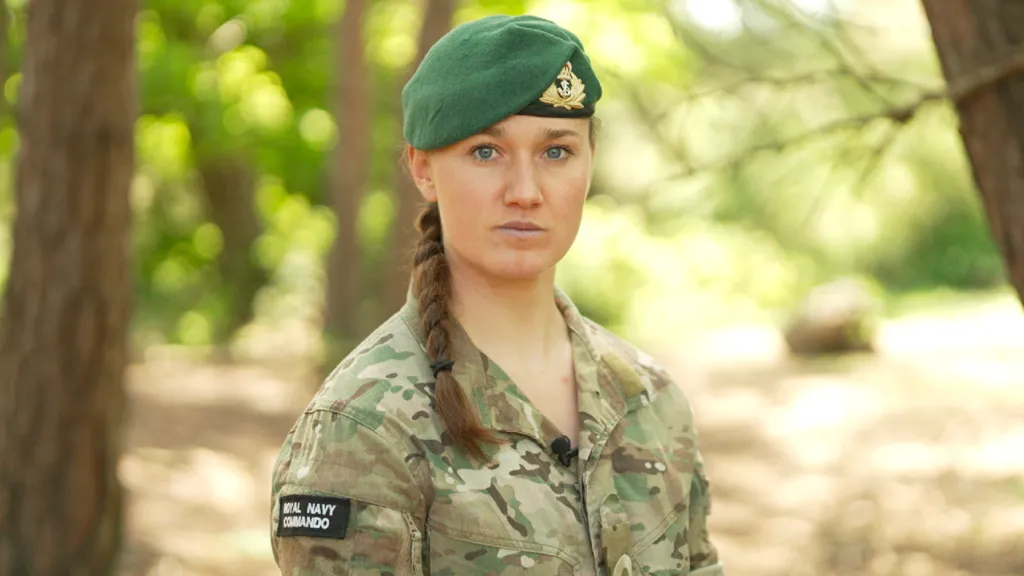
Despite being open to women for six years, the Royal Marines are still searching for their first female Royal Marines Commando. More than 900 women have applied to join the elite force, but none have yet completed its rigorous 32-week training program. However, two women who have experienced the demanding training believe it is only a matter of time before a woman completes the ultimate military test.
Pippa Birch, a club-level rower from Henley, Oxfordshire, became the first woman to attempt the Royal Marines’ grueling recruit training in 2019. At 25 years old, she began the course at the Royal Marines training center in Lympstone, Devon, which is renowned for being one of the world’s toughest military training programs. After suffering a broken leg 10 weeks in, Birch returned the following year but was forced to leave after 24 weeks.
“It was knackering and exhausting. It was such an intense period with a lot of physical training and very little sleep,” Birch recalled. “I don’t think anyone can prepare for the sleep deprivation other than just turning up and surviving.”
The Royal Marines is an elite force known for operating in extreme environments and completing some of the most physically demanding tasks in the military. To become a Royal Marine, recruits must complete four commando tests: a nine-mile speed march, an aerial assault course, a cross-country obstacle run, and a 30-mile march over Dartmoor, all while carrying a 21lb load and a rifle.
Though no woman has yet completed the full course, Birch remains optimistic, believing that the first female Royal Marine Commando is on the horizon. “It’s just a matter of time before a woman who is determined enough joins and passes the course,” she said.
While no woman has yet achieved the prestigious title of Royal Marine, seven women have succeeded in the shorter, 13-week All Arms Commando Course (AACC), a program open to serving members of the military. One notable success is Lt. Lily-Mae Fisher, a Royal Navy officer who earned the green beret in June 2022 after completing the AACC. She is currently the only female Royal Navy Commando.
“It was so much harder than I expected it to be, with factors like sleep deprivation, self-induced pressure, and doubt,” Lt. Fisher admitted. However, completing the AACC was a milestone for her, and she proudly wears the green beret as a symbol of her achievement. “It was the best day of my career, if not my life,” she said.
Lt. Fisher believes the Royal Marines’ training is not an impossible task for women. “It will take the right woman with the right mindset—resilience, perseverance, determination, and stubbornness,” she said. She added that while physical strength is important, mental toughness is key to success in this challenging environment.
Both Fisher and Birch agree that the standards for Royal Marines training must remain the same for all recruits, regardless of gender. “Standards 100% have to stay the same across the board,” Fisher emphasized. Birch echoed her sentiments, stating, “There should be no concessions made for women.”
Former Royal Marine David Coleman, who now trains individuals aspiring to join the Marines, stated that the low number of women applicants is a significant factor in the current lack of female success in the course. “It’s a numbers game,” Coleman said. “As more women apply, the pass rate will rise, and once the first woman completes the course, others will follow.”
The Royal Marines opened its doors to women in 2016 when a ban on female participation in close combat units was lifted. The following year, the final hurdle was removed, allowing women to apply for all combat roles, including those in the Royal Marines. The shift was part of a broader effort to ensure equal opportunities for both men and women in the British military.
Since then, a total of 38,229 men have applied to join the Royal Marines, compared to just 924 women. In the same period, 4,630 men and seven women have started the 32-week training course, with the pass rate for men hovering around 60%. Despite these statistics, the Ministry of Defence has committed to increasing the number of women recruits to 30% by 2030.
The Royal Marines remain dedicated to supporting women who want to join, providing tailored support and ensuring women are properly prepared for the challenges they will face. “We have invested heavily to ensure that training and information are delivered to women before they attend,” a spokesperson for the Royal Marines said.
As Lt. Fisher advises, anyone determined to join should be prepared to fail and try again. “Don’t hold back,” she said. “Be willing to fail, and if you fail, try again, and again, and again. Success will come with persistence.”
As more women enter training and continue to push boundaries, the Royal Marines are confident that the first female Royal Marine Commando is closer than ever. The doors to elite military service are open, and it is only a matter of time before a woman steps through them and claims her place among the Marines.