
Growing up as a Muslim immigrant in California, journalist and author Rozina Ali once believed deeply in the ideals of the United States.
Having moved from Pakistan to the US with her family at the age of five, Ali spent her childhood surrounded by American culture and history. But that sense of belonging was shaken after the September 11, 2001 terrorist attacks, when her parents warned her that Muslims in America could face suspicion and surveillance.
At the time, Ali struggled to understand their fears.
“I kept telling my parents: ‘This is America. This is not Pakistan. We are living in the United States of America,’” she recalled.
Her parents, however, feared that the country was entering a period in which Muslims would increasingly come under scrutiny.
Years later, while reporting on the impact of the US “war on terror” on Muslim communities, Ali came to understand that her parents’ concerns had been far from unfounded.
Her new book, Seasons of Fury, explores the history of Islamophobia in the United States, arguing that anti-Muslim suspicion and policies did not begin with 9/11 but developed over decades.
Drawing on years of research and the experiences of four families, Ali traces the evolution of government surveillance, racialization, national-security policies and political rhetoric targeting Arab and Muslim communities—from the aftermath of the 1967 Arab-Israeli war to the post-9/11 era and the politics of Donald Trump.
A History That Began Before 9/11
For Ali, September 11 was a major turning point, but not the beginning of America’s history of suspicion toward Muslim and Arab communities.
One of the critical moments she examines is the 1967 Israel-Arab war, which triggered increased political activism among Arab Americans in the United States.
Arab American communities organized protests and fundraising campaigns in support of Palestinian refugees. At the same time, Palestinian militant groups were becoming increasingly involved in attacks against Israel and Western targets.
The 1972 Munich Olympics massacre, in which members of the Palestinian militant group Black September killed Israeli athletes, became another major turning point.
According to Ali, the Nixon administration subsequently launched a surveillance programme targeting Arab communities in the United States.
What initially focused on Arab immigrants and visa holders eventually extended to American citizens of Arab heritage.
One of the most prominent figures in Ali’s book is Arab American lawyer Abdeen Jabara, who was subjected to years of government surveillance and became the first US citizen whose surveillance by the National Security Agency was publicly acknowledged by the agency.
Ali argues that the growing US relationship with Israel and the Israeli-Palestinian conflict played a significant role in shaping American perceptions of Arabs and, later, Muslims.
She describes a gradual process in which Arabs became racialized in American political discourse, with Palestine and Muslim communities increasingly viewed through the lens of national security.
“Islamophobia has become a feature of American politics,” Ali said.
From Arab Americans to the Broader Muslim Community
The focus of US government surveillance expanded during the 1980s and 1990s.
After the collapse of the Soviet Union, the United States increasingly viewed Islamist terrorism as a major national-security threat.
Ali argues that the definition of terrorism gradually became broader, while terrorism itself became increasingly associated with Islam and Muslim communities.
The 1995 Oklahoma City bombing demonstrated how deeply this assumption had entered public consciousness.
The attack was carried out by Timothy McVeigh, a white American and former US Army soldier. Yet Ali recalled that some law-enforcement officials and media outlets initially suspected Arab or Muslim terrorists.
That reaction, she argues, reflected a narrative that had already taken hold: the assumption that terrorism in the United States was likely to originate within Muslim communities.
By the 1990s, the focus had shifted from Arab Americans to the much larger Muslim population.
Several developments contributed to this change, including the rise of political Islam, greater visibility of Muslim communities and changes in US immigration policy that brought more Muslim immigrants into the country.
At the same time, Muslim Americans were becoming more politically and socially active, including through efforts to support Palestinians.
For Ali, Palestine remained a recurring thread connecting different periods in the history of American Islamophobia.
After 9/11, Surveillance Became a Reality
The September 11 attacks dramatically intensified the government’s scrutiny of Muslim communities.
According to Ali, FBI agents, police departments and undercover informants monitored Muslim neighbourhoods, cafes and mosques.
In some cases, informants attempted to encourage individuals to participate in criminal plots, she said.
The impact went beyond those directly investigated.
Many ordinary Muslims began to feel that they were being watched.
One phrase repeatedly encountered by Ali during her interviews was: “The walls have ears.”
The perception that someone might be listening or monitoring them became part of everyday life for many Muslims, she said.
For Ali, this was a profound departure from the America she had believed in as a child—a country she associated with religious freedom, tolerance, pluralism and freedom of speech.
It took her years to recognize the extent of the fear her parents had experienced immediately after 9/11.
Twenty-Five Years Later, Islamophobia Remains
A quarter-century after the attacks, Ali believes Islamophobia in the United States has not disappeared. Instead, she argues, it has become more visible and politically normalized.
A 2026 Pew Research Center survey found that a majority of Muslim Americans report experiencing discrimination in their daily lives.
Ali also points to the changing political environment surrounding Muslim Americans and Muslim politicians.
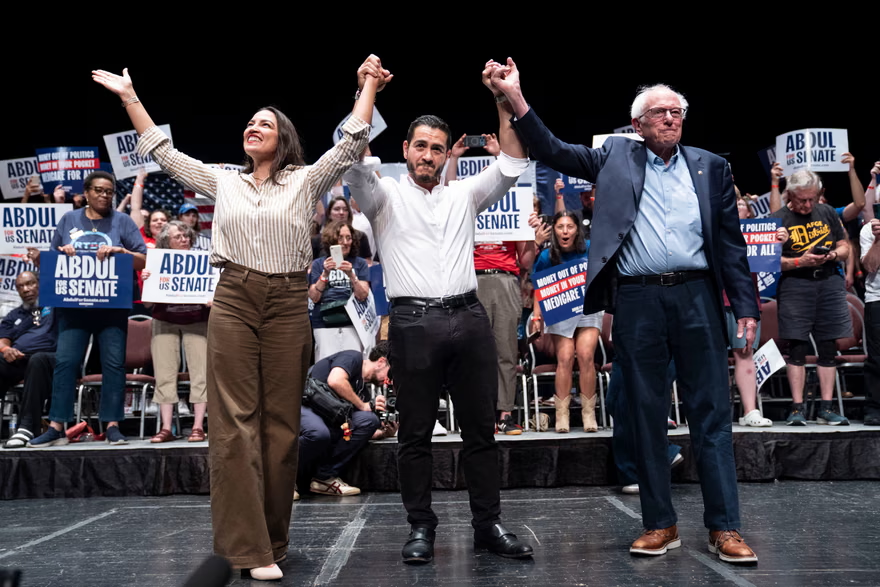
The rise of figures such as New York City Mayor Zohran Mamdani and Michigan politician Abdul El-Sayed has been accompanied by rhetoric that, according to Ali, echoes the suspicion directed at Muslims in earlier decades.
She argues that accusations of terrorist connections or hidden motives directed at Muslim political figures resemble narratives that were common among law-enforcement agencies and anti-Muslim groups decades ago.
For Ali, Islamophobia has increasingly become a political instrument.
Gaza and a New Political Divide
Ali believes the political environment surrounding Islamophobia has become particularly intense since the October 7, 2023 attacks and the subsequent war in Gaza.
She argues that the US government’s strong support for Israel has generated growing opposition among Muslim and Arab Americans as well as sections of the wider American public.
At the same time, public opinion on the Israel-Palestine conflict has shifted considerably, creating what Ali describes as a widening gap between public sentiment and government policy.
She believes the growing political presence of Muslim Americans has further intensified the debate.
In her view, attacks against Muslim politicians and communities increasingly rely on racism and Islamophobia at a time when some of their policy positions have gained broader public support.
She describes Islamophobia as having become “a weapon” in American politics.
From the War on Terror to Immigration Enforcement
Ali also warns that the government powers created or expanded after 9/11 did not remain confined to Muslim communities.
She argues that legal and security mechanisms developed during the “war on terror” are now being applied to other groups, including Latino immigrants and political activists.
For Ali, this development is troubling but not surprising.
Civil-rights lawyers and activists, she says, had long warned that broad national-security powers could eventually be used beyond the communities originally targeted.
A major concern is the increasingly expansive definition of terrorism.
According to Ali, the post-9/11 framework created extensive executive powers while leaving the definition of terrorism sufficiently broad to allow those powers to be applied in new contexts.
Over the past 25 years, she argues, the authority of the US executive branch has expanded significantly under the justification of national security.
Concerns Over Muslim Civil-Rights Organizations
Ali also points to recent political attacks against the Council on American-Islamic Relations (CAIR), a major Muslim civil-rights organization in the United States.
She argues that moves by states such as Texas and Florida to designate CAIR as a terrorist organization signal an effort to marginalize Muslim institutions and undermine organizations that document anti-Muslim hate and defend Muslim civil rights.
For Ali, CAIR remains an important institution in American Muslim life because of its nationwide presence and its work documenting discrimination and hate crimes.
She says she once expected the US government and CAIR eventually to reach some form of reconciliation, but recent developments have instead raised concerns about increasing hostility toward Muslim institutions.
A Legacy That Extends Beyond Muslims
One of the most unsettling conclusions of Ali’s research is that policies created to target one community can eventually be expanded to others.
The surveillance and security architecture developed during the “war on terror,” she argues, has created a precedent for an increasingly powerful executive branch.
Ali warns that when terrorism is defined broadly and national security is repeatedly invoked to justify government action, the boundaries of who can be treated as a threat can continue to expand.
The result, she argues, is an American political system in which extraordinary powers originally justified by the threat of terrorism can increasingly be directed at immigrants, activists and political opponents.
An Unfinished American Story
For Ali, Seasons of Fury is ultimately more than a history of Islamophobia.
It is an examination of how fear, national security and political power can reshape the treatment of minority communities—and how policies introduced during moments of crisis can survive long after the original crisis has passed.
When she first began researching the book roughly a decade ago, Ali expected to write a historical account of a period that had largely passed.
Instead, she finds herself publishing the book at a time when anti-Muslim rhetoric remains highly visible in American political life.
The experience has changed the way she understands her own childhood and her parents’ fears after 9/11.
What once seemed like paranoia now looks, in retrospect, like an early recognition of how quickly suspicion can become policy.
For Ali, the central lesson is not limited to Muslims.
The history she documents suggests that once the government acquires expansive powers in the name of national security, those powers can eventually reach far beyond the community they were initially designed to target.
And that, she argues, makes the history of Islamophobia not simply a story about America’s Muslims, but a broader story about civil liberties, political power and the future of American democracy.