
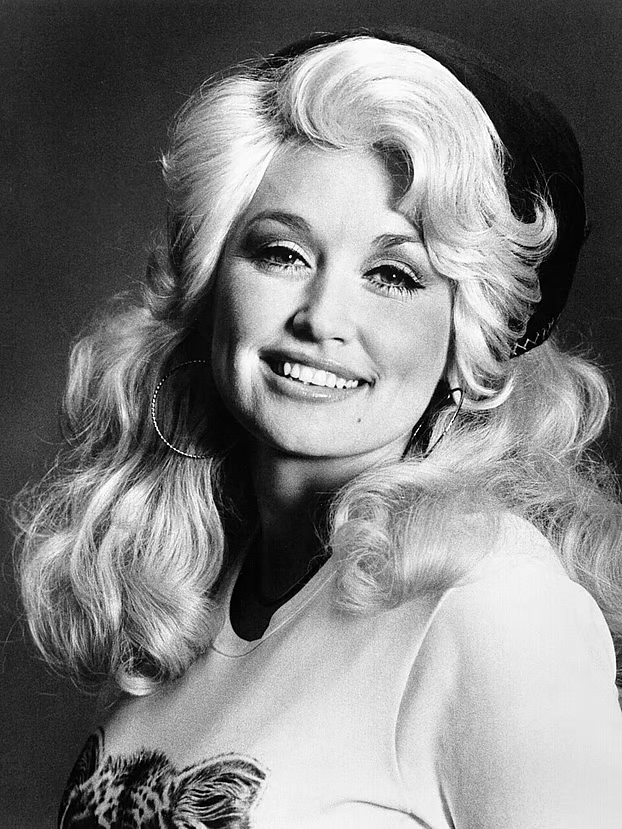
Dolly Parton may forever be remembered as the larger-than-life “Queen of Country Music,” but her most enduring legacy could extend far beyond the stage, recording studio and cinema screen. For millions of children around the world, her name is becoming associated with something much quieter yet equally powerful: a book arriving at their doorstep.
The legendary American singer, songwriter, actress and philanthropist devoted much of her life to encouraging children to discover the joy of reading. Through her Imagination Library programme, millions of children have received books free of charge, turning an idea born from her own childhood experiences into one of the world’s most remarkable literacy initiatives.
Parton died on August 25 at the age of 80, after a career spanning music, film, business and philanthropy. Just four days before her death, she appeared in a video message discussing her health and acknowledging the emotional strain she had experienced following the illness and death of her husband, Carl Dean.
Despite those personal struggles, she remained determined to continue working. She spoke of recovering from her health problems and said she still had many dreams she hoped to fulfil. Her words reflected a philosophy that had defined much of her life: success was never simply about personal achievement, but about using what she had gained to create opportunities for others.
That philosophy was particularly evident in the way she approached children’s education.
Parton was born in 1946 in Tennessee into a large and extremely poor family. She was one of 12 children, and financial hardship was a constant part of her early life. At times, the family struggled even to put sufficient food on the table.
Music became her escape. She began singing and playing guitar at church when she was only six years old, eventually writing and performing her own songs. After finishing high school, she moved to Nashville in 1964, determined to build a career in music.
She went on to become one of the most successful figures in country music. Her catalogue includes some of the most recognisable songs in popular culture, including “I Will Always Love You,” which was later transformed into a global phenomenon by Whitney Houston.
Parton also established herself as an actress, with her performance in the 1980 film “9 to 5” becoming one of the highlights of her film career. Her achievements in music earned her numerous honours, including multiple Grammy Awards, while her name was later added to both the Country Music Hall of Fame and the Rock & Roll Hall of Fame.
Her commercial success was equally extraordinary, with more than 160 million albums sold during her career.
But alongside all of this, Parton maintained a deep commitment to philanthropy, particularly initiatives designed to improve children’s access to education and books.
The roots of the Imagination Library can be traced to her own family.
Parton’s father never had the opportunity to complete his formal education because of poverty. She believed that his lack of literacy had prevented him from fulfilling some of his dreams. That personal experience helped shape her conviction that children should have access to books regardless of their family’s financial circumstances.
In 1995, Parton launched the Imagination Library in her home region of Tennessee. The initial goal was straightforward: encourage children to develop a love of reading from an early age by giving them books at no cost.
What began as a local programme gradually expanded across the United States before reaching children beyond America’s borders. The initiative later spread to Canada, the United Kingdom, Australia and Ireland.
By the programme’s 30th anniversary in 2025, more than 300 million books had been distributed to children.
Today, more than three million children between birth and the age of five are enrolled in the programme and receive a book every month.
The scale of the initiative is remarkable, but its significance can perhaps best be understood through the experiences of individual families.
Harriet Anscombe, a mother in London, enrolled her daughter in the Imagination Library when the child was only three months old. By the time the girl reached four, receiving a new book every month had become an established part of her childhood.
For her mother, the programme helped create a reading culture at home from the earliest years. Without the regular arrival of books, she believes she might not have developed the same habit of reading stories to her daughter so early.
The programme has also created opportunities for children’s authors. British writer Selina Brown, whose work was selected for the initiative, saw around 14,000 copies of her book distributed to children in the United Kingdom.
For families facing financial pressure, the importance of such a programme can be profound. When food, electricity and other basic necessities compete for a family’s limited income, books can easily become an unaffordable luxury.
The Imagination Library removes that barrier by putting books directly into children’s hands.
That is perhaps the most powerful aspect of Parton’s legacy. She understood that access to books is not merely about entertainment. Books can introduce children to imagination, curiosity, language, knowledge and possibilities that may otherwise remain beyond their immediate surroundings.
A child opening a book is being given more than a collection of printed pages. They are being given an opportunity to imagine another life, another place and another future.
Parton’s own journey makes that message especially significant. She grew up in circumstances where educational opportunities were limited, yet eventually built a global career through determination, creativity and talent. Her success allowed her to return something meaningful to children who might otherwise face similar limitations.
Her philanthropic work therefore represents an important continuation of the story she began as a child.
The millions of books distributed through her programme will outlive albums, awards and even many of the cultural moments associated with her career. Each book becomes a small part of her legacy, travelling into a child’s home and becoming part of that child’s memories.
For the children who receive them, Dolly Parton may never simply be the country singer whose songs their parents know. She may instead be remembered as the person whose name appeared on a book that arrived every month, helping them discover stories and encouraging them to dream.
That is a remarkably intimate form of legacy.
Music can bring people together for a few minutes. Films can tell stories for a few hours. But a book placed in a child’s hands can remain with them for years, shaping how they understand themselves and the world around them.
Dolly Parton’s life was filled with extraordinary achievements, but perhaps her most meaningful accomplishment is the creation of a system that continues to put books into the hands of children regardless of their family’s ability to pay.
Her voice may have defined generations of country music, but through hundreds of millions of books, another part of her voice will continue to speak—quietly, personally and repeatedly—to children around the world.
Dolly Parton may have left the stage, but her stories, songs and dreams will continue to live on. And somewhere, every month, a child will open a new book and discover a world of imagination.
That may ultimately be one of the most beautiful ways for an artist to be remembered.
A news by Alisha Pradhan, General Secretary, HerNet Foundation