
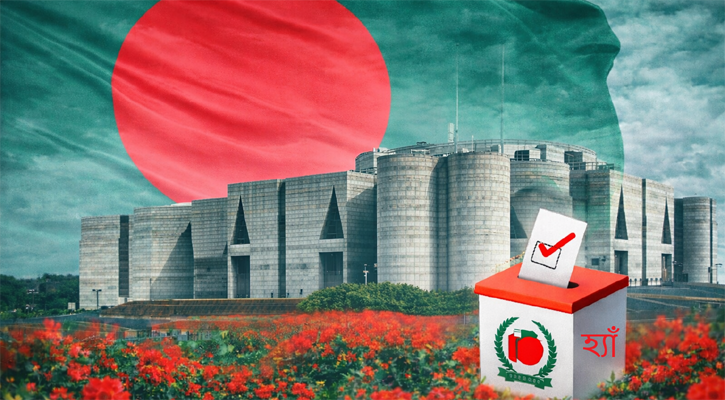
If voters approve the July Charter referendum on Feb 12 alongside the general election, Bangladesh would open a fast-track process to rewrite major parts of its Constitution, shifting the political system toward a caretaker-supervised election model, a bicameral legislature, stricter checks on executive power, and broader institutional independence.
Under the Referendum Ordinance, 2025, the ballot carries four yes/no questions endorsing the Charter’s framework: (a) forming a caretaker government, Election Commission and other constitutional bodies per the Charter; (b) creating a bicameral Parliament with a 100-member upper house (allocated to parties in proportion to national vote) whose majority approval would be required for constitutional amendments; (c) binding implementation of agreed items—ranging from stronger fundamental rights and judicial independence to enhanced local government and opposition roles; and (d) pursuing the remaining reforms as pledged by parties.
If “Yes” prevails, the next Parliament would simultaneously sit as a Constitution Reform Council with constituent power. Within 270 days it must complete amendments aligned to the Charter; if the deadline lapses, the adopted bill would automatically take effect as constitutional law—one of the most debated provisions given its compression of deliberation time.
Key structural shifts proposed
- Caretaker election period: A restored, rules-bound interim authority formed with input from government, opposition and the second-largest opposition.
- Bicameral legislature: Retains the elected lower house; adds a 100-seat upper house by proportional vote share. Money bills bypass the upper house; other bills face time-limited review.
- Amendment rules: Certain core articles would require not only a two-thirds vote in the lower house but also a referendum (and upper-house majority).
- Presidency & clemency: President elected by secret ballot of both houses; impeachment would need two-thirds in each. Presidential pardons would require victim/family consent.
- Executive limits: A single person could not be both party chief and prime minister; a 10-year cap would apply to any one individual’s tenure as PM.
- Opposition guarantees & women’s representation: Deputy Speaker from the opposition; key committee chairs assigned to the opposition; reserved women’s seats expanded toward 100, with parties encouraged to nominate at least 5% women in general seats.
- Judiciary & watchdogs: Seniority-based Chief Justice, expansion of the Appellate Division, judicial appointment councils/commissions, stronger Supreme Judicial Council, High Court benches outside Dhaka, and merit-based, multi-party selection panels for the Election Commission, ACC, PSC and other constitutional bodies.
- Elections & local government: Delimitation shared by the EC and an expert panel; local governments gain fiscal autonomy, own funds, and control over devolved officials.
Identity, principles and emergency powers
The Charter also proposes politically sensitive changes: recognizing non-Bangla mother tongues alongside Bangla as state language; shifting nationality nomenclature to “Bangladeshi” (citizen-based); revising foundational state principles toward equality, human dignity, social justice, religious freedom and communal harmony; and rewriting emergency provisions to tie declarations to threats to independence/sovereignty or major disasters, with cabinet approval and the opposition leader present. Critics point to proposed deletions or reframing of certain 1971 references as especially contentious.
Supporters vs. skeptics
Backers argue the package disperses power, professionalizes appointments, restores electoral credibility, and embeds opposition rights. Opponents say voters lack a full, authoritative consolidated text, and warn that the auto-pass after 270 days could short-circuit debate on far-reaching changes.
What happens next
A “Yes” verdict would immediately constitute the Reform Council from the newly elected MPs to begin the 270-day clock. A “No” keeps the current Constitution in force. Either way, the twin ballot’s outcome will set the trajectory of state structure, electoral administration, and separation of powers for years to come.