
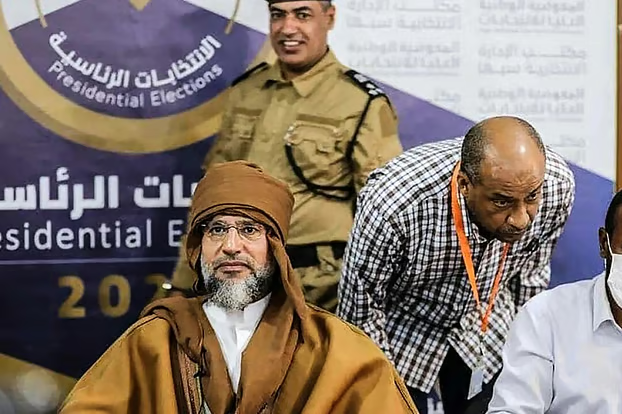
Saif al-Islam Gaddafi, the most influential son of former Libyan ruler Muammar Gaddafi, was shot and killed by four assailants inside the garden of his residence in Zintan, about 136 kilometers southwest of Tripoli, according to accounts provided to Al Arabiya by a source close to the family. The attackers reportedly first disabled the home’s security cameras before confronting him and escaping. He was 53.
A close associate described the killing as an “assassination,” while one of his political advisers, Abdullah Osman, posted a brief confirmation of Saif’s death on Facebook. As of Wednesday, Libyan authorities had not released fuller details on suspects or a possible motive.
Saif al-Islam’s life tracked the arc of Libya’s tumultuous modern history. Without ever holding formal office, he became a chief interlocutor on foreign policy during his father’s four-decade rule, fronting talks that led Libya to abandon programs related to weapons of mass destruction and to compensate families over the 1988 Lockerbie bombing. Educated at the London School of Economics and fluent in English, he was long viewed by Western capitals as a potential reformist face of the regime even as he defended its core power structure.
During the 2011 uprising that, with help from NATO, toppled his father, Saif sided decisively with the regime. He was captured later that year by a local militia and held for six years in Zintan. In 2015 a Tripoli court sentenced him to death in absentia; he was freed in 2017 under a general amnesty and lived largely out of sight thereafter. Rights group Human Rights Watch met him during his detention, when he described being isolated from the outside world.
He re-emerged in 2021, filing papers to run for president in the southern city of Sabha—a bid that became a focal point of legal and political battles and ultimately collapsed as Libya’s election process stalled. Opponents of the former regime, as well as powerful armed groups that grew out of the 2011 conflict, rejected his candidacy outright.
The killing, in a town that once served both as his place of captivity and, later, as a refuge, underscores Libya’s persistent fragmentation and the risks faced by polarizing figures from its past. With no immediate claim of responsibility and few official details, attention now turns to whether the attack will deepen local security tensions in western Libya and complicate already fragile efforts to restart a national political process.