
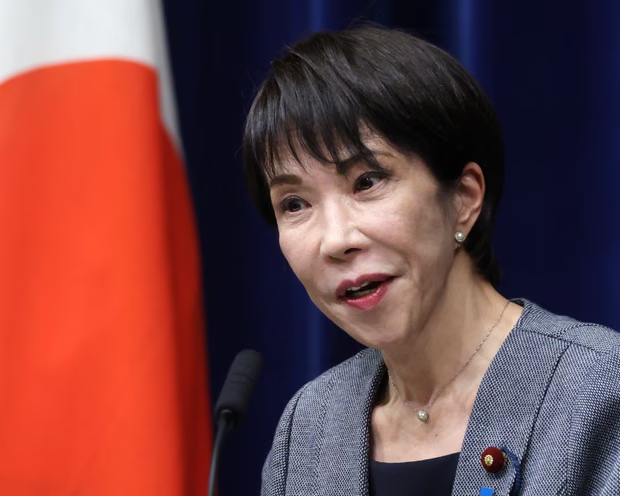
Nearly 60 female lawmakers in Japan — including Prime Minister Sanae Takaichi — have petitioned the lower house to increase the number of women’s toilets in the Diet building, arguing that facilities have not kept pace with rising female representation.
Opposition MP Yasuko Komiyama said long queues form before plenary sessions because, near the main chamber, there is only one women’s restroom with two cubicles for the lower house’s 73 female members. The cross-party petition, signed by 58 legislators, was submitted to Yasukazu Hamada, chair of the lower house rules and administration committee, earlier this month.
Built in 1936 — nearly a decade before Japanese women gained the vote — the lower house building currently has 12 men’s toilets with 67 stalls and nine women’s facilities with 22 cubicles, according to the Yomiuri Shimbun. Lawmakers say the imbalance reflects an era when politics was even more male-dominated.
Women remain under-represented across public life. Japan ranked 118th of 148 in the World Economic Forum’s 2025 global gender gap report. In the Diet, 72 of 465 lower-house members and 74 of 248 upper-house members are women, with the government’s stated goal for women to hold at least 30% of legislative seats.
Takaichi — Japan’s first female prime minister, who has spoken openly about women’s health and her experience with menopause — previously called for “Nordic” levels of gender balance but named only two women to her 19-member cabinet. She remains socially conservative, opposing changes to the law requiring married couples to share a surname and supporting male-only imperial succession.
Komiyama said the toilet request both signals progress and exposes persistent gaps. “In a way, this symbolises how the number of female lawmakers has increased,” she said, adding that she hopes it spurs broader equality measures in parliament and beyond.