
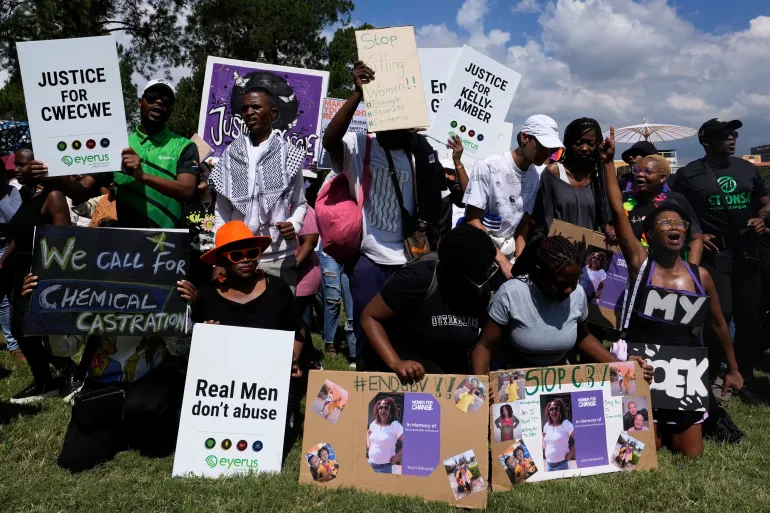
The brutal murder of 30-year-old South African woman Olorato Mongale has once again thrown a spotlight on the devastating femicide crisis sweeping across Africa. Mongale, a master’s student at the University of the Witwatersrand and former journalist, was killed on May 25 after going on a date. Her half-naked body, bearing signs of severe trauma, was found abandoned by a roadside in Lombardy West, north of Johannesburg. For her grieving family, the tragedy confirmed the very fears Mongale had carried for years as she sought to protect herself from male violence — fears tragically realized in the most harrowing way.
Her killing is far from an isolated case. In South Africa, a woman is murdered every three hours, which amounts to nearly eight women a day. Studies estimate that around 7.8 million South African women have experienced physical or sexual violence, with Black women disproportionately affected due to the enduring inequalities rooted in apartheid. Despite repeated government initiatives, including the creation of a National Council on Gender-Based Violence and Femicide, the scourge persists, fueled by deeply entrenched patriarchy and societal norms that legitimise male dominance.
The crisis extends well beyond South Africa. According to a 2024 United Nations report, Africa recorded the highest rate of partner-related femicides globally. Kenya has emerged as another epicenter of this violence, registering over 7,100 cases of sexual and gender-based violence between September 2023 and December 2024, including the murders of more than 100 women within just four months. Among the victims was Ugandan Olympian Rebecca Cheptegei, who was horrifically killed when her former partner doused her in petrol and set her alight. Her death underscored the lethal consequences of male control and patriarchal violence.
The roots of this crisis lie in a toxic intersection of cultural traditions, economic dependence, and harmful social practices such as forced marriage, female genital mutilation, and dowry-related abuse. These factors, combined with structural inequality and normalized male entitlement, create an environment where women’s lives remain perilously disposable. The COVID-19 lockdowns further exposed the fragility of women’s safety, as cases of domestic violence surged across the continent.
Efforts to combat the epidemic have so far proven inadequate. Public campaigns, legal reforms, and government councils have failed to bring real change, partly because they do not address the cultural foundations of the problem. Alarmingly, surveys reveal that nearly half of all Africans still view domestic violence as a private matter rather than a crime, reflecting just how deeply patriarchal values remain embedded in society.
It is increasingly clear that men must lead the reform. From the household to schools, churches, mosques, and traditional institutions, a new model of African masculinity must be created — one grounded in equality, dignity, and nonviolence. As South African rugby captain Siya Kolisi said on International Women’s Day, “Men are not doing enough.” Without their active engagement, the cycle of violence will only continue.
For Olorato Mongale, who fought desperately against her attacker until her final breath, and for countless others like Rebecca Cheptegei whose lives were stolen, change cannot be delayed. Unless African manhood is fundamentally redefined and patriarchal norms dismantled, women across the continent will remain at risk from the very men closest to them. A just and safe African future depends on it.