
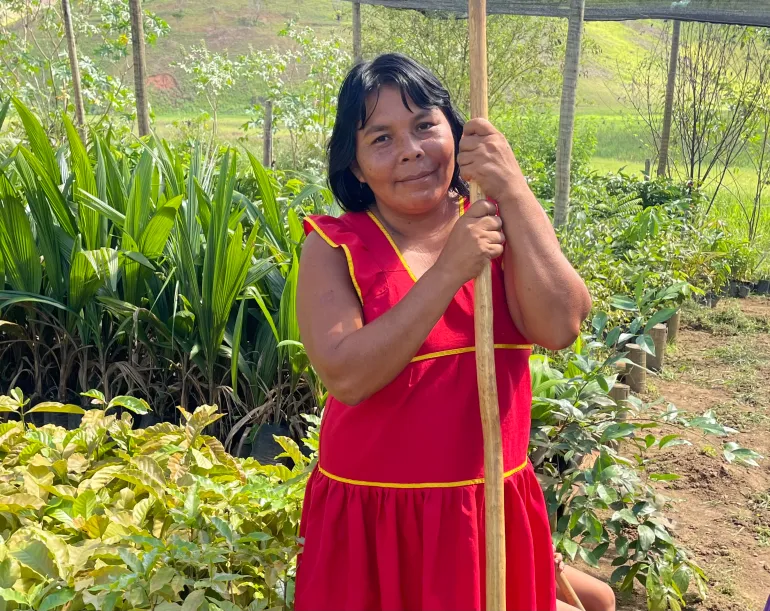
In the blistering heart of Brazil’s Jequitinhonha Valley, where blackened earth and flammable guinea grass stretch for miles across scorched hills, a vibrant oasis blooms against all odds. In the village of Pradinho, banana palms, cassava stalks, and guava trees flourish where others see only the dry, wildfire-prone remnants of a once-lush forest. This green patchwork is the result of Hāmhi Terra Viva, an Indigenous-led agroforestry project by the Maxakali people, also known as the Tikmũ’ũn, who are reclaiming their land and ecological identity through ancestral songs and sustainable planting. Once covered by the Atlantic Forest — one of the most biodiverse ecosystems on Earth — Maxakali territory has been devastated by centuries of deforestation, colonial exploitation, and more recently, the climate crisis. Nearly 85% of the Atlantic Forest has been destroyed, and in Minas Gerais, only about 8% remains. Farmers introduced highly flammable guinea grass, a non-native species, after burning the forest to make way for cattle, contributing to a landscape primed for destruction. In 2023 alone, Minas Gerais saw a record 24,475 wildfires in just nine months. In the nearby city of Araçuaí, temperatures soared to a record-breaking 44.8°C (112.6°F), placing the Maxakali homeland at the epicenter of Brazil’s escalating climate crisis. But amid this environmental collapse, the Maxakali are resisting — not only with tools and seeds, but with songs. Hāmhi Terra Viva intertwines reforestation with Indigenous cultural revival, using traditional music as a guide for ecological restoration. Maxakali songs — which are not composed but inherited — serve as oral encyclopedias of lost flora and fauna, detailing hundreds of species now extinct or endangered in the region. These ritual songs are sung as part of everyday agricultural work in Hāmhi’s nurseries, where caretakers bury seeds while singing to them, echoing ancestral wisdom. The lyrics act as mnemonic devices, preserving knowledge of species behaviors and ecological relationships that many younger Maxakali have never seen firsthand. For example, one song lists 33 bee species — only two of which remain in the territory today — complete with intricate behavioral patterns. Music also governs community structure, spiritual rites, and practical instructions like weaving and crafting. For the Maxakali, music is more than culture; it is ecology, history, and resistance. Through Hāmhi, more than 215 hectares of fruit trees and Atlantic Forest vegetation have been planted since 2023, with the aim to double that area. The Maxakali have even formed a provisional fire brigade and are planting fire-resistant species as natural barriers. This revival is more than reforestation — it is a cultural reawakening. Maxakali elders, like village leader Manuel Damásio Maxakali, speak of the forest not just as a physical space but as home to spiritual beings and ancestral presences. “Songs help the forest grow,” Damásio said. “We ask those who have died to help us. They walk here and assist us. We are calling on the forest to grow back.” In a land where rivers are drying, fire consumes faster than memory, and imported grasses burn like kerosene, the Maxakali’s verdant song-filled plots stand as both resistance and hope — a testament to the power of Indigenous knowledge in healing a scorched earth.