
The United Kingdom’s Supreme Court has ruled that under the UK’s Equality Act, the legal definitions of “woman” and “sex” refer solely to those who are biologically female, concluding a years-long legal battle that has divided feminist and transgender rights groups. The unanimous decision by five judges is expected to have widespread implications across the UK, particularly for policies governing women-only spaces and services.
The legal dispute began in 2018 when the Scottish Parliament passed the Gender Representation on Public Boards (Scotland) Act, which required that at least half of the non-executive members on the boards of public bodies be women. The Act included transgender women holding Gender Recognition Certificates (GRCs) in its definition of “women.” This inclusion was challenged by the feminist advocacy group For Women Scotland (FWS), who argued that the law redefined “woman” in a way that contravened the UK Equality Act 2010, which protects against discrimination based on a variety of characteristics, including sex and gender reassignment.
After multiple hearings in Scottish courts that upheld the inclusion of trans women, FWS escalated the case to the UK Supreme Court with the backing of several feminist and lesbian rights organizations, as well as high-profile public support from author JK Rowling, who reportedly donated £70,000 to the campaign. On April 16, 2025, the UK’s top court ruled in favor of FWS, stating that the terms “woman” and “sex” in the Equality Act must be understood as referring only to biological females.
Justice Patrick Hodge explained that interpreting “sex” to include legally transitioned individuals would create “heterogeneous groupings” and cause confusion within the legal framework. The court stressed that while transgender people remain protected from discrimination, some protections under the law are intended exclusively for biological females.
The decision has broad implications. Trans women with GRCs will no longer be counted toward female representation quotas on public boards, nor will they qualify for all-women shortlists or designated female-only spaces such as domestic violence shelters, changing rooms, and certain medical or counseling services. The ruling may also influence how transgender athletes participate in women’s sports in the UK, though current regulations vary by sport.
While groups like FWS celebrated the verdict as a return to “common sense,” trans advocacy groups expressed deep concern. They warned that the ruling could open the door to increased discrimination, undermine the protections of the 2004 Gender Recognition Act, and compromise the legal recognition of trans identities. Some rights groups fear the decision will embolden anti-trans rhetoric and policies, pointing to rising hate crimes against transgender individuals in recent years. According to Stop Hate UK, more than 2,600 hate crimes against transgender people were reported in 2021, a figure likely underreported due to safety concerns among victims.
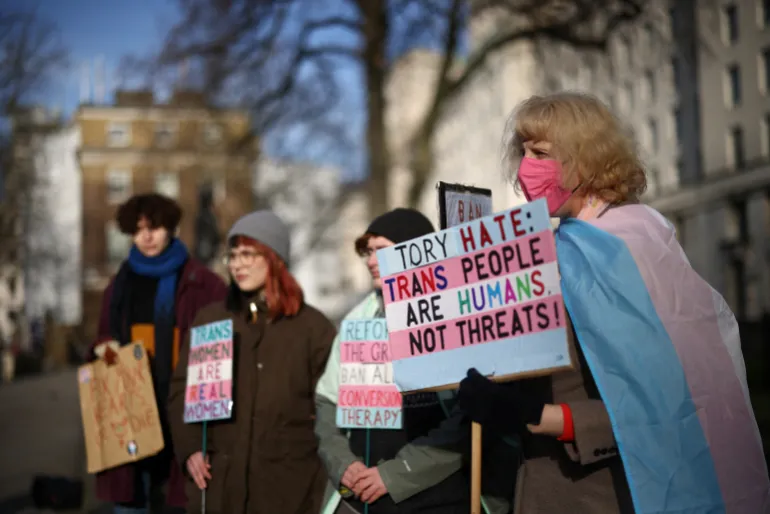
Outside the court, FWS co-director Susan Smith declared, “Everyone knows what sex is and you can’t change it,” calling the ruling a victory for “basic common sense.” Meanwhile, trans rights supporters, many of whom had protested outside government buildings throughout the case, voiced fears that the judgment strips trans people of key legal recognitions and reinforces exclusionary definitions of gender.
As debates around gender identity and legal recognition continue to polarize public opinion in the UK and beyond, the Supreme Court’s ruling stands as a landmark moment. While celebrated by those advocating for sex-based rights, the decision has triggered renewed calls for legal reform and stronger protections for the trans community.