
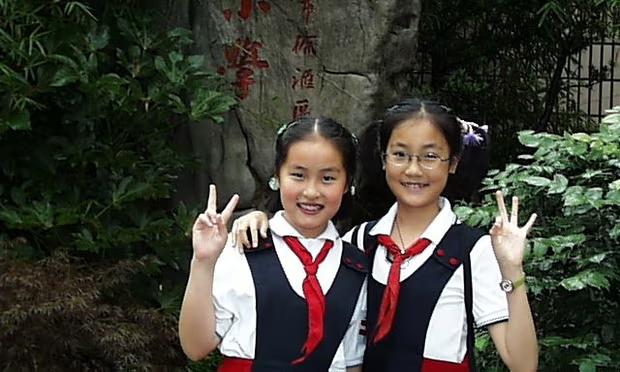
One sunny afternoon in 1997, while playing with a classmate in a small park in Shanghai, she revealed a secret: “I’m allowed to have a little brother or sister.” I froze. At seven years old, the concept of siblings was alien to me and everyone my age. In China’s tightly controlled one-child world, siblings were a relic of the past, an impossibility for my generation.
When she added, “I have a congenital disorder,” waving her frail hand, I felt a sharp pang in my chest. It dawned on me that her family’s exception was tied to the fact that she might not live long. For the first time, I questioned the normalcy of the one-child policy. It was no longer just a rule – it was a life-defining tragedy.
My parents’ One Child Honorary Certificate, a shiny red booklet, sat proudly in our home. It symbolized their compliance with the law, a badge of their sacrifice for the nation’s population control. But beneath their obedience lay hidden pain.
Before my birth in 1990, my mother had a miscarriage – a son lost on a bumpy tricycle ride. She often recounted the story with a forced smile, calling him “my brother.” I thought her sadness had faded until she started comparing me to him whenever I fell short. My father, on the other hand, called me his “female son,” a term that was meant to reconcile his longing for a boy with the reality of the policy.
I grew up unaware of the lengths to which families went to circumvent the one-child rule. But behind closed doors, the government’s enforcement was brutal: forced abortions, sterilizations, and even infanticide. Girls were particularly devalued in rural areas, where sons were seen as essential for manual labor and family survival.
Later that year, tragedy struck closer to home. My teenage cousin, Brother Lulu, was diagnosed with a brain tumor. The government granted my aunt and uncle permission to have another child. Yet, how could they plan for a second child while their son was fighting for his life? For them, choosing another baby would have meant admitting to Lulu that they didn’t believe he’d survive. Instead, they devoted their remaining years to cherishing him, never speaking of their “option.”
It took me decades to understand my parents’ quiet struggles. My father’s attempts to mask his disappointment with me as a daughter were, in hindsight, progressive for a man of his time. And my mother’s occasional outbursts stemmed from the deep unfairness she endured, forced to grieve silently for the children she could never have.
Now, as a mother of a two-year-old with the freedom to plan for more children, I recognize how far my life has diverged from theirs. The one-child policy ended in 2015, and I live far from China, free from its oppressive shadow. Yet the trauma it inflicted lingers in my generation’s collective psyche.
That spring day in the park revealed the harsh truth: my classmate’s family could break the rules, but only at the cost of their pain and her life. It took years for me to fully grasp that what we once celebrated as “honor” was, in reality, an unimaginable sacrifice. Today, I treasure the choices I have, even as I carry the weight of what my parents endured.