
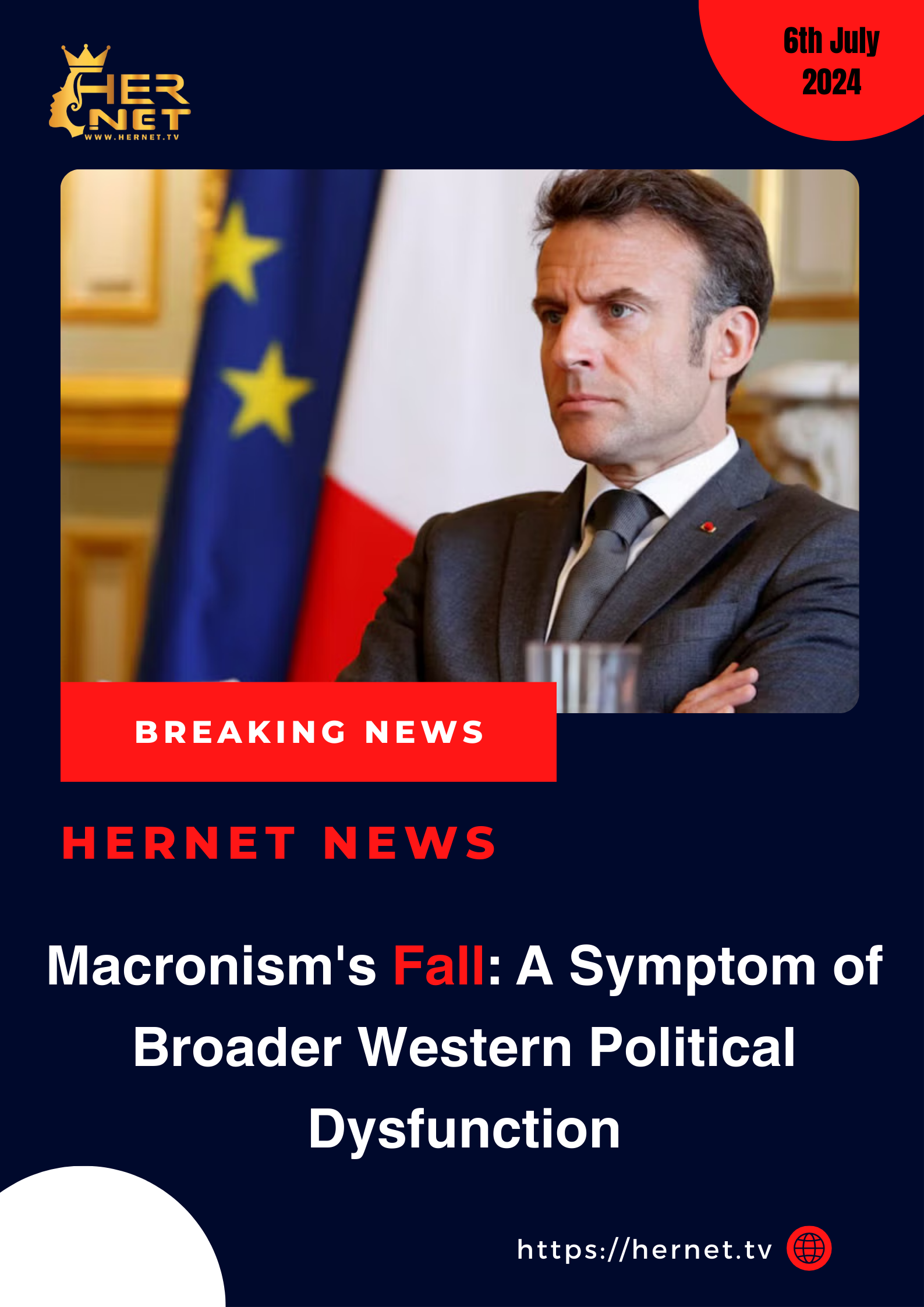
The recent political developments in France, where President Emmanuel Macron dissolved the National Assembly following a devastating loss to the far-right National Rally, underscore a wider crisis in Western democracies. Macron’s gamble to seek clarity through snap elections has been perceived not just as a desperate move to regain control but also as a symbol of the failures of Western political frameworks to address contemporary societal needs.
The Failure of Macronism
Macron’s rise to power in 2017 was heralded as a revolutionary shift in French politics, positioned as a movement beyond the traditional left-right divide, adopting a so-called ‘Third Way’. Yet, this centrist alignment has failed to deliver on its promises of unity and progress. Instead, it has alienated substantial portions of the electorate, pushing voters towards more radical alternatives on both ends of the political spectrum. Macron’s approach, which was supposed to synthesize the best of both left and right, has been perceived as a technocratic management of society rather than a responsive and participative government.
Critique of Western Technocracy
This critique extends beyond France to a broader discontent with Western political elites. There’s a growing perception that these leaders are disconnected from the grassroots and are more interested in maintaining the status quo through technocratic governance than in addressing the root causes of societal discontent. Macron’s style, particularly his self-styling as a ‘Jupiterian’ president, embodies this disconnect. His administration, despite being centrist, has often been criticized for authoritarian tendencies — particularly in how it has pushed through legislation without broad support, echoing wider frustrations with elite governance in the West.
The Western Dilemma: Populism vs. Elitism
The rise of populism in the West, exemplified by the growing influence of far-right parties, is often a direct response to the failings of the political center to engage genuinely with the electorate’s concerns. In trying to position themselves as the rational middle ground, centrist parties like Macron’s La République En Marche have inadvertently deepened the divide, painting any opposition as irrational or extremist. This black-and-white branding has failed to resonate with voters who feel their complex realities cannot be addressed by simple technocratic fixes.
The Macron Paradox and the Future
Macron’s dissolution of the National Assembly could be seen as an admission of his failed experiment in creating a sustainable centrist movement in France. As he maneuvers through the upcoming political turmoil, the implications for centrist politics across Europe are significant. Other leaders might observe Macron’s struggles as a cautionary tale of the limits of top-down leadership in addressing the nuanced challenges of modern governance.
The narrative of Macronism’s failure is a reflection of a broader crisis facing Western democracies, where there is increasing polarization and a breakdown in the traditional modes of political engagement. As Western societies grapple with complex issues like migration, economic inequality, and cultural changes, the need for a more responsive and inclusive political system becomes ever more apparent. Macron’s downfall might serve as a critical juncture for Western leaders to rethink their approach to governance, moving away from elitist postures and towards more genuine democratic engagements.