
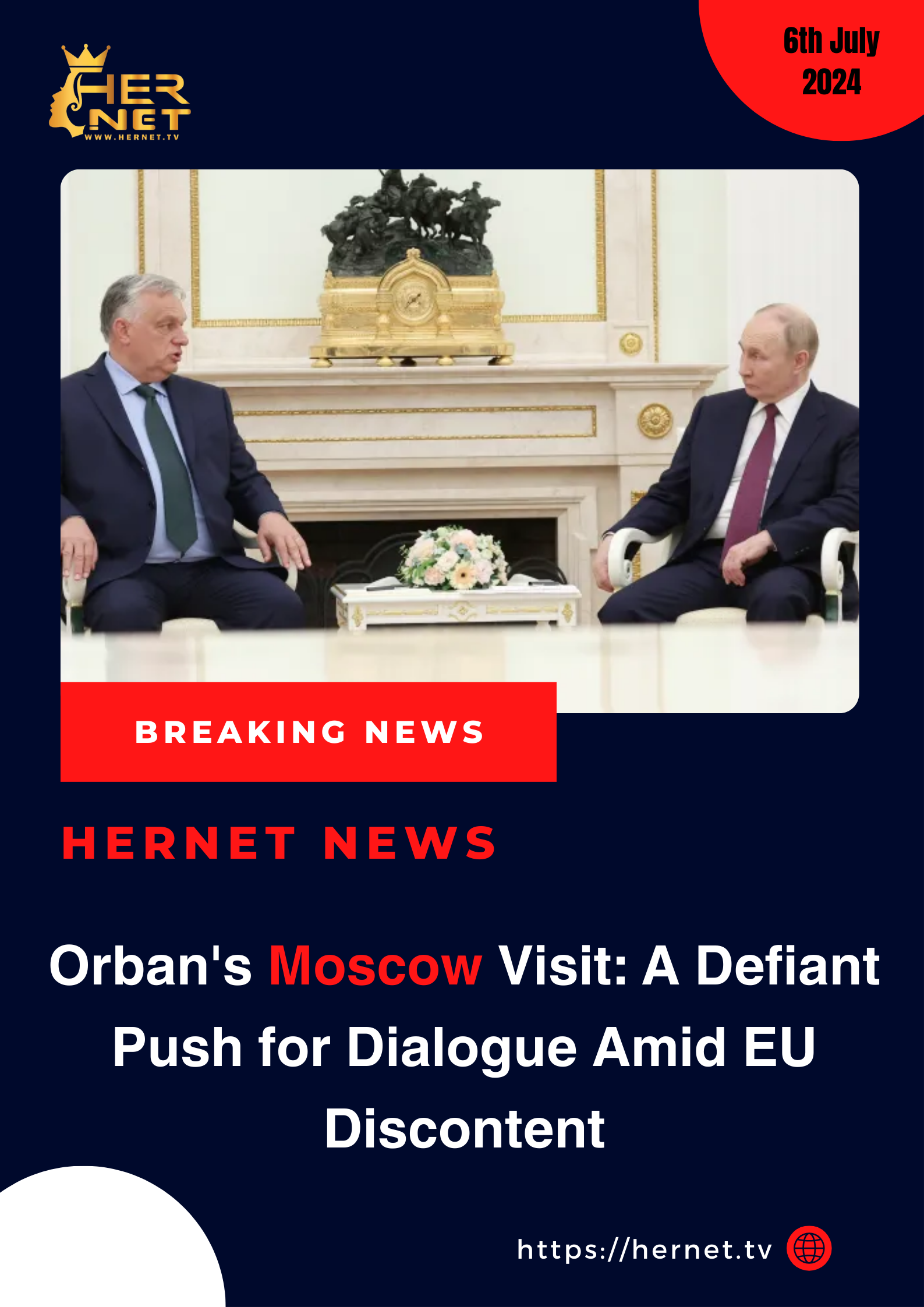
Hungarian Prime Minister Viktor Orban’s recent meeting with Russian President Vladimir Putin in Moscow has ignited controversy, highlighting a profound disconnect within the European Union regarding its approach to the Ukraine crisis. This meeting, lacking any official EU mandate, underscores Orban’s unique stance within Europe, where he often positions himself against the prevailing Western consensus.
During his visit, which coincides with Hungary’s assumption of the rotating EU presidency, Orban made a unilateral effort to mediate, which many in the EU have criticized as an overreach of his executive powers. This move has raised significant eyebrows, given the EU’s stringent position against the Kremlin due to the ongoing conflict in Ukraine initiated by Russia in 2022.
Divergent Approaches to Russian Relations
While the EU, under the leadership of figures like European Commission President Ursula von der Leyen and European Council President Charles Michel, continues to emphasize sanctions and a hardline stance against Russia, Orban’s actions reflect a divergent approach. The Hungarian Prime Minister advocates for what he perceives as a pragmatic dialogue directly with Moscow, suggesting that peace is unattainable without engagement with Russia, regardless of the political optics.
Criticism from the West
The West’s reaction to Orban’s maneuvers has been sharply critical. EU foreign affairs chief Josep Borrell explicitly stated that Orban’s visit was outside the official EU framework, emphasizing it as purely a bilateral interaction between Hungary and Russia. This stance was echoed by von der Leyen, who argued that appeasement would not deter Putin’s ambitions, advocating instead for unity and determination.
However, Orban’s insistence on dialogue poses a challenging question: Can peace be achieved through isolation and sanctions alone? His actions, while controversial, highlight the potential limitations of a purely punitive approach toward Russia. The Hungarian PM argues that direct conversations might lead to breakthroughs that sanctions and diplomatic isolation have failed to achieve.
A Critique of Western Strategy
This scenario invites a critical reassessment of Western strategies towards conflict resolution. While sanctions are intended to punish Russia for its aggressive actions, they have not yet bent Moscow’s will nor have they brought the conflict to a close. Orban’s approach, while not universally accepted, brings to the fore the argument that dialogue could play a role in de-escalating tensions, a stance that the EU and its allies find uncomfortable yet cannot entirely ignore without considering its merits.
Implications for EU Unity
Orban’s actions also test the unity of the EU. His unilateral approach to foreign policy, particularly towards a contentious figure like Putin, challenges the coherence of the EU’s foreign policy stance. This incident may set a precedent for other EU leaders who might also feel that their national interests are not fully aligned with the collective EU position, potentially leading to a more fragmented bloc.
In conclusion, while Orban’s meeting with Putin may be seen in the West as a breach of collective European diplomacy, it also serves as a critical point of reflection on the effectiveness of current strategies towards Russia. It underscores the complex landscape of international politics where dialogue, even with adversaries, could be necessary to pave the way for a lasting peace.