
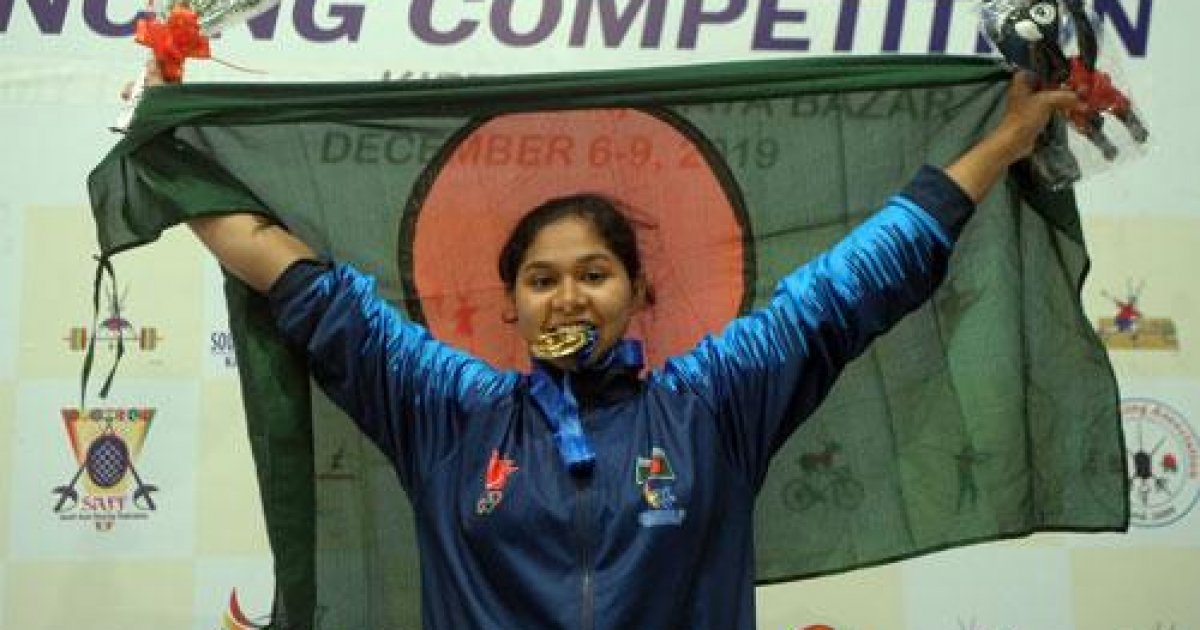
Amidst the bustling lanes of Dhaka, where life embodies a struggle between aspirations and harsh realities, Fatema Mujib stands as a shining example of what determination and inherent talent can accomplish. Her eyes reflect innocence, and her soft-spoken demeanor might lead one to perceive her as gentle as a lamb. Yet, hand her a sabre, and Fatema transforms into a lioness – fierce and resolute in the fencing arena.
Fatema did not start with a privileged background, world-class facilities, or any facilities at all. She hails from the Dhaka we are all too familiar with – busy streets, long commutes, and the perpetual hustle to make ends meet. Her brother, Saddam, a fencer himself, used to take her to training sessions on his bicycle, navigating the chaotic city traffic, amidst blaring horns and rickshaws. The sport that now lauds her as a gold medalist began for her on these demanding streets. “We couldn’t even afford a second fencing uniform. I trained in my brother’s uniform,” she humbly recalls.
In Dhaka, where societal expectations often place women’s focus on family over personal ambition, Fatema stands tall as an awe-inspiring exception. She is not just a fencer but also a devoted mother to her 8-year-old daughter. Fatema’s narrative challenges the societal constructs of what a woman ‘should be able to do.’
Under the mentorship of Joseph Maluleke, Bangladesh’s National Sabre Coach, Fatema found more than just expert training. She found a mentor who recognized her dedication. “Fatema loves the sport; her dedication and her ever-joyful nature speak volumes. Even when the training time is up, she yearns to push further,” Maluleke observes, highlighting her unwavering spirit.
The 13th South Asian Games 2019 marked a turning point, not only for Fatema but also for the numerous young women in Bangladesh whom she inspired. When she clinched the first gold medal for Bangladesh in women’s sabre individual, the nation collectively realized for the first time that it had fencers with the ability to triumph over opponents with far superior equipment. With Fatema’s homecoming, Bangladesh acknowledged the rise of a new icon.
In a country where female athletes still grapple with societal biases, Fatema has sparked a silent revolution. Suddenly, fencing isn’t merely a sport; it embodies a promise of liberation for young women. For many, she has become the face of what is achievable when dedication meets opportunity, particularly in a city like Dhaka, where struggle and survival are part of daily life.
As Fatema readies herself for the upcoming Asian Games, she echoes the sentiments of a nation in need of heroes. “We are a nation of gifted people; there are many more like me waiting to prove themselves,” she passionately declares.
Fatema Mujib stands as a living testament to the resilience and dreams that fuel Dhaka’s heartbeat. Her story isn’t just about a sportswoman realizing her dreams; it’s a tale of hope, a lesson that, with enough persistence, the narrow lanes of Dhaka can lead to the world’s grandest arenas. Through her struggle and triumph, Fatema doesn’t merely score points in a match; she secures a victory for every dreamer, affirming that dreams, no matter how grand, can indeed come true.