
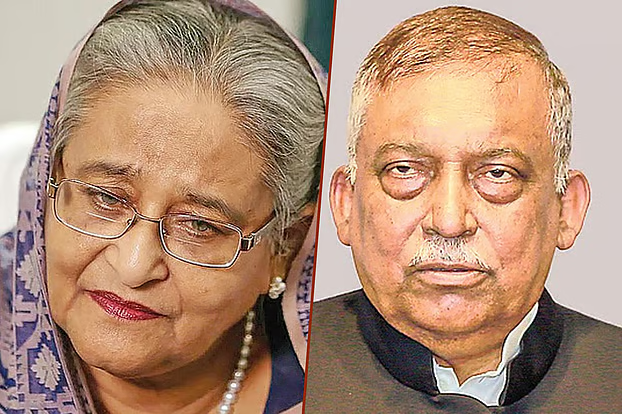
Bangladesh’s International Crimes Tribunal-1 on Monday sentenced former prime minister Sheikh Hasina and former home minister Asaduzzaman Khan Kamal to death for crimes against humanity linked to the July uprising, and handed former inspector general of police Chowdhury Abdullah Al-Mamun a five-year prison term as an approver.
Reading from a 453-page judgment comprising six sections, presiding judge Justice Golam Mortuza Mojumdar said the prosecution proved the charges against all three accused. The court found Hasina guilty on two counts carrying capital punishment; Asaduzzaman Khan received a death sentence on one count. The verdict—the first tied to killings and other atrocities during the July movement—was broadcast live from the ICT-1 courtroom.
The tribunal detailed five allegations overall against the trio: (1) incitement through inflammatory speech; (2) orders to use lethal force to “eliminate” protesters; (3) the shooting death of Abu Sayeed, a student at Begum Rokeya University in Rangpur; (4) the shooting deaths of six demonstrators at Chankharpul in Dhaka; and (5) the burning deaths of six in Ashulia. Judges summarized extensive evidentiary exhibits—audio and video, witness testimonies, and recordings of Hasina’s phone calls during the unrest, including a conversation with then information minister Hasanul Haq Inu.
The court also ordered the seizure of assets belonging to Hasina and Asaduzzaman Khan and directed compensation for families of the dead and for the injured. Law adviser Asif Nazrul hailed the ruling as a milestone and said the government will again seek Hasina’s extradition from India. Chief prosecutor Mohammad Tazul Islam argued the case met international norms and standards, while attorney general Md. Asaduzzaman said the judgment delivers long-awaited justice for “the martyrs of July,” adding the death sentences would take effect upon arrest.
Authorities noted that Hasina and Asaduzzaman Khan are fugitives, believed to be in India; Al-Mamun cooperated as a state witness and received a reduced term. Outside the tribunal, political groups rallied in support of the verdict, while at Dhaka University’s TSC large screens showed the live reading as crowds chanted slogans. Security was tightened across the capital, with roughly 15,000 police deployed alongside army, RAB and APBn units; elsewhere, soldiers and police dispersed agitators who brought excavators to Dhanmondi 32 amid clashes.
The bench said it had weighed arguments for and against the maximum penalty before concluding the proven crimes warranted the sentences imposed.